

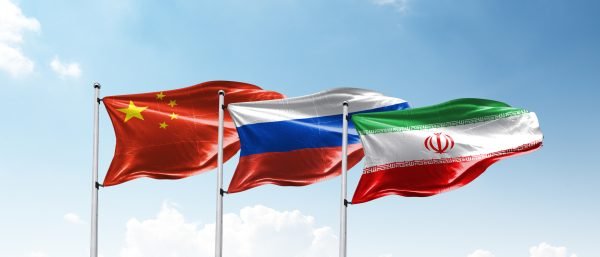
The Diplomat author Mercy Kuo regularly engages subject-matter experts, policy practitioners, and strategic thinkers across the globe for their diverse insights into U.S. Asia policy. This conversation with Dr. Stephen J. Blank – non-resident senior fellow in the Foreign Policy Research Institute’s Eurasia Program and author of numerous publications on Soviet/Russian, U.S., Asian, and European military and foreign policies – is the 527th in “The Trans-Pacific View Insight Series.”
How is China-Russia cooperation supporting Iran’s resistance against U.S. military actions?
Sino-Russian cooperation supports Iran in many ways. Russia is transmitting satellite intelligence about the location and movement of American troops, ships, and aircraft. Iran used this intelligence to strike U.S. bases in Jordan and Saudi Arabia and may also have obtained Russian intelligence to strike at secret CIA installations.
Second, Moscow is making good Iranian drone losses, having helped Iran restock about 60 percent of its losses, often with improved versions of drones Iran sent to Russia. Russia also gives Iran tactical guidance on drone use, e.g. how many drones Iran should use and should use and from what altitudes it should shoot. Thus, Iran benefits from Russian lessons in Ukraine.
Third, Russia’s “Caspian Express” has become a major logistical lifeline for Iran. Lastly Russia provides diplomatic support for Iran.
China and possibly Russia are selling Iran shoulder-fired air missile defenses MANPADS. Chinese engines power the Russian drones sent to Iran, which reportedly also incorporate Chinese radio modems and cameras. China also has recently closed a deal to sell Iran supersonic anti-ship missiles with a range up to 290 km to deter or strike U.S. vessels.
Likewise, Chinese entities provide chemical precursors and dual-use items for Iran’s ballistic missile program. Chinese entities are also reportedly loading Iranian vessels with the solid rocket-fuel precursor, sodium perchlorate, and may be preparing to supply spare parts and missile components. Iran also has military-grade access to China’s Beidou satellite navigation system and China has given Iran geospatial intelligence through state-affiliated commercial satellite companies.
What is the strategic calculus for Beijing and Moscow in bolstering Tehran’s position?
Both Russia and China share a common motivation to weaken the U.S. either leading to its defeat or to a protracted war that bleeds U.S. strength, ties it down in the Gulf, and prevents greater military support for Ukraine, Taiwan, and Washington’s Asian and European allies. They also aim to weaken American alliances, damage America’s global standing and economy, and increase its domestic polarization. Moreover, this war validates their ideology about the decline of an American-led world order and the alleged rise of a new multipolar order, thereby lending credence to that ideology.
How is China benefitting from protracted conflict in both the Ukraine and Iran wars?
These wars benefit China in many ways. Since it previously built up its energy reserves the blockade of the Strait of Hormuz does not threaten it. China already gets Turkmen and Russian energy at a discount. Iran’s dependence has grown while Washington’s military-political-economic capabilities and strategy have failed. Meanwhile Russia’s economy gains a reprieve, and a distracted Washington is increasingly unable to support Taiwan or other Asian allies as needed. Trump has proven himself to be strategically incompetent, giving China more freedom to threaten Taiwan, the Philippines, Japan, etc. In Ukraine, the lack of aid to Kyiv and energy windfalls for Russia thanks to Iran divert Western attention from Asia while Russian dependence on China grows. Lastly the war has enabled China to project air and naval power into the Middle East at an unprecedented scale.
Examine the impact of the Strait of Hormuz imbroglio on China-U.S. competition in the Middle East.
The stalemate over the Strait of Hormuz benefits China by showing what can only be described as Trump’s egregious strategic malpractice. When his ravings and utter lack of strategic capability are juxtaposed – or more precisely contraposed – to China’s steadiness, refusal to commit its military but substantial support for Iran and Russia’s war in Ukraine, Beijing looks better and better. Moreover, it diverts Washington, which has done little or nothing to push back on Chinese encroachments against Taiwan, Japan, and the Philippines, or against Russia since the May summit in Beijing.
Assess the effectiveness of U.S. leadership vis-à-vis China-Russia cooperation in advancing U.S. interests in the Iran war.
As I noted above, egregious strategic malpractice and incompetence have characterized Trump’s wartime policies, and arguably almost all of his foreign and defense policies. This war had no strategic planning, its goals change daily, and enormously damaged U.S. interests. Indeed, as of today Iran has arguably won, which benefits Russia and China.
While the Moscow-Beijing axis is tightening in economics, politics, and military affairs; every U.S. alliance system – NATO, our alliances in Asia and in the Middle East – is under pressure or in growing disarray. Although there are some structural causes for this trend, the common denominator is Trump and his team, many of whom are equally strategically incompetent, for their attacks on allies, reckless ignorance of strategic realities, and failure to plan for this war.
Consequently, there is diminished pressure on Russia; indeed there are secret talks with it rather than support for Ukraine, China advances on our Asian allies while the administration is either silent or spouts platitudes as Assistant Secretary Colby’s tour of Southeast Asia and speech there show. There is apparently no effort to strengthen our alliances against this Moscow-Beijing axis or the larger axis including Iran and North Korea, i.e. the CRINK. Instead, leading members of this administration regularly depreciate, devalue, or even threaten our allies, giving them reasons for distrusting America’s commitment.
So, while our alliances are all faltering Russo-Chinese ties, along with ties among the CRINK, e.g. Iran-North Korean ties, are expanding. The contrast with the Trump administration policy is both telling and ominous.
