

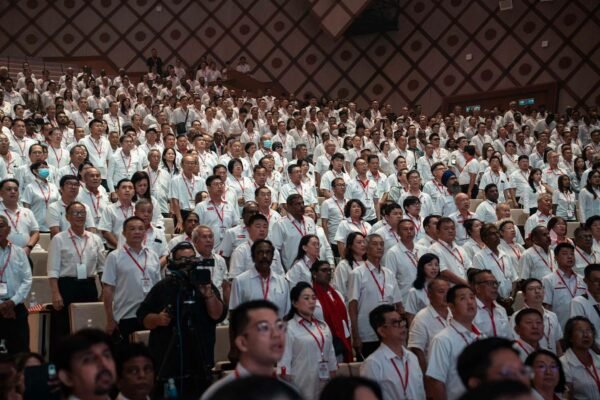
Poor electoral performances in the Sabah, Johor, and Negeri Sembilan Malaysian state elections overshadowed the Democratic Action Party (DAP)’s national congress on August 16.
The extraordinary congress was called in the wake of the disappointing return in Negeri Sembilan on August 1, which analysts said was due to the government’s perceived mishandling of corruption cases and concerns over its commitment to promised reforms.
The DAP leadership subsequently decided to convene a special national congress, at which it would table a motion on whether the party should remain a part of Prime Minister Anwar Ibrahim’s unity government.
Although the party voted in favor of remaining a part of the government, the meeting highlighted the DAP’s predicament over what cost the party is paying for finally tasting the fruits of power.
The 60-year-old party, once seen as the most vocal opponent of the old Malay establishment, today has to remain “silent” on the shortcomings of Anwar’s government, including alleged corruption charges.
It was this silence which reverberated loudly during the congress as most delegates were concerned about the party losing appeal among its core voters, urban and semi-urban ethnic Chinese communities. Results of the three state elections reflected this, as the party lost seats which it had held for three consecutive terms.
Sangeet Kaur Deo, the daughter of the late prominent Malaysian lawyer and DAP stalwart Karpal Singh, raised the issue of the party’s silence on many issues concerning corruption. Sangeet said voters had questioned DAP’s silence on too many issues, like the discharge not amounting to an acquittal granted to Deputy Prime Minister Ahmad Zahid Hamidi on 47 corruption charges in September 2023.
“So stay in government and speak up while we are there. And if we must become opposition again, at least we have laid the basis and regained credibility,” she said.
She urged the DAP’s Central Executive Committee to “seriously reassess” its relationship with Anwar, whom she accused of dividing coalition partners, pitting them against one another and strengthening the United Malays National Organization (UMNO) – the primary component of the Barisan Nasional coalition, which is part of Anwar’s unity government – at the DAP’s expense.
Sangeet also challenged the party’s reason for joining the government: that its ministers would help implement the reforms long promised to voters.
“If we were, we would have done it already,” she said, adding that DAP should use the next 18 months in government to speak up on issues of concern and rebuild its credibility.
Although there was no official reaction to Sangeet’s appeal, it found resonance in DAP National Chairman Gobind Singh Deo’s statement, in which he called on Anwar to immediately accelerate several long-awaited institutional reforms, including the separation of the attorney general and public prosecutor roles and the creation of a two-term limit for the prime minister.
Gobind said the decision by DAP delegates at the party’s National Congress to remain in the federal government sent a clear message that the party’s core reform agenda must now be implemented without further delay.
“While the party has voted to remain in the Federal Government, urgent and concrete steps must now be taken to implement our core agenda, specifically institutional and economic reforms,” he said.
He urged Prime Minister Anwar to set clear and firm timelines for the implementation of foundational institutional reforms.
The challenge that the DAP has faced since entering government in late 2022 is how to manage the transition from vocal opposition party to silent coalition partner.
Winning power is the ultimate goal of any political outfit; that was the aim of DAP as well. Now, it is in power but is in danger of losing the appeal that brought it to this point.
How DAP manages to achieve these dual objectives will be the biggest challenge of its six-decade existence, as it moves from being Malaysia’s most successful opposition party to becoming a part, and possibly a permanent one, of the country’s political establishment.
