

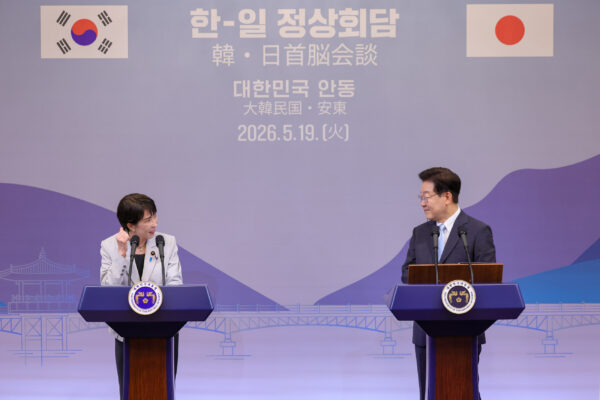
On May 19, South Korean President Lee Jae-myung and Japanese Prime Minister Takaichi Sanae met in Andong, Lee’s hometown, as part of their shuttle diplomacy. This marks their fourth meeting in just six months. The two leaders had already met this January in Takaichi’s hometown of Nara. On average, they have met once every two months since Lee’s inauguration.
The frequency of these meetings, combined with the visibly warm rapport between Lee and Takaichi, is by itself promising for bilateral relations. Despite early concerns over the ideological distance between them, Lee and Takaichi have maintained a notably cordial and cooperative relationship. Their meetings at APEC and other international gatherings have projected personal warmth, while both governments have generally exercised a degree of diplomatic restraint on historically sensitive issues. Lee has avoided actions such as a presidential visit to Dokdo, while Takaichi refrained from dispatching a ministerial-level representative to Takeshima Day. This mutual restraint has helped preserve diplomatic momentum at a time when both governments increasingly recognize the strategic value of closer cooperation.
The symbolism of these reciprocal hometown visits is particularly meaningful. This is the first time a Korean and Japanese leader have visited one another’s hometowns, lending the diplomacy a more personal character that helps deepen interpersonal trust. Andong itself is a historically meaningful place in Korea, home to multiple UNESCO World Heritage sites and the birthplace of many prominent Confucian scholars of the Joseon dynasty as well as independence fighters during Japanese colonial rule.
At the summit, the two leaders agreed to cooperate on strengthening the resilience of the energy supply chain and in the fields of artificial intelligence and economic security. South Korea and Japan share similar vulnerabilities as energy-importing states that are highly exposed to geopolitical instability in the Strait of Hormuz. This summit produced agreements on supply chain collaboration based on deeper information-sharing and communication regarding oil supplies, strategic reserves, and crude oil and petroleum product swaps.
Lee and Takaichi also reaffirmed stronger security coordination and mentioned the gradual institutionalization of progress through the elevation of regular security talks to the vice-ministerial level from director-general level. However, the most politically manageable progress in bilateral cooperation is likely to emerge in economic security, technological cooperation, and maritime coordination rather than overt military integration. Military cooperation remains politically sensitive in South Korea, where concerns persist that Japan’s remilitarization could contribute to greater regional instability by provoking an arms race.
Japan’s outreach toward South Korea is driven not only by goodwill but by strategic necessity. Tokyo increasingly sees practical value in closer coordination with Seoul amid worsening tensions with China. From Japan’s perspective, South Korea is not simply a neighboring partner but an increasingly important component in balancing against China’s growing assertiveness. China-Japan relations have deteriorated following Takaichi’s remarks last November suggesting the potential for Japanese involvement in a Taiwan contingency.
As the recent China-U.S. summit approached, concerns emerged in Japan about a Nixon Shock-type of event – a reference to U.S. President Richard Nixon’s sudden 1971 announcement that he would visit China without prior notice to Japan. The comparison reflects anxieties in Tokyo not only about worsening relations with China, but also about uncertainty regarding Trump’s strategic position. Some in Japan feared that Trump could adopt a softer stance toward China, potentially leaving Japan strategically exposed. For Tokyo, a Taiwan contingency is not a distant geopolitical issue but a direct security concern. More recently, China again urged Japan to withdraw Takaichi’s Taiwan-related remarks, underscoring the sensitivity of the issue.
Prior to Trump’s visit to China, there were also reports that he might stop in Japan before or after the summit, though this ultimately did not materialize. Instead, Takaichi received a phone call from Trump explaining the outcome of the meeting.
The feud between Japan and China places Lee in a balancing act, with both sides seeking to court South Korea. A potential source of friction in the Japan-South Korea relationship lies in the divergence between their threat perceptions regarding China and North Korea. Although Seoul and Tokyo broadly face the same strategic environment, they approach it from different geopolitical and political positions. During their January summit press briefing, for example, Takaichi avoided any references to China in her opening remarks, whereas at this summit, Lee emphasized the importance of China-Japan-South Korea trilateral cooperation for regional peace and stability. The contrast illustrates the subtle but important difference in how each government frames regional order and strategic priorities.
Ultimately, Japan’s current approach toward South Korea reflects a broader strategic calculation: Tokyo is seeking reliable partners to reinforce its regional position amid growing uncertainty surrounding both China and the United States in addition to economic risks stemming from the Iran War. The key question for Japan-South Korea relations, therefore, is whether the incentives created by these largely circumstantial geopolitical conditions can be institutionalized enough to sustain rapprochement beyond the personal rapport between Lee and Takaichi.
