

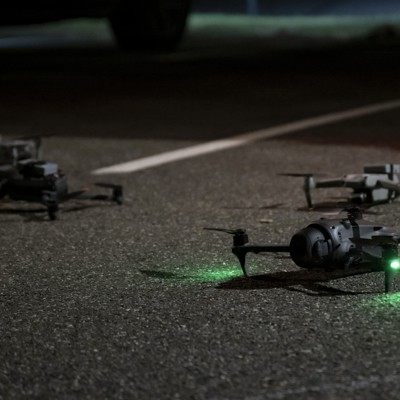
In a September exercise on a Florida airfield, members of the 10th Special Forces Group launched a drone assault that mirrored the “spiderweb” attack that Ukraine had recently staged against Russia. The defenders were counter-drone troops from across the U.S. military, trained for a week on tech that the Pentagon has spent billions to develop.
U.S. counter-drone efforts haven’t been the same since.
“What I would tell you is that it helped us develop our priorities,” said Brig. Gen. Matt Ross, who leads Joint Interagency Task Force 401, the Pentagon’s counter-drone clearinghouse.
Dubbed Operation Clear Horizon, the exercise at Eglin Air Force Base sought to replicate conditions and weapons seen on the battlefields of Ukraine.
The special operators “had lessons learned from Ukraine in Eastern Europe and they came back and they said, ‘This is what we’re seeing on the battlefield’,” Ross said.
In their mock assault, the special operators used a wide range of drones, from small to large, and many that were resistant to jamming and radar.
“They flew drones that were regular [radio-frequency], commercial drones. They flew drones that had directional antennas on them so they’re harder to jam, drones that were frequency hopping so they have a more resilient connection” against electromagnetic attack, Ross said Tuesday at the Sea-Air-Space event. “They went up to Group 3 drones” and down to Group 1s. “We used fiber optically-controlled drones…We used drones controlled by LTE, the cellular network,” enabling operators in Colorado to launch against targets in Florida, a first for the U.S. military.
That effort to replicate the battlefield of Ukraine is a big departure from the way the department usually tests its technology against drones.
Because the electro-magnetic effects used against drones interfere with airplane guidance and cellular service, the military can only test them in very particular circumstances. Even the most recent counter-drone tests—such as August’s T-REX exercise at Camp Atterbury, Indiana, and the Army’s FlyTrap exercise last November in Germany—don’t do so. Instead, they mostly test concepts for bringing down drones without using million-dollar missiles.
What’s more, data from such tests don’t usually fully inform the planning of other exercises and experiments, according to participants and observers of such events. Between September and December, Ross said, 67 tests were conducted by the services, combatant commands, the Pentagon’s research office, and other DOD outfits.
“It was all well-intentioned. But we couldn’t see all of that data in a way that would allow informed comparisons between different systems that were tested at different venues,” he said.
Even if circumstances make it hard to test jamming defenses against UAVs, the military still needs to drill against drones built to elude radar as well. What the U.S. really needs now is continuously up-to-date understanding of how U.S. tactics and gear would perform on a battlefield like Ukraine. That’s what the task force is trying to do.
“We were over in Ukraine about six weeks ago, talking to the Unmanned Systems Force [sic], watching how they defend Kyiv on any given night, understanding what they have along the forward line of troops,” Ross said. “Then we’ve looked at those most promising technologies and we referenced their performance data in Ukraine instead of internal department testing and evaluation.”
That’s leading to changes in how the U.S. buys equipment to take down drones and plans defenses for installations and forces.
The September exercise in Florida showed that U.S. drone defenders needed a way to combine the data coming in from far-flung radars, drones, and counter-drone systems.
“If you look at the Department of War installations across the panhandle of Florida, we should be able to identify a [drone] track from the west and pass it between installations,” Ross said.
Now, the U.S. has a single drone-tracking software solution and interface across the services, he said. (Defense One has asked for details.)
“If you were to go to a location where you have multiple services working together, and even other federal agencies or international partners, we have seamless air domain awareness and the ability to sense connect any sensor with any effector”—that is, a drone-downing system, Ross said.
The exercise also revealed a need to focus more on long-range drones that can damage “high-payoff targets, which are going to be command-and-control, logistics, or air defense,” he said.
For smaller drones—Groups 1 and 2—the U.S. must develop interceptor drones that cost less than today’s expensive defense missiles.
Ukraine has already absorbed such lessons, which the task force is now passing to U.S. commanders, including those in the Middle East.
“We’ve procured some of those systems now to start integrating across the Department of War,” he said. “In the past six weeks, we’ve committed over $600 million to this problem, specifically for the rapid integration of new counter [unmanned aerial system] technology.”
In the 2027 budget proposal, the Pentagon is requesting $75 billion for new drone technology, a sum larger than the annual GDP of some countries and the current budget of the U.S. Marine Corps.
If those numbers seem far apart, it’s because the United States has highly-effective missiles to take down drones. But they were designed to take down missiles, and they’re expensive. But Ross says that getting the most out of both efforts means linking them together in a way that traditional long-range fires teams and missile-defense units have not been, historically.
Offensive and defensive drone operations are “inextricably, inextricably linked,” he said.
The threat, however, is evolving far faster than annual budgets. Ross took issue with the idea, advanced by some senior military leaders, that today’s drones are analogous to the IEDs of the Iraq and Afghanistan wars. No commercial market spurred the evolution of IEDs, nor could software and data spur improved performance.
“For IEDs, you had no commercial application for that technology. With unmanned systems, and specifically with autonomy, there’s so many commercial applications that we’re going to see this accelerated development in this space,” he said. “That’s going to cause us concerns, from a security perspective.”
