

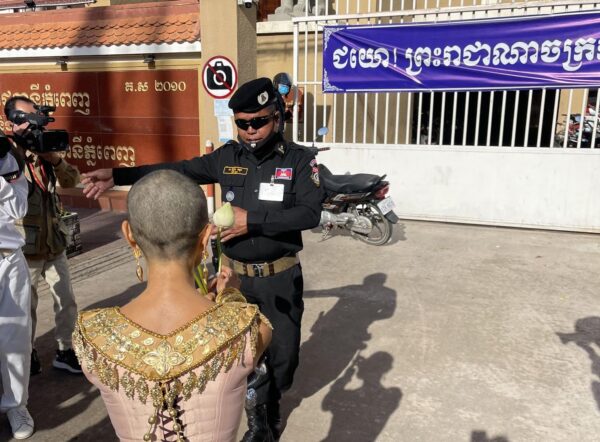
Four years ago, American lawyer and human rights icon Theary Seng was sentenced to six years in Cambodian prison for “conspiracy to commit treason” and “incitement of social disorder.” Her crime? Facebook posts criticizing Hun Sen, Cambodia’s strongman dictator. Charged in a mass trial alongside 60 opposition members, Theary’s trial was rife with human rights and due process abuses. Today, she remains in a cramped cell in Phnom Penh.
Theary’s story is emblematic of Cambodia’s broader authoritarian reality. Amid crackdowns on activists, shuttered independent media, and sham elections, the United States and the international community must act – both for Theary and for all Cambodians fighting for freedom.
Theary is a citizen of both the U.S. and Cambodia who is dedicated to public service. After the Khmer Rouge murdered her parents, she and her siblings escaped to the United States as children. Then, upon graduating from law school, she returned to Cambodia to advocate for survivors of the genocide.
Later, as a high-profile critic of then-Prime Minister Hun Sen, she became a target and was taken into custody in June 2022, immediately after her conviction. The United Nations found her detention illegal and demanded her immediate and unconditional release. Theary has also been denied access to her international counsel, Jared Genser, an author of this article, who after attending her trial was baselessly “banned forever” from Cambodia. Her appeal remains indefinitely delayed.
Ahead of last year’s anniversary, Theary launched her fourth hunger strike to demand the release of Cambodia’s political prisoners. In eight days, she lost nearly 15 percent of her body weight and endured life-threatening health complications. Another hunger strike in December 2023 led to her hospitalization.
Despite four years in prison, Theary’s moral courage shines through, as she believes her personal sacrifices are justified to inspire action against Hun Sen’s authoritarian regime.
One of the world’s longest-serving leaders, Hun Sen spent nearly 40 years strengthening his grip on all branches of government, destroying any semblance of democracy. According to the U.S. Department of State under the administrations of both Donald Trump and Joe Biden, Hun Sen and his loyalists in the Cambodian People’s Party (CPP) have created a “de facto one-party state,” banning opposition parties, consolidating control of the legislature, and weaponizing the judiciary to silence dissent.
Since 2020, more than 250 opposition figures and activists have been targeted, leaving many imprisoned or in exile. After the 2023 election, there was a shift in power for the first time in decades, as Hun Manet, Hun Sen’s son, was appointed prime minister. Yet Hun Sen remains in control as president of the Cambodian Senate, president of the CPP, and acting head of state when King Norodom Sihamoni is outside the country.
Despite years of growing Chinese influence in Phnom Penh, Cambodia has recently reaffirmed its commitment to stronger ties with Washington. Over the past few years, the two countries have expanded cooperation through resumed trade, the lifting of a U.S. arms embargo, conducting of joint military training, and investment of $30 million U.S. development aid and capital support for aviation infrastructure. Hun Manet has also sought to position Cambodia as a constructive regional partner, initiating a U.N.-backed maritime dispute-resolution process with Thailand after a ceasefire in December ended a conflict over the two nations’ land border. And Cambodia successfully sought inaugural membership in U.S. President Donald Trump’s Board of Peace.
As Cambodia leans on the United States amid severe financial problems, Trump has more leverage than ever to also act to halt the country’s enduring human rights freefall. The release of the country’s political prisoners must be central to any serious process of reconciliation between the regime and its political opposition. Given Trump’s commitment to freeing wrongfully detained Americans, that effort should begin with securing Theary’s release.
While former President Joe Biden and Secretary of State Antony Blinken each called for her release, they failed to get Theary out. There is much that can be done now through bilateral diplomacy led by the White House, combined with the designation of Theary as “unlawfully or wrongfully detained” under the Levinson Act. This would transfer her case to the Office of the Special Presidential Envoy for Hostage Affairs, which would coordinate efforts to secure her release. While serving as a U.S. senator, now Secretary of State Marco Rubio called for Theary’s “immediate release” and her designation as a “wrongfully detained American.” Now it is time to follow through.
Theary’s case is about more than one political prisoner; it reflects the unnecessary human rights crisis created by Hun Sen and his government. The fourth anniversary of her imprisonment will be a test of whether the world will stand by Cambodia’s political prisoners, or turn its back on those who risk their very lives to advance democracy and human rights.
