

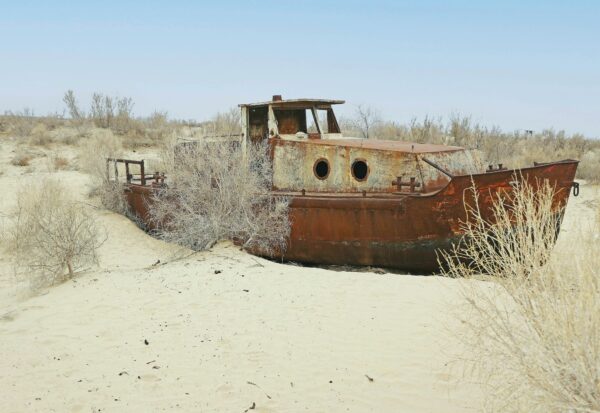
Central Asia is home to one of the most infamous human-caused ecological catastrophes: the dramatic drying-up of the Aral Sea. That disaster was rooted in systemic mismanagement of the region’s water resources in pursuit of cotton production, primarily during the Soviet period.
Today, the region is in hot pursuit of emerging industries that could prove just as disastrous to the region’s water resources as cotton was: critical minerals and artificial intelligence (AI).
The Diplomat’s Managing Editor Catherine Putz spoke with Dr. Theresa Sabonis-Helf, professor of the practice and concentration chair for science, technology and international affairs at Georgetown University’s School of Foreign Service, about the intersection of several critical issues in Central Asia: water and energy, critical minerals and AI, and how regional governments are (or are not) prepared to balance these competing concerns.
Central Asia’s water woes are not new. The Aral Sea is one of the most infamous examples in the world of the consequences of water mismanagement. Can you lay out what factors contributed to the shrinking of what was once the world’s fourth-largest lake?
The Aral Sea tragedy was largely a consequence of cotton farming. From Tsarist times (but escalating dramatically in the Soviet era), the region was prized for farming cotton. It was the only region of the Tsarist empire warm enough to grow it … but cotton is an infamously thirsty crop, so the continuous expansion of cotton production required more and more water. In addition, the irrigation systems used to supply the cotton were unlined, and leaked water constantly into the desert.
By the early 1990s, only a trickle of water from the once-mighty Amu Darya was arriving at the Aral Sea, and as the sea grew more and more shallow, evaporation accelerated. The other tributary to the Aral Sea, the Syr Darya River, was also delivering a declining volume. By the early 1990s, hydrologists calculated that the only way to save the Aral Sea was to take no withdrawals from the two rivers for a decade… which was impossible. Today, Uzbekistan produces less than 50 percent of the cotton it did in the Soviet era, but cotton still accounts for 24 percent of employment and provides 19 percent of its GDP.
What lessons did that experience convey to the Central Asian states?
In the early years of independence, the Central Asian states appealed to the World Bank to help improve irrigation systems, but the Bank was concerned by the unsustainability of cotton in the desert, so it focused instead on damage mitigation. Kazakhstan was willing (and able) to reduce outtakes from the Syr Darya, so the World Bank helped finance the Kokaral Dam, completed in 2005, which separated and attempted to save a small portion of the sea, now known as the North Aral Sea.
The North Aral is now a healthy body of water, but it is less than a tenth the size of the former sea… and its construction did hasten the collapse of the rest of the sea, by retaining all the flows of the Syr Darya in a smaller area.
Kazakhstan learned from this experience to take water resources more seriously – it is now a leader in the region in water efficiency technologies. Uzbekistan and Turkmenistan pursued policies to reduce cotton in favor of wheat, but they discovered that the wheat they can produce is lower-value… it is also too low-gluten to make the preferred regional breads, so the agricultural transition wasn’t what the governments had hoped. Turkmenistan is now an exporter of fodder wheat to Afghanistan even as it continues to import bakery-quality wheat from Kazakhstan.
Even with better water management, the viability of agriculture in the region is likely to continue to decline. It isn’t evident that the governments of the region have come to terms with that issue.
The latest economic hot topics – artificial intelligence (AI) and critical minerals – are all the rage in Central Asia. Can you describe how AI and critical minerals relate to water security?
Both of these put significant pressure on water resources. Central Asia does have 25 of the minerals that the U.S. designates as “critical,” so they are an attractive target for investment. Mining, however, is water-intensive, and refining (which adds value but requires water for separating minerals, cooling mining machinery and controlling dust) is also water-intensive.
Central Asia is not alone – an estimated 16 percent of critical minerals mines and assets globally are located in water-stressed regions, so best practices are evolving. Mining companies will focus on water efficiency only if pressed to do so by host countries – that emphasis should be built into any Central Asia contracts. Without careful attention to water use, critical minerals can both consume a lot of water, and pollute nearby water resources.
As Central Asian states negotiate with companies interested in their mineral resources, the World Resources Institute’s recommendations for water protection from mining effects should prove useful, including use of efficient/water-saving/ technologies, setting water usage targets for mining companies, improving governance and environmental regulation, and expanding access to data about the impacts of mining.
Artificial intelligence uses a substantial amount of water as well. Although arid climates are favorable for data center equipment (reducing damage from humidity), a large data center can require hundreds of thousands of gallons of water daily to carry away the surplus heat. Some of the water is released after it is cycled through the system, and the precise amount of water used by data centers is typically unclear. Unless there are legal requirements to do so, data centers do not track their water withdrawals. One example might be illustrative, however – a U.S. court case revealed that the data centers in one Oregon town were responsible for more than one-fourth of the city’s total water withdrawals.
One example of the growing awareness of AI’s water footprint can be seen in the recent completion near Shanghai of the world’s first undersea data center. The design is a response to the amount of water and electricity required to keep massive data centers cool. Using seawater as a coolant saves both energy and water, reducing the energy demand for cooling to under 10 percent (on-shore data centers can require as much as 50 percent of their energy consumption for cooling). It also reduces water withdrawals in a country that acknowledges it faces increasing freshwater scarcity.
Another stress point in Central Asia is energy, specifically electricity – much of which is generated via hydropower in states like Kyrgyzstan and Tajikistan. The AI and critical minerals industries also require large amounts of electricity. Are regional governments planning for this increase?
The region has faced electricity crises in recent years even without new energy-intensive infrastructure. Better regional connectivity is helping the grid’s flexibility, but not entirely resolving the problem. Electricity demand has risen everywhere.
The region is doubling down on hydropower, with work continuing on Rogun and Kambarata-1. The upstream states are pursuing hydropower because it’s the resource they have, and certainly as water becomes scarcer, they wish to manage it more closely… but the reliability of hydropower is changing significantly, and not only in Central Asia. In 2024, hydropower produced 10 percent more electricity than it had in 2023 – due more to the impact of droughts in 2023 than to the addition of new power plants.
Rainfall patterns are becoming less predictable even as glacier-fed rivers (such as those in Central Asia) are experiencing profound changes. Due to warmer weather in Central Asia, the summer melt cycle begins earlier than it did previously, providing the most runoff in early July rather than in August. Hence, even before the glaciers disappear, Central Asia is experiencing drier late summers and lower soil moisture.
Regional governments – such as Kazakhstan and Uzbekistan – have made some progress in regard to water conservation in agriculture, but have they wrestled with the connection between water and the AI and critical mineral industries?
Both Kazakhstan and Uzbekistan have made important policy strides in trying to improve irrigation efficiency and water storage, and to better monitor transboundary water flows. I don’t find evidence that they are yet grappling with the water needs of next-generation industries. The Kazakhstan Ministry of Water Resources and Irrigation has considerable expertise, but not in these new demands. I am also somewhat concerned at the lack of discussion in Kazakhstan regarding the water demands associated with its new pursuit of nuclear power.
Can Central Asian governments pursue their economic and industrial agendas without parching the region? How can they go about balancing the immediate economic motives with the reality of the region’s water resources?
The very troubling reality is that Central Asia’s carrying capacity is declining, even if the governments move toward more efficient use of water (which they must do). As landlocked states, they don’t have the option of developing reliance on desalination, which some Middle East states have done. As downstream states, they are suffering from increased demand by their neighbors, which is leaving less for them: China, Russia and Afghanistan are each increasing outtakes from rivers that have historically fed Central Asia.
Kazakhstan has some understanding of the coming crisis, which is why they have shown leadership in trying to establish a U.N. body dedicated to water resources and associated transboundary concerns. The dissatisfying answer is that (somewhat like the North Aral Sea) it will take significant policy intervention to preserve a portion of what once was. Central Asia will have to build a future less reliant on agriculture, one in which water is much more closely managed.
What are the consequences if Central Asia’s governments don’t find a way to balance demands for water, electricity and economic development?
Given the magnitude of challenges coming from changes in both demand and in supply, it is a very difficult problem. It is a great irony that Central Asian states are finally learning to cooperate in water, even as the more distant upstream riparians are becoming more aggressive in their own water demands. An estimated 60 percent of Central Asia is now considered vulnerable to desertification processes, and water availability is more likely to decline than to increase.
Even with good policy, the carrying capacity of Central Asia may become lower. In response to increased Russian use of the Volga River, and the associated decline in the water levels of the Caspian Sea, some Central Asian leaders have hinted darkly that mass outmigration could be a possible consequence of insufficient water. To date, changes to tighten Russia’s migration policies are more evident than changes in water policy.
