

A photograph taken moments after the crash showed Major General Mehta seated amid the wreckage, battered but composed, and flashing a victory sign alongside his crew.
Beneath the admiration, however, lay a far more troubling reality that the viral image inadvertently obscured. The fact that a division commander was flying in a legacy, first-generation Cheetah helicopter in 2026 for routine operational duties in the high Himalayas should be triggering national alarm rather than inspirational headlines.
This single incident underscores a systemic failure: after more than twenty-five years of attempting to replace its ageing light helicopter fleet, the Indian Army has still not inducted a single modern light utility helicopter into operational service for the very missions these helicopters fly every day.
The Cheetah and Chetak fleets, descendants of the French Alouette-II and Alouette-III helicopters first conceived in the 1950s, remain the workhorses of India’s high-altitude military operations. These machines are undeniably legendary.
They have sustained operations at Siachen, rescued wounded soldiers from icy ridge-lines, ferried commanders and supplies to impervious posts, and built one of the most respected reputations in military aviation anywhere in the world. Yet nostalgia is not an airworthiness philosophy, and these helicopters are painfully old by any modern standard.
Many Cheetahs and Chetaks have long exceeded their intended service lives and continue flying only because Indian military engineers and technicians have become masters at extracting life from metal that should reasonably have been retired years ago.
Army Aviation pilots operate them daily through punishing wind conditions, narrow valleys, unpredictable Himalayan weather and high density altitude environments where performance margins shrink terrifyingly fast. Every sortie is effectively an exercise in skill, caution and faith.
This situation persists not because the Army enjoys flirting with risk, but because the Indian state has repeatedly failed to provide replacements despite decades of attempts. The search for a new Light Utility Helicopter has become one of India’s longest-running and most embarrassing military procurement sagas.
The combined requirement of the Army and Air Force has hovered around 380 to 400 helicopters, roughly split as 197 for the Army and 187 for the Air Force. These are not luxury acquisitions or prestige platforms; they represent one of the most basic operational necessities for a military tasked with permanently holding some of the highest and harshest battlefields on earth.
Yet the procurement process has collapsed repeatedly under the crushing weight of India’s defence procurement dysfunction. One global contest after another was launched, evaluated, challenged, cancelled and restarted. Helicopters were tested, vendors were shortlisted, and the Eurocopter (now Airbus) Fennec was repeatedly near selection before the process was aborted each time. Through all of this, the Army kept flying Cheetahs.
Later came the highly publicised India–Russia Ka-226T program, unveiled with ceremonial flourish as a solution to the problem. Around 200 Ka-226T helicopters were envisaged under a joint venture between HAL and Russian Helicopters, with large-scale production planned in India under the Atmanirbhar Bharat and Make in India banners.
On paper, the Ka-226T appeared ideal for Himalayan operations, with its coaxial rotor design and claimed high-altitude performance. In practice, the program became entangled in localisation and workshare disputes, pricing disagreements, sanctions anxieties, engine complications and commercial deadlocks.
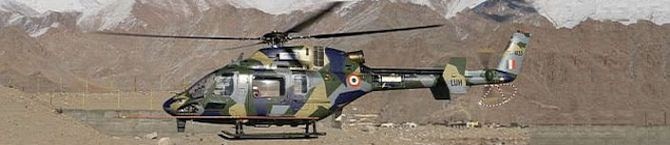
The LUH was designed as an indigenous, purpose-built, compact, modern helicopter specifically around the operational realities of Indian military flying, particularly at high altitude. The LUH flew impressive trials, demonstrated high-altitude capability, and operated successfully in Siachen conditions. Army Aviation pilots spoke positively about its handling and performance.
For the first time, it appeared India had an Indian-designed helicopter purpose-built for Indian conditions rather than another imported compromise dressed up as strategic necessity. This is precisely why the current state of the LUH program is so deeply alarming.
Livefist also reported that the HAL LUH has not flown even once in nearly three months and has barely lifted off over the last year. One of India’s most important helicopter programs is effectively sitting still.
The reasons are depressingly familiar and somewhat opaque: differences between HAL, certification authorities such as CEMILAC and RCMA, and the Army itself have reportedly produced a deadlock over testing standards, certification observations, operational expectations and compliance parameters.
In any mature aviation ecosystem, disagreements during development are normal and expected. In India, however, such disagreements have a unique ability to metastasise into paralysis, and the LUH is the latest victim of this pattern.
Paralysis is a dangerous luxury for an Army that flies daily in the Himalayas, where operational realities do not pause for bureaucratic processes. The irony borders on absurdity: over the last twenty years, India has inducted virtually every other category of military helicopter imaginable.
New medium-lift helicopters such as the Mil Mi-17 V5 entered service in large numbers. Heavy-lift Boeing CH-47F Chinook helicopters were inducted to support high-altitude logistics. Boeing AH-64 Apache attack helicopters joined the fleet, significantly enhancing offensive firepower.
Maritime helicopters such as the Sikorsky MH-60R Seahawk were acquired for anti-submarine and search-and-rescue roles. India even inducted indigenous combat helicopters and sophisticated airborne early warning and control platforms.
Yet the humble light utility helicopter, the one aircraft the Army arguably needs more than any other in forward areas, remains trapped in endless limbo. The situation has deteriorated to such an extent that the Army has explored leasing civilian helicopters for light utility roles.
Following the Pahalgam terror attack, operational pressures forced the Army to resume flying portions of its grounded HAL Dhruv fleet for surveillance and logistics duties in Kashmir, because operational realities do not politely pause for certification processes and institutional caution.
The uncertainty surrounding the LUH program is mirrored in the Ministry of Defence’s latest moves on the same requirement. In September 2025, the MoD floated a new Request for Information (RFI) for 200 light utility helicopters, effectively reopening a contest the Indian military has already spent two decades unsuccessfully trying to conclude.
This RFI carries a different kind of weight, however, because barely months later, in February 2026, TATA and Airbus inaugurated India’s first private-sector helicopter Final Assembly Line (FAL) at Vemagal in Karnataka for the Airbus H125 family. Significantly, the military variant of that helicopter, now designated the H125M, is essentially the evolved avatar of the old Fennec helicopter that had emerged as a frontrunner in at least two earlier Indian contests before those processes imploded under procurement chaos.
This time, however, the equation is very different: the helicopter now comes wrapped in increasingly attractive Make in India packaging, backed by an operational Indian assembly line and a private-sector industrial footprint the government is visibly keen to encourage.
In military aviation circles, there is growing belief that this latest RFI is unlikely to suffer the fate of earlier zombie procurements and could finally mature into an active acquisition program. If that happens, the space available for HAL’s LUH, already shrinking under the weight of delays and uncertainty, could narrow even further. This raises uncomfortable questions about the LUH program.
It remains unclear whether the current freeze reflects purely technical disagreements during testing, or whether the long shadow of prolonged scrutiny surrounding the Dhruv program has infected decision-making around the LUH as well, given that the newer helicopter inevitably derives certain design philosophies and engineering lineage from HAL’s broader rotary-wing ecosystem.
Whatever the explanation, the bottom line remains brutally simple. The HAL LUH, once hailed as the great indigenous answer to one of India’s oldest military aviation problems, has tasted the air over Siachen but now sits largely idle in a hangar. Meanwhile, ageing legacy helicopters continue flying dangerous missions over the Himalayas, placing Indian Army personnel, including division commanders, at unnecessary risk.
Recommendations:
- Break the LUH certification deadlock immediately via high-level MoD intervention, with a clear timeline and a designated authority empowered to resolve certification and testing disputes.
- If LUH cannot be resolved within a tight deadline, expedite the 200-helicopter RFI and swiftly move to an RFP, treating the H125M as a serious candidate given local assembly and industry commitment.
- The Army and Air Force must converge on a single unified operational requirement for light utility helicopters to remove inter-service divergence that has derailed past programs.
- Treat interim measures (leasing civilian helicopters, limited Dhruv reactivation) only as stopgaps with strict safety limits and sunset clauses.
- Create a high-altitude helicopter task force with HAL, services, CEMILAC, RCMA and industry to align certification, testing and operational requirements from the outset for future programs.
- The Court of Inquiry must specifically assess whether continued use of legacy Cheetahs in high-risk missions was justified and whether command-level aircraft selection reflected systemic procurement failures.
The longer this limbo continues, the greater the risk to personnel and the more the credibility of India’s defence modernisation narrative is eroded. The LUH program remains the most promising indigenous route forward, but it cannot be allowed to stagnate indefinitely while the Army flies helicopters whose design predates India’s independence in key aspects.
Agencies
