

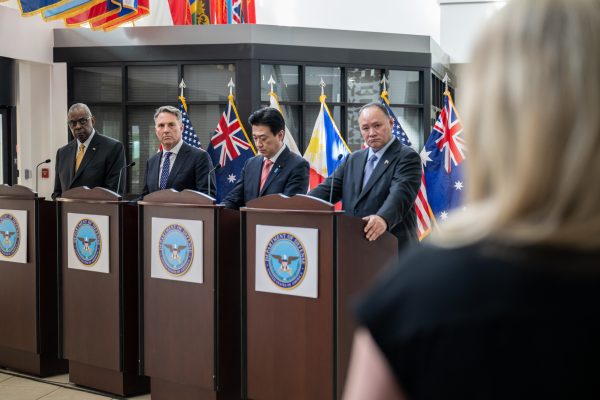
ASEAN often says “don’t make us choose,” yet some of the region’s sharpest observers argue its states are shifting toward China and away from the United States, particularly in the economic and diplomatic domains. Washington, meanwhile, is left with a shrinking traditional security portfolio. Many now speculate that the contested, high-growth region of Southeast Asia may drift toward a Chinese-led order.
This argument captures a real trend. China is now sufficiently influential that breezily presumed U.S. primacy in Asia, in general, is over. Given China’s vastly enhanced economic heft since the 1990s, this is hardly surprising. However, the end of U.S. primacy need not mean a defeatist acceptance of its replacement by Chinese hegemony.
To start, Chinese influence has grown unevenly across ASEAN and has been most successful in the countries least consequential to U.S. grand strategy: Cambodia, Laos, and Myanmar. This is not to say that these countries are unimportant; their futures matter. Yet in the context of strategic competition and the regional balance of influence, ASEAN states do not weigh equally. U.S. regional interests are more bound up in the orientations of Malaysia, Thailand, and especially the “VIPS”: Vietnam, Indonesia, the Philippines, and Singapore.
More critically, Washington can plausibly deny Beijing dominance and ensure Southeast Asia remains free and open, and not forced to choose. To do so, it must invigorate burgeoning minilateral regional networks and look to allies in Northeast Asia and beyond.
Strong Allies: Washington’s Latent Advantage
A bipolar framing of Southeast Asian order misses that ASEAN has other external partners. Fortunately for Washington, the next most influential are its Pacific allies: Japan, South Korea, and Australia. The Lowy Institute’s Southeast Asia Influence Index shows the balance of influence changes dramatically if one measures China against a latent U.S.-led minilateral bloc rather than the United States alone.
Economically, China tops the U.S. as a trading partner for ASEAN as a whole and every major regional state. China has also outinvested the U.S. in nearly all Southeast Asian states since 2015. The United States and its allies together, however, outmatch China as a trade partner and investment source for ASEAN as a whole and every major regional state, with the exception of trade, but not investment, for Indonesia.
The allies mitigate Washington’s other weaknesses. Diplomatically, China’s total bilateral dialogues with ASEAN states more than doubles the United States’ total, yet the allies’ combined total more than doubles China’s. Socially, Southeast Asia sends more students to universities in China than the United States, but Australia alone outperforms China. China draws greater Southeast Asian online searches than the U.S., but Japan outdoes the superpowers combined. In security, still the main U.S. advantage, developments from Korean arm sales to Japanese access agreements to Australian defense pacts make Southeast Asia less automatically dependent on China if the U.S. grows unreliable.
Beyond added heft, Washington ought to approach ASEAN minilaterally because it appeals more than the United States alone. Polling data and regional commentary consistently show Southeast Asians trust Japan more than both the U.S. and China. South Korea, while still a maturing power, is perceived as attractive and benign. Australia presents a more measured, embedded, and consultative Western presence.
A Playbook for a Free and Open Southeast Asia
Of course, a U.S.-Japan-South Korea-Australia bloc is not a unitary actor. The governments have differing threat perceptions, China postures, and domestic political and economic considerations. South Korea has been particularly hesitant to embrace minilateralism or antagonize China, and holds historic grievances against Japan. However, these divergences are manageable. All four states seek resilient supply chains, prioritize freedom of navigation, and are averse to Chinese hegemony in the Indo-Pacific. Seoul’s capabilities and Southeast Asia ties, especially with Vietnam, meanwhile, are too robust to overlook, and its relationship to Tokyo is rapidly improving.
However, crafting a minilateral Southeast Asia strategy is not simply a matter of tallying each ally’s influence. Without coordination, the whole is less than the sum of its parts. This playbook to deny creeping Chinese hegemony is achievable but not self-executing.
First, while the United States and its allies should build greater ties to all ASEAN members, it should prioritize the VIPS. Within that grouping, Indonesia’s apparent drift toward China is especially concerning – even with the recent U.S. security deal. Here, minilateralism’s merits are evident, as Tokyo, Seoul, and Canberra have all stepped up their Jakarta ties in precise, consequential domains.
Second, whether the United States actively leads or delegates day-to-day management, likely to Japan, such engagement must expand beyond the security-heavy portfolio, especially in economics. The Luzon Economic Corridor (LEC) in the Philippines, with integrated Japanese participation, offers a template. Efforts in the LEC and Subic Bay would benefit from South Korea’s complementary commercial strengths. Making such coordinated engagement a minilateral undertaking and extending it beyond the Philippines would go far to address the United States’ greatest regional disadvantages. Offering Indonesia alternative partnership options to develop domestic downstream processing of nickel and other minerals is a win-win candidate for this model of cooperation.
Third, the United States should empower its allies to “carry the torch” on its behalf. Sheer distance inhibits even engaged U.S. senior leaders from frequently appearing in the region. Such logic extends to people-to-people ties generally. Inevitably, Southeast Asian leaders and publics will see their Chinese, Japanese, Korean, and Australian peers more often than the Americans. ASEAN leaders must be able to raise concerns and advance U.S.-involved agendas when meeting with allied counterparts. Japan appears particularly well-suited to such a role.
Making Minilateralism Work
Practically, joint Southeast Asia influence-building requires more regularized consultation among the allies beyond the ad hoc, hub-and-spoke model. Whether through a formal mechanism or enhanced iterations of recent developments, the group should identify opportunities, divide labor according to comparative strengths, and amplify one another’s initiatives.
Take Indonesia as an example. South Korea is selling KF-21 fighter jets to Jakarta and developing EV-based investments, Australia brings geographic links including and beyond the Jakarta Treaty, and Japan is a longstanding ODA and infrastructure leader. Korean-led supply chains, Australian-led maritime capacity building, and Japanese-led infrastructure should be collectively supported and integrated, not isolated, efforts. Such coordination will help the world’s fourth most populous country remain “free and active” rather than “sleepwalking” into alignment with China.
Most importantly, the United States’ negligence toward Southeast Asia and the Indo-Pacific generally, where rhetoric outpaces substance, must be addressed; the “pivot to Asia’s” declared failure is well supported. Minilaterally engaging ASEAN will reduce the U.S. burden of denying Chinese hegemony. Yet that does not mean that Washington can simply hand the task off to its allies and engage as it pleases.
To not cede the regional balance of influence to China, a substantial U.S. contribution remains essential. When Washington yet again shifts limited capabilities, even temporarily, to other regions, promised initiatives fizzle out, and individual leaders seem uninterested in the Indo-Pacific and especially Southeast Asia, Chinese hegemony can look inevitable. Japan’s laudatory efforts to step into the breach appear insufficient, South Korea reverts to outdated small-state habits, and “post-alliance” Australian voices sound more compelling. Greater ally-based minilateralism makes it possible to avoid losing Southeast Asia; it does not take the task off the U.S. foreign policy board.
The need for a bloc-based, multidomain, minilateral approach to Southeast Asia is part of and reflects Washington’s Indo-Pacific and grand strategic dilemma generally. Whether or not Americans should have sought perpetual 1990s-style global liberal primacy in the first place, it is simply no longer viable. But this brave new world does not mean Washington must cede a key, emerging region to its strategic rival.
From calls for allied scale to a Pacific Defense Pact, a latent prioritized, disciplined U.S. strategy can leverage domestic and allied capabilities and would serve core national interests far better than clinging to an outdated post-Cold War status quo or reverting to hemispheric isolationism. Southeast Asia fits very well into such a strategy. The key is to frame the region’s alternative to China not as the United States alone, but as the U.S. and its allies together.
