


Donald Trump will discuss the war in Ukraine with Xi Jinping and Vladimir Putin when the three leaders gather for an unprecedented meeting in China.
Ukraine and its European allies will have no seat at the table at the Asia-Pacific Economic Cooperation (APEC) summit.
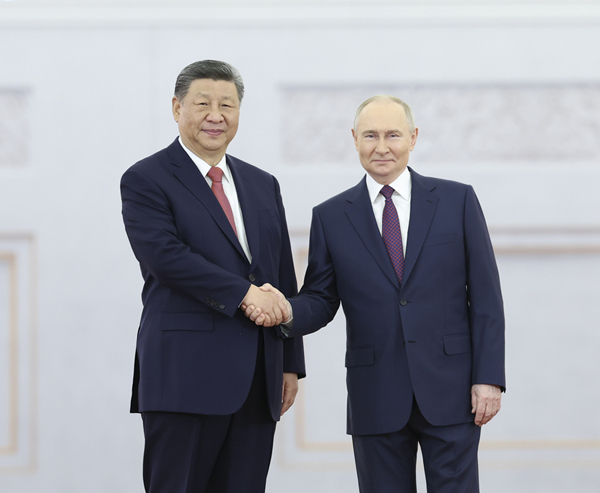
Xi and Putin met in Shenzhen on Wednesday ahead of the first three-way talks between the leaders of China, Russia and the United States.
US officials had initially said Trump would focus on nuclear arms cuts and the war in Iran.
Speaking before he left Washington, the US president said he would also raise Ukraine.
He has since arrived in China, where he was warmly greeted by President Xi and given a red-carpet reception ahead of formal talks on Thursday.
Ukraine’s president, Volodymyr Zelensky, has warned against a repeat of Yalta, the 1945 conference at which the United States, Britain and the Soviet Union negotiated arrangements for postwar Europe.
“We really don’t want this to turn into ‘Yalta 2, 3, 4’ with a redistribution of influence,” he said.
The Ukrainian president added: “What China, Russia, and the United States might discuss has not yet been clearly defined today.”
“Russia wants this meeting more than anyone,” Zelensky said, warning against handing Moscow “another major diplomatic advantage”.
Germany’s president, Frank-Walter Steinmeier, said Xi had told him in a recent meeting that Europeans must be involved in talks about the war.
Beijing has said Thursday’s meeting will cover world peace and strategic stability.
Xi earlier criticised protectionism and called for greater international co-operation on artificial intelligence.
Putin used his speech to criticise Western sanctions and export controls. The two presidents later praised their countries’ partnership and pledged to work towards a more “multipolar world”.
Trump wants China to join nuclear arms control talks with the United States and Russia. The New START treaty, which capped the number of strategic warheads Washington and Moscow could deploy, expired in February. Beijing has previously resisted efforts to bring China into negotiations with the two countries.
The Stockholm International Peace Research Institute estimated that Russia had 5,420 nuclear warheads in its total inventory in January, the United States 5,042 and China 620. The Russian and American totals include retired warheads awaiting dismantlement.
Mao Ning, China’s foreign ministry spokeswoman, called the meeting “of groundbreaking significance”.
The Kremlin said officials were still negotiating a joint statement and that the three leaders could give separate accounts of the talks if they failed to agree on a text.
APEC is one of the few international bodies of which Taiwan is a formal member. The self-governed island is a founding member, and its attendance at the leaders’ summit usually proceeds without major difficulties.
This year’s gathering in China, however, has introduced complications because of tensions with Beijing.
China says it welcomes Taiwan’s participation under the “one-China principle”, which asserts that Taiwan is not an independent territory but part of China.
However, Taipei has rejected this position, with President William Lai saying last week that Taiwan’s participation should be regarded on an “equal basis”.
“APEC is different because Taiwan already enjoys formal membership,” Felix Brender, a postdoctoral fellow in Taiwan studies at Harvard, said, arguing that it would be difficult for Beijing to challenge Taipei’s participation, unlike at the United Nations and the World Health Organisation, where Taiwan is not officially recognised.
Trade tensions are expected to dominate the talks after President Trump’s tariffs disrupted global trade and prompted China to restrict exports of vital materials, including rare earth minerals. A fragile trade truce between Washington and Beijing is due to expire in January.
Artificial intelligence is another major source of tension, with both countries competing for technological supremacy. A recent scandal involving Nvidia has intensified scrutiny of the alleged smuggling of advanced AI chips into China, which Washington regards as a national security threat.
Trump has also said discussions with Putin and Xi will cover nuclear disarmament. However, China has long resisted joining arms control negotiations, arguing that its nuclear arsenal is considerably smaller than those of the United States and Russia.
The war in Ukraine could also feature in the talks, although experts believe a breakthrough is unlikely because of conflicting interests and the absence of Ukrainian representatives. US officials have reportedly suggested that Trump is unlikely to raise the conflict with Putin and Xi.
The conflict in Iran is also expected to be discussed. Trump has indicated that he intends to raise the issue with both leaders, whose countries maintain strategic partnerships with Tehran despite not being formal military allies of the Islamic Republic.
