

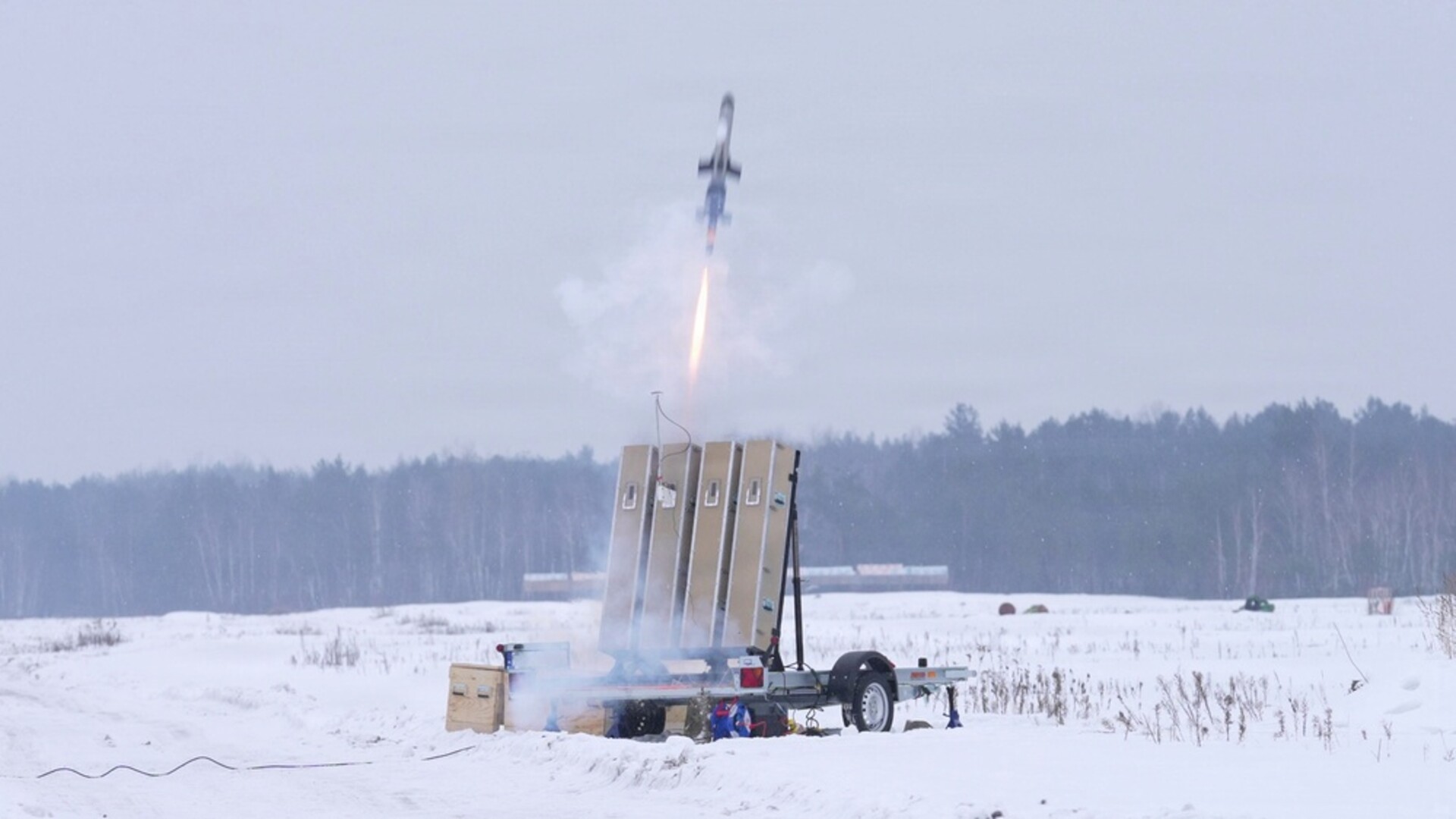
The U.S. Army’s 52nd Air Defense Artillery Brigade (52nd ADA BDE) is testing DZYNE Technologies’ IonStrike kinetic interceptor in Europe as part of a broader effort to field low-cost counter-unmanned aircraft system (C-UAS) capabilities on NATO’s eastern flank. The tests – disclosed on 21 May 2026 and conducted under the banner “Project Bullfrog” – were observed by senior leaders from U.S. Army Europe and Africa (USAREUR-AF) and NATO Allied Land Command (LANDCOM) at an undisclosed location in Europe.
IonStrike is a radar-agnostic, low-cost kinetic interceptor designed to provide a mid-range intercept capability against one-way attack drones and other small unmanned aerial systems (UAS). DZYNE Technologies, the California-based manufacturer, positions the system as a solution to the cost-exchange imbalance that has defined air defence operations in Ukraine and the Middle East – where intercepting a $10,000 drone with a $500,000 missile is a trade that no military can sustain at scale.
C-UAS News and Market Intelligence
Track counter-UAS programmes, procurement signals, vendor activity, and operational lessons across markets often missed by mainstream defence coverage.
The system’s defining characteristic is its integration with command-and-control architectures already fielded by the U.S. Army. IonStrike cues on existing radar feeds and connects to the Forward Area Air Defense (FAAD) System and the Integrated Battle Command System Maneuver (IBCS-M), which means operators detect, track, classify, and engage targets through the same systems they already use daily.
“IonStrike is important because it does not require Soldiers to learn a new kill chain,” said Maj. Cody Davis, the 52nd ADA BDE’s operations officer. “It integrates with approved C2 systems, cues on existing radar feeds, and provides commanders another kinetic option within the air defense architecture.”
The interceptor is launched from a multi-interceptor pallet – currently a four-cell launcher, with a 12-interceptor configuration under development alongside DZYNE to increase magazine depth against larger raid profiles. Unlike traditional fire-and-forget interceptors, IonStrike is designed to be re-taskable in flight, with abort capabilities that give operators greater flexibility after launch.
The tests are focused specifically on the Eastern Flank Deterrence Initiative (EFDI), a warfighting concept using unmanned and minimally manned systems supported by an integrated mission command network that uses live data to accelerate decision-making. EFDI is intended to offset forward posture challenges – including the reduced U.S. troop presence following the recent withdrawal of 5,000 soldiers from Germany – and counter adversary advantages in mass and momentum.
A follow-on operational assessment is planned for summer 2026, evaluating command-and-control integration, radar cueing performance, launcher configuration, reload procedures, lethality against representative one-way attack drones, and the reliability of the system’s abort and re-tasking functions. Maj. Benjamin Bowman, the brigade’s forward operations officer, stated that evaluators will focus on whether IonStrike can function as a repeatable and sustainable combat layer in operational environments.
IonStrike enters an increasingly crowded counter-UAS interceptor market. The Pentagon’s Joint Interagency Task Force 401 (JIATF-401) awarded Perennial Autonomy a $500 million contract on 19 May 2026 for a separate family of AI-enabled drone interceptors – Merops, Bumblebee, and Hornet – already deployed with U.S. Central Command. JIATF-401 separately expanded its drone defence marketplace to Australia, Poland, and South Korea on the same day, broadening allied access to U.S.-made counter-drone technologies.
The brigade’s testing is guided by USAREUR-AF and LANDCOM, and soldiers from the 52nd ADA BDE provided hands-on feedback on operational employment, integration requirements, and the defence of fixed and semi-fixed sites against one-way attack drones throughout the spring demonstration events.
Quwa Pro
Track C-UAS Demand Where the Market Is Still Forming
Follow the news, procurement activity, and buyer priorities shaping counter-UAS adoption across developing and underserved defence ecosystems.
Featured & Trusted By
