

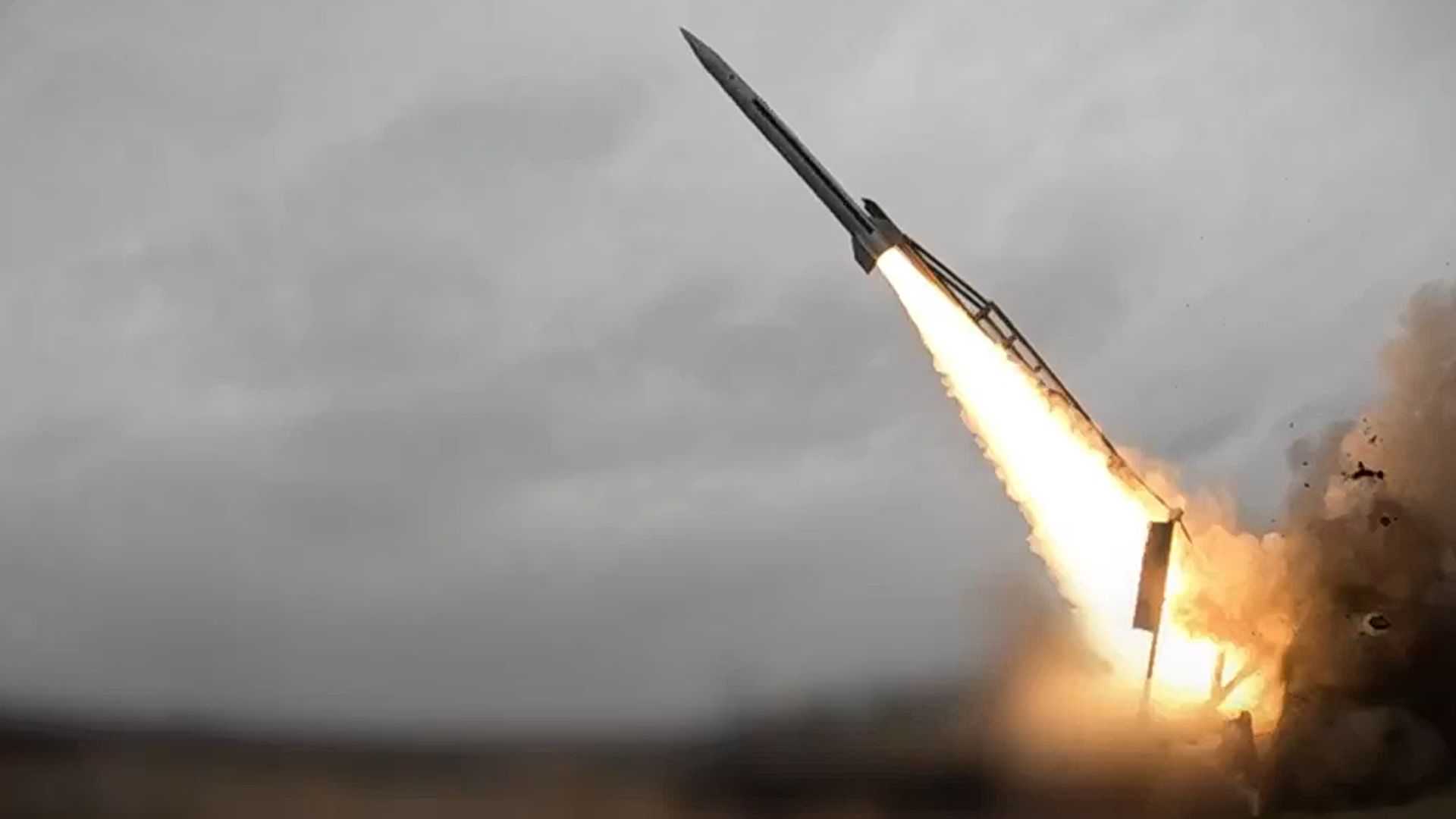
When Denis Shtilerman, a co-founder of the Ukrainian missile and drone manufacturer Fire Point, set out the design of his company’s “Freya” project in the middle of May, he reframed an effort that had until then been understood largely as a deep-strike story around a problem that has troubled every air-defence operator drawn into the war against Russia, namely the difficulty of continuing to intercept incoming ballistic missiles when each engagement consumes an interceptor costing several times more than the weapon it is meant to destroy (Militarnyi; Ukrainska Pravda).
The instrument that Fire Point has settled upon as its answer is the FP-7.x, an anti-ballistic interceptor derived from the airframe of the company’s FP-7 tactical ballistic missile, and conceived from the outset as the entry point of a platform whose defining attribute, at least for the moment, is that it can be built cheaply enough to be expended in the quantities that a war of saturation demands.
The Freya Interceptor and Its Claims
According to the account that Shtilerman provided, and that Militarnyi subsequently detailed, the Freya effort is intended to feed into a broader pan-European air- and missile-defence architecture, and the FP-7.x interceptor that sits at its centre has been constructed from composite materials precisely so that the cost of each shot can be held down, with the missile credited with a speed band of between 1,500 and 2,000 m/s — a figure that sits just beneath the roughly 2,100 m/s that the Russian Iskander-M is reported to reach at the close of its powered phase, yet remains sufficient to reach a tactical ballistic missile during its terminal descent.
The interceptor is described as 7.25 m in length with a fuselage diameter of 0.53 m, and is to be guided through its terminal phase by an imaging infra-red seeker, with a semi-active seeker supplied by Germany’s Diehl Defence reportedly planned as a complementary option for the same airframe.
What is most telling about the wider system, and what Quwa noted when the architecture was first disclosed, is the degree to which Fire Point has chosen to assemble the surrounding sensor and command layer from European systems already in service rather than developing those elements from first principles, such that long-range detection would fall to a Hensoldt TRML-4D, a Thales Ground Master 400 or a SAAB Giraffe radar, target illumination and guidance to a Leonardo Kronos Land or a Weibel set, and command-and-control to a Kongsberg Fire Distribution Center, with the whole tied together through the NATO Link 16 data protocol that Ukraine secured the right to use in 2025.
