

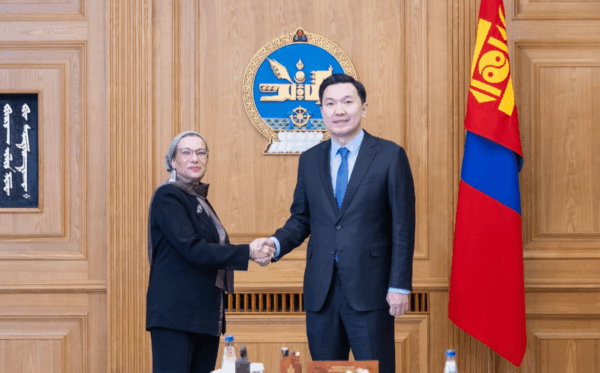
This year, Mongolia will host the 17th Session of the Conference of the Parties (COP17) to the United Nations Convention to Combat Desertification (UNCCD) from August 17-28. COP17 includes segments on finance, water, land and people, and food systems, which are all crucial elements for Mongolia’s fight against desertification – and also issues that intertwine with the country’s economic goals and policies.
In an exclusive interview, The Diplomat’s Bolor Lkhaajav spoke with UNCCD Executive Secretary Dr. Yasmine Fouad on range of issues facing Mongolia, the significance of Mongolia hosting COP17, and what policy recommendations UNCCD has for the country’s policymakers.
What do countries, leaders, and participants hope to get out of COP17? What outcomes Mongolia should expect?
COP17 comes at a pivotal moment for global action on land. Across the world, countries increasingly recognize that desertification, land degradation, and drought are no longer solely environmental concerns. They affect economies, food production, water security, biodiversity, and the resilience of communities.
I believe countries will come to Mongolia with a shared understanding that the challenge is no longer understanding the problem – we know what is at stake. The priority now is implementation. Countries have already committed to ambitious goals, including restoring around one billion hectares of degraded land by 2030. The focus now is on translating those commitments into action through stronger partnerships, increased investment and practical solutions. COP17 represents an opportunity to move from ambition to implementation by scaling finance, innovation and partnerships that deliver measurable results on the ground.
One of the key expectations for COP17 is progress in mobilizing finance for land restoration and drought resilience. Addressing land degradation and drought requires around $355 billion annually, yet current investment is only about $77 billion each year. Closing this gap will require stronger engagement from governments, development banks, the private sector and new financing partners.
Another important outcome will be advancing cooperation on drought resilience, sustainable rangeland management and more resilient food systems. COP17 also coincides with the International Year of Rangelands and Pastoralists, creating a unique opportunity to place rangelands and pastoral communities higher on the global policy agenda.
For Mongolia, hosting COP17 is an opportunity to place the challenges and opportunities facing drylands and pastoral communities higher on the global agenda, while strengthening international cooperation on land restoration and drought resilience. I hope the Conference will reinforce a simple but increasingly important message: investing in healthy land is investing in people, economies and a more sustainable future for generations to come.
In 2024, Mongolia committed to spending at least 1 percent of its GDP annually to combat climate change and desertification. What are some of the policies UNCCD recommends for addressing Mongolia’s desertification situation?
Land restoration should be viewed not as an environmental cost, but as an investment in economic resilience, food security, water security, and sustainable development. Countries that invest in healthy landscapes today reduce the far greater economic and social costs associated with land degradation, drought, and ecosystem decline in the future. Healthy land is the foundation of healthy food systems, water security, and resilient economies. Investing in restoration today reduces future costs while creating long-term opportunities for sustainable growth.
One of UNCCD’s key recommendations is to integrate sustainable land management and restoration into national development planning so that investments in agriculture, water, infrastructure, and climate action reinforce one another rather than operate in isolation.
Another priority is creating policy and regulatory frameworks that encourage long-term investment in sustainable land use and reward measurable restoration outcomes. Countries should also strengthen policy coherence by integrating land restoration across agriculture, water, infrastructure, climate and food systems policies, ensuring that public investment delivers multiple development benefits.
Public finance remains essential, but it cannot meet the scale of the challenge on its own. It should be used strategically to mobilize additional investment from development banks, the private sector and other financing partners. Innovative financing approaches and stronger public-private partnerships will be critical to scaling up action. Public finance should increasingly be used to reduce investment risks and unlock larger flows of private capital, making restoration more attractive as a long-term investment opportunity.
Globally, implementing countries’ plans to address land degradation and drought requires around $355 billion annually, while current investment is estimated at only $77 billion each year. Yet the cost of inaction is even greater – estimated at nearly $900 billion every year. Investing in restoration is therefore not simply an environmental imperative; it is also a sound economic decision.
Ultimately, every country will determine the financing approaches that best reflect its national priorities and circumstances. UNCCD’s role is to support countries by sharing knowledge, strengthening partnerships, and helping mobilize the investment needed to restore land and build resilience to drought.
In the last decade, Mongolia witnessed hundreds of little lakes and rivers disappear. What are some of the direct and indirect impacts of these catastrophic events? What UNCCD policy recommendations and global knowledge can be shared with Mongolia to solve this crisis?
The disappearance of lakes and rivers is one of the clearest signs that climate change, land degradation, and water scarcity are becoming increasingly interconnected. While changing rainfall patterns and rising temperatures are major drivers, the condition of the land largely determines how landscapes respond to these pressures.
Healthy soils regulate the water cycle by absorbing and storing water, replenishing groundwater, and reducing runoff. As land degrades, soils lose this capacity, making landscapes increasingly vulnerable to drought and water scarcity. In turn, prolonged drought further accelerates land degradation, creating a cycle that becomes increasingly difficult to reverse. Healthy land and healthy water systems are inseparable. Restoring landscapes is one of the most effective ways to improve water security while reducing the impacts of drought.
Mongolia is experiencing these pressures very directly. Nearly 77 percent of its territory is affected by land degradation, while average temperatures have risen by more than 2 degrees Celsius since the 1940s – more than twice the global average. Rainfall has declined, droughts have become more frequent, and the number of sand and dust storm days has more than tripled over the past six decades. These changes reduce pasture productivity, place increasing pressure on water resources and threaten the livelihoods of pastoral communities.
The devastating combination of summer drought followed by the 2023–2024 dzud, which resulted in the loss of more than 7 million livestock, illustrates how climate extremes can cascade through ecosystems, livelihoods, and the wider economy.
From the UNCCD perspective, one of the most important recommendations is to manage land and water together rather than as separate issues. Restoring degraded landscapes improves water retention, strengthens drought resilience, and helps sustain agriculture, biodiversity, and rural livelihoods.
Experience from dryland regions around the world also shows the value of shifting from crisis response to prevention. Sustainable land management, drought preparedness, early warning systems, and science-based decision-making help reduce risks before they become disasters. Solutions are most effective when they combine scientific knowledge with the experience of local communities and pastoralists, who have managed drylands sustainably for generations. Also, artificial intelligence, Earth observation, and digital technologies are also creating new opportunities to strengthen drought forecasting, monitor land conditions, and support evidence-based decision-making.
The implications extend far beyond Mongolia. For countries like Mongolia, protecting water resources begins with restoring the landscapes that sustain them.
Given Mongolia’s vast landscape and its over-dependence on mining resources, what has been the main struggle to balance economic development and environmental protection? What steps should Mongolia take in the next five to ten years to make a major impact?
Finding the right balance between economic development and environmental sustainability is one of the defining policy challenges of the 21st century. It is certainly not unique to Mongolia.
Many countries rely on natural resources to generate jobs, growth, and public revenues while facing increasing pressures from land degradation, drought, and climate change. Countries rich in mineral resources face the additional challenge of ensuring that economic growth today does not undermine the natural capital on which future prosperity depends. The question is therefore not whether countries should pursue development, but how development can be achieved in ways that sustain the land, water and ecosystems on which economies ultimately depend.
Healthy land underpins food production, water security, biodiversity, and resilient livelihoods. When land degrades, the costs extend well beyond the environment. Globally, land degradation already costs the world nearly $900 billion every year, while drought causes at least another $300 billion in annual losses. By contrast, investing in sustainable land management and restoration generates long-term economic, environmental and social returns. Land should therefore be viewed as productive natural capital that supports long-term economic competitiveness rather than simply an environmental asset.
Prevention is not only more environmentally effective – it is also far more cost-effective than responding once degradation has become entrenched. Mongolia illustrates both the opportunities and the complexity of this challenge. As a resource-rich country, it is also confronting the growing impacts of land degradation, drought, and water stress. Ensuring that natural resource development goes hand in hand with sustainable land management, healthy rangelands and resilient landscapes will be essential to building lasting economic resilience.
Over the next decade, one of the greatest opportunities lies in adopting integrated approaches that bring together sustainable land use, responsible resource management, restoration, water management and investment in resilient rural livelihoods. Economic development and environmental protection should not be seen as competing objectives. The greatest opportunities will come from aligning responsible mining, sustainable agriculture, restoration, water management and private investment within one integrated development vision.
Restored landscapes support productive economies, thriving communities and long-term prosperity. Countries that invest in land restoration today will be better placed to strengthen resilience, support sustainable growth and reduce future risks.
In 2021, Mongolian incumbent President Khurelsukh Ukhnaa initiated the “One Billion Tree” national movement to restore and reforest the country. Do projects like these actually have an impact on reducing desertification and related issues? How is Mongolia’s initiative progressing?
Large-scale tree-planting initiatives can make an important contribution to reducing land degradation, provided they form part of a broader landscape restoration strategy. The key point is that land restoration is about much more than planting trees. Successful restoration means improving soil health, increasing water retention, protecting biodiversity, and supporting the people whose livelihoods depend on healthy ecosystems. It is about restoring the ecological functions of landscapes rather than simply increasing tree numbers. The right tree must be planted in the right place. Successful restoration always begins with understanding local ecosystems rather than applying one solution everywhere.
In dryland countries such as Mongolia, this is particularly important. Trees have an important role where ecological conditions are suitable, but healthy rangelands, well-managed grasslands, and sustainable grazing systems are equally essential. Restoration therefore needs to reflect local ecosystems and combine scientific knowledge with the experience of local communities and pastoralists.
Mongolia has shown a clear commitment through initiatives such as the Billion Trees campaign and broader efforts to strengthen rangeland management and sustainable livestock systems. These initiatives reflect an important understanding that restoring degraded landscapes contributes not only to environmental protection, but also to water security, food production, resilient livelihoods and climate resilience. As with any large-scale restoration effort, the long-term impact will depend on sustained implementation, effective monitoring and ensuring that the right restoration approaches are applied in the right places.
Success should not be measured simply by the number of trees planted. It should be measured by healthier landscapes, restored soils, improved water security, more resilient rural communities and ecosystems that continue to provide livelihoods for future generations. That is the true measure of successful land restoration.
Based on your experience serving as Egypt’s minister of environment and the current extreme water scarcity and air pollution challenges facing Egypt – similar to Mongolia – what can Mongolia learn from Egypt about how to overcome these challenges?
Although Egypt and Mongolia have very different geographies and ecosystems, countries facing water scarcity and land degradation often confront similar policy choices: how to manage natural resources sustainably while supporting economic development and people’s livelihoods.
One of the most important lessons from my time as Egypt’s minister of environment is that water scarcity cannot be addressed through water policy alone. Water, land, agriculture, and climate are deeply interconnected, and policies are far more effective when they reflect those connections rather than treating each challenge separately. Healthy food systems ultimately depend on healthy land and reliable water resources. Integrated policies therefore deliver stronger environmental, economic and social outcomes than sectoral approaches.
It is equally important to shift from crisis response to prevention. Droughts and land degradation are slow-onset disasters whose impacts accumulate over time, affecting food production, livelihoods and economic stability. Globally, droughts have increased by nearly one-third since 2000, while water demand is projected to exceed available resources by up to 40 percent by 2030. Investing early in sustainable land management, healthy soils, ecosystem restoration, efficient water use and early warning systems is therefore far more effective – and far less costly – than responding once crises unfold.
This is particularly relevant for Mongolia, where pastoralism supports around one-third of the population. Protecting rangelands is therefore not only an environmental priority; it is fundamental to food security, water management and rural livelihoods as climate pressures continue to intensify. For Mongolia, investing in healthy rangelands is also an investment in preserving cultural heritage, strengthening pastoral livelihoods and enhancing long-term national resilience.
No country has all the answers. That is why international cooperation is so important. UNCCD provides a platform for countries to exchange experiences, strengthen partnerships, and translate science into practical action. By learning from one another and investing in restoration, countries can build more sustainable and resilient futures.
