

Surrounding Chinese President Xi Jinping’s state visit to Washington, D.C. – capped by a summit at the White House with U.S. President Donald Trump – was a spate of commentary from both sides of the political aisle. Clearly, not everyone was convinced of the need for Xi to visit in the first place.
Even Trump loyalists such as Louisiana Senator John Kennedy spoke out against having Xi at the White House. One of the Senate’s most colorfully spoken members, Kennedy made his point of view known in no uncertain terms, speaking on the Will Cain show.
Kennedy opined: “All four of them are the same. It’s like the same hooker in different dresses. They all lie like time share salesmen. You can’t trust ‘em. You can’t turn your back on any of ‘em, even if I thought, I knew they were two days dead.”
Kennedy was referring to the leaders of China, Iran, North Korea, and Russia – Xi Jinping, Masoud Pezeshkian, Kim Jong Un, and Vladimir Putin, respectively.
Kennedy went on to dub the quartet “a colony of reptiles,” giving Xi pride of place as the “chief reptile” and “quarterback.”
Taking a more serious approach from his powerful perch as chairman of the Senate Armed Services Committee, Mississippi Senator Roger Wicker, also a strong Trump supporter, forcefully stated his opposition to the state visit and summit. From the Senate floor, Wicker said, “Quite frankly, had the White House asked me for advice, I would have suggested the president not invite Xi Jinping to Washington for such a lavish welcome here in the United States of America based on all of the troubling issues we have with President Xi and the Chinese Communist Party.”
The Senate Armed Services Committee carries enormous influence and prestige in Washington and beyond, and Wicker used that platform to call out Trump’s decision to bring Xi to Washington, and roll out the red carpet for him.
Key among the core functions of the committee itself is responsibility for aeronautical and space activities associated with the development of weapons systems, and for the Departments of Defense, Army, Navy, and Air Force. It also oversees military research and development.
With that authority behind him, Wicker said, “I want to take a moment to suggest a list of topics that the president might mention during the summit.”
“This summer,” he continued, “it was all over the press that China gave Iran satellite imagery intelligence, and that intelligence led to the death of American troops. So I would certainly suggest that the president try to get an answer to that.”
Wicker’s list continued. He wanted answers on the plight of the Uyghur people, along with Tibetan Buddhists, Christians, and Falun Gong practitioners. “Why not suggest,” Wicker reflected, “releasing all imprisoned Christians and allowing all people of whatever faith to worship freely?”
Finally, Wicker listed the abuses by China of its neighbors, of Taiwan, of Hong Kong, of African nations, of dissidents, and of Jimmy Lai, the 78-year old former Hong Kong newspaper publisher who ran afoul of security laws pushed through by Beijing and who is now serving a 20-year sentence for sedition and collusion with foreign forces.
Wicker continued, “During every minute of dialogue, our commander in chief should keep in mind that his guest is a brutal, unelected, and oppressive dictator who seeks to dominate his neighbors and whose massive military arsenal is aimed directly at the United States of America.”
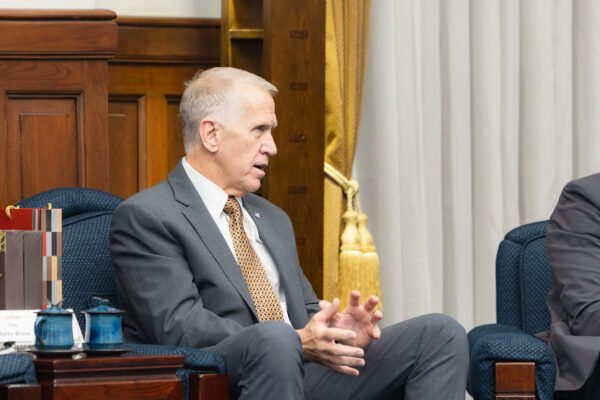
Joining the chorus, North Carolina Republican Senator Thom Tillis told CBS News on September 24 – the day of the summit and state dinner – that Trump’s hosting of Xi was “bad timing.”
Calling the meeting a “WTF moment,” Tillis questioned why Xi had received a red-carpet welcome that surpassed those given to traditional U.S. allies.
Axios reported that Tillis was “worried about the trend of spending more time with despots and less time with democratic leaders of nations.”
“It’s not that Xi Jinping is coming here to learn how to become a democratic, capitalist nation,” Tillis said. “Xi Jinping is trying to understand how his opposition will ultimately embrace their worldview.”
Tillis went on to question what prompted the “sea change” he sees in Trump’s posture toward China after years of pledging to take a hard line against Beijing.
The White House downplayed the criticism from the Republican senators, with spokeswoman Anna Kelly pointing out that Trump was “reciprocating” the “hospitality” Xi showed when Trump visited China in May.
It could be argued that it is less hypocritical to honor Xi with a state dinner than not. The reasons are myriad. From 1990 through 2020, the United States invested $284 billion into Xi’s country, not including venture capital. And, according to the Global Times, there are over 84,000 U.S.-invested companies in China.
Notably, the United States has educated over 3 million Chinese students since visas became available in the late 1970s.
And, as strong as the Chinese Communist Party (CCP) is, its belief and behavioral systems have had to radically alter in order to build an economy that serves the people well enough to keep the CCP in power.
The CCP has had to abandon the command economy that is central to communist countries in favor of a fusion economy that blends state-owned enterprises, private domestically owned enterprises, and importantly, foreign-owned enterprises. It is the latter, the foreign-owned enterprises, that have brought about profound changes to the mindset and living standards of much of the Chinese population. By manufacturing in China products never seen before in the country, whether for domestic use or export, or both, China experienced a rapid modernization by exposure to the products themselves, the processes and standards of quality required to manufacture them, and the labor standards and management styles that make those businesses profitable.
Perhaps, then, instead of focusing on a state dinner for a Chinese leader little trusted in the United States, it is more fitting to view that dinner and the pomp and ceremony that surrounded it as a state dinner in honor of the Chinese people. They have had to put up with a lot, and still do. They may not have had a seat at the table in the White House, but they will have viewed with pride the American treatment of a Chinese leader. Diplomatically, and historically, that goes a long way.
