

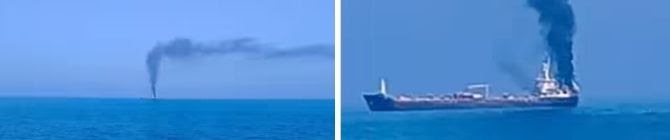
US Central Command has confirmed that American forces struck the Guinea-Bissau-flagged oil tanker MT Jalveer in the Gulf of Oman, which was carrying 20 Indian seafarers.
The strike was carried out after the vessel allegedly attempted to transport Iranian oil in violation of the US blockade in the region.
According to CENTCOM, the incident occurred at around 11:20 pm ET on 10 June, when two Hellfire missiles were fired into the ship’s engine room to halt its movement after repeated warnings were ignored.
The Union Ministry of Ports, Shipping & Waterways reported that no casualties or injuries were sustained in the incident. Smoke was detected due to a fire in the engine room near Shinas port, Oman, but all crew members were confirmed safe.
Evacuation procedures commenced, with six more crew members awaiting transfer to Shinas port. Additional Secretary Mukesh Mangal confirmed that the vessel was carrying 20 Indian nationals, all of whom survived the attack.
This marks the third commercial vessel targeted by US forces in the Gulf of Oman within the same week. Earlier, the Palau-flagged MT Marivex and MT Settebello were disabled on Monday and Tuesday respectively, also for attempting to transport Iranian oil.
The Ministry of External Affairs confirmed that three Indian seafarers lost their lives in the attack on MT Settebello, and their mortal remains are being repatriated to India. MEA spokesperson Randhir Jaiswal stated that the attacks were carried out by the US Navy operating in the region and clarified that all three vessels involved were foreign-flagged. He further noted that two of the ships were sanctioned under the US Office of Foreign Assets Control (OFAC), while another was categorised as non-compliant.
CENTCOM provided figures on the blockade’s enforcement since its initiation on 13 April. Nine non-compliant vessels have been disabled, 135 ships redirected after complying with instructions, and 42 vessels carrying humanitarian aid permitted to pass.
The blockade is being enforced against vessels of all nations attempting to enter or depart Iranian ports and coastal areas. CENTCOM emphasised that the enforcement is impartial and forms part of wider diplomatic efforts to resolve hostilities in West Asia.
The broader conflict began on 28 February, following US-Israeli strikes on Iran, and has since escalated into a major regional confrontation. The strategic Strait of Hormuz, a critical artery for global energy trade, has become the focal point of this struggle, with both Iran and the US seeking to assert control.
The attacks on MT Jalveer, MT Marivex, and MT Settebello highlight the intensifying maritime dimension of this geopolitical contest, with significant implications for international shipping and energy security.
ANI
