

Chhatrapati Shivaji Maharaj known as the “Father of the Indian Navy,” recognised as early as the 17th century that a formidable indigenous maritime force was essential to counter colonial threats (Portuguese, British, Dutch) along India’s Konkan coast.
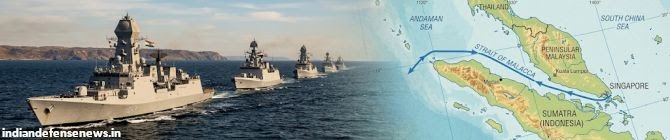
India’s modern-day Navy is carrying forward this legacy in the maritime domain & have understood strategic importance of the key global chokepoint – The Straight of Malacca.
One of the most important waterways in the world and a crucial global chokepoint, it facilitates quarter of global commerce between the Indian & Pacific oceans. Although this constricted route supports economies from East Asia to Europe, its bottlenecks increase the risk of piracy and geopolitical unrest.
For centuries, the strait has served as a pivotal point for Southeast Asia’s trade routes connecting the Far East and the Indian Ocean, promoting the development of ports as hubs of Cultural & religious beliefs.
Situated between the Malay Peninsula and Sumatra, the Strait of Malacca is a funnel-shaped passage linking Pacific Ocean with Indian ocean. The Chokepoint in the Phillips Channel near Singapore, the navigable width narrows to a dangerous 2.7 km. Over 94,000 vessels transit annually.
It carries 35% of the world’s maritime oil and 20% of its natural gas, supporting the economies of south east Asia. It’s closure would cost China an estimated $63 million each week. China relies on this route for 80% of its oil imports.
To mitigate the risk of a blockade, Beijing has pursued the “String of Pearls”—investing in ports like Gwadar (Pakistan) and Kyaukpyu (Myanmar) to create land-based energy corridors that bypass Malacca. This will help it mitigate it’s ‘Malacca Dilemma’.
India has leveraged its geography to act as a regional balancer. ANC Command established in 2001, this tri-service command sits just 600 km from the Strait, allowing India to oversee routes critical to East Asian freight. ANC undertakes patrols, anti-smuggling operations, and humanitarian missions, thereby enhancing India’s influence in the context of regional tensions.
INS Baaz (Great Nicobar): The southernmost air station for P-8I Poseidon patrols, providing oversight of the strait. INS Utkrosh and INS Kohassa: These bases support maritime reconnaissance operations with Do-228 aircraft and helicopters. INS Kardip and INS Jarawa: These serve as forward bases for corvettes, Offshore Patrol Vessels (OPVs), and logistics operations near critical chokepoints.
Despite its importance, the Strait faces mounting pressures related to Security, Piracy, smuggling, and terrorism remain persistent threats requiring joint patrols by Malaysia, Indonesia, and Singapore. Excavating for greater depths and establishing new pipelines or channels to bypass. Example: Thailand’s Kra Canal.
Increasing trade resulting from China’s BRI amplifies dependence; alternative pathways such as the China-Pakistan Economic Corridor (CPEC) leading to efforts for diversification, primarily through Balochistan port of Gwadar. The Strait of Malacca is more than a waterway; it is a barometer for Indo-Pacific stability.
As trade volumes grow and geopolitical tensions rise, the management of this chokepoint with the help of the Indian Navy, will require a delicate balance of military vigilance and international cooperation to ensure the “freedom of navigation” that sustains the global economy, thus helping India achieve it’s goal of Viksit Bharat by 2047.
Adwet Prasad Tripathy & Avishkar Pamnani are experts in the field of Strategic Studies. They provide in-depth analysis on maritime security, energy corridors, and the evolving geopolitical landscape of South Asia, tracking the modernisation of conventional and asymmetric capabilities. This essay reflects authors opinions alone
