

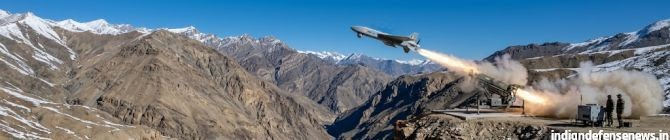
These trials were conducted in April at two demanding locations — the Pokhran firing range in Rajasthan and the high-altitude terrain of Joshimath (Malari) in Uttarakhand. What makes this achievement particularly noteworthy is that the demonstrations were carried out without any financial commitment from the Army, reflecting the company’s confidence in its creation.
A loitering munition is essentially a smart drone capable of circling patiently in the sky until it identifies a target, at which point it dives in to destroy it. On 18 and 19 April, Nibe tested the anti-personnel variant at Pokhran. Armed with a 10-kg warhead, the Vayu Astra-1 travelled a distance of 100 kilometres and destroyed its target with remarkable precision, achieving a Circular Error Probable (CEP) of less than one metre.
This level of accuracy is akin to hitting the bullseye of a dartboard consistently. Importantly, the system demonstrated the ability to abort an attack mid-flight and re-engage, a feature that provides soldiers with enhanced tactical flexibility in combat.
The trials also included a night-time demonstration against armoured vehicles using infrared cameras. These sensors detect heat signatures, enabling accurate targeting even in complete darkness. The munition struck its target with a CEP of just two metres, underscoring its effectiveness in nocturnal operations.
Another key highlight was the successful transfer of control from the primary Ground Control Station to a Forward Control Segment located 70 kilometres away, ensuring safe and secure remote operation during missions.
The high-altitude trials at Joshimath (Malari) on 26 and 27 April further validated the system’s resilience. Operating above 14,000 feet in thin air and freezing conditions, Vayu Astra-1 remained airborne for over 90 minutes.
This capability is crucial for deployment in India’s mountainous border regions, where extreme weather and altitude pose significant challenges. Notably, after completing its mission, the munition returned safely to base. This reusability marks a major advancement, allowing the same system to be deployed multiple times, thereby reducing costs and enhancing operational efficiency.
In addition to these demonstrations, Nibe Limited successfully tested its indigenously developed Suryastra rockets at the Integrated Test Range on 18 and 19 May.
These rockets achieved strikes at ranges of 150 kilometres and 300 kilometres, showcasing formidable long-range strike capabilities. Together, these achievements highlight India’s growing self-reliance in defence technology and the dedication of its engineers and scientists to strengthening national security.
The Vayu Astra-1’s combination of pinpoint accuracy, abort-and-reattack capability, night-fighting proficiency, high-altitude endurance, and reusability makes it a highly valuable asset for the Indian Army.
It represents a proud step forward in India’s journey towards advanced indigenous defence solutions, ensuring that the nation is better equipped to safeguard its borders under diverse and challenging conditions.
Agencies
