

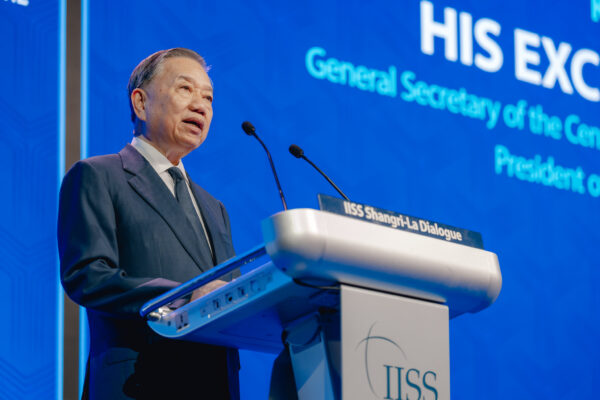
Hours after delivering the keynote at Asia’s premier security forum, Vietnam’s top leader, Communist Party of Vietnam General Secretary To Lam, stated in an interview that Vietnam “does not approach [its] relations with major powers through the prism of security.” For 13 years at the Shangri-La Dialogue (SLD), Hanoi has built its regional standing on a nontraditional security agenda that has steadily widened. That agenda began with Nguyen Tan Dung’s 2013 keynote at the SLD and reached its fullest expression in To Lam’s 2026 address.
Balancing between the United States and China has kept Vietnam safe, but it has offered little say over the region’s direction. Hanoi’s emphasis on nontraditional security provides fertile ground to help shape regional arrangements without touching either great powers’ red lines.
On May 31, 2013, then-Prime Minister Nguyen Tan Dung became the first Vietnamese leader to deliver a keynote at the Shangri-La Dialogue. His speech came less than a year after ASEAN had failed, for the first time in its history, to issue a joint communiqué. The July 2012 Phnom Penh meeting had deadlocked over language on the South China Sea.
In his keynote, Nguyen Tan Dung introduced “lòng tin chiến lược” (strategic trust), a Vietnamese diplomatic concept for how Asia-Pacific states should manage their security relationships. He returned to the concept across the speech, tying it to great power responsibility and ASEAN’s centrality. He also used it to frame nontraditional challenges such as climate change, pandemics, and water security.
For the next decade, the Vietnamese voice at the dialogue came from the Ministry of National Defense. A succession of defense ministers kept Nguyen Tan Dung’s “strategic trust” framework while widening the nontraditional security agenda.
The 2014 plenary was the clearest illustration of Vietnam’s emphasis on nontraditional security. Then-Minister of Defense Phung Quang Thanh spoke on May 31, 2014, weeks after China towed the Haiyang Shiyou 981 oil rig into waters Vietnam claimed. Although the title of his speech – “Managing strategic tensions” – named the moment, Thanh actually spoke about transnational crime and maritime safety cooperation. In the midst of a sovereignty crisis, Hanoi chose to talk in the language of cooperation.
By 2025, Minister of Defense and Deputy Prime Minister Phan Van Giang’s plenary showed how wide the nontraditional security agenda had grown. Again citing strategic trust, he ran through a list that included natural disasters, pandemics, climate change, water security, food security, terrorism, drug-related crime, and human trafficking.
To Lam opened the 23rd Shangri-La Dialogue on the evening of May 29, 2026, becoming the second Vietnamese leader after Nguyen Tan Dung to deliver a keynote. The 2026 keynote returned to strategic trust and gave it more weight.
Lam framed regional instability as the product of three foundational crises occurring at once: a crisis of the international order, a crisis of the development model, and a crisis of strategic trust. He placed the concept Dung had introduced at the center of the diagnosis. In his account, strategic trust was the work of managing differences within rules-based frameworks so that great power competition stays bounded and predictable.
Lam spoke of the need to shape “an Asia-Pacific that is peaceful, stable, resilient and capable of mitigating risks early and from afar.” The specific risks he mentioned included technology and defense industry norms, AI governance, undersea cable and critical infrastructure resilience, information environment cooperation, human security and societal resilience, and preventive diplomacy capacity. His use of “kiến tạo” (proactive construction) also showed the ambition of a country that has decided it can help design regional arrangements.
One feature set 2026 apart from 2013. Dung had named the U.S. and China directly, as the two powers with the greatest responsibility for the region’s future. In contrast, Lam in 2026 referenced “partners with major influence in and outside the region” and “major powers” in general. He condemned coercion and unilateral moves to create new facts on the ground, and warned against turning trade and technology into instruments of pressure.
Vietnam’s investment in the nontraditional security agenda is a response to the regional contest. Competition between the United States and China has narrowed the room available to small and middle states across the Asia-Pacific. Balancing between the two, the long-standing flexibility Hanoi calls “bamboo diplomacy” secures Vietnam’s survival yet leaves limited room to shape outcomes. Thus, the nontraditional security agenda is the domain where a state of Vietnam’s weight can try to set terms on the ground of its choosing.
The agenda opens room for cooperation with Japan, South Korea, Australia, India, and the European Union in areas where Vietnam faces capability gaps, including AI governance, undersea cable protection, cyber norms, and critical infrastructure resilience. These are areas where hard‑security alignment would not be possible for Vietnam, given its need to manage relations with China. It also spares Vietnam from taking sides in the China-U.S. contest, which keeps its flexibility with both intact.
None of this means Vietnam has gone soft on the hard questions. Lam restated Vietnam’s South China Sea position without hedging, and made clear that warmer relations with China and the defense of sovereignty run together. In that sense, the nontraditional security agenda is the ground Vietnam chose to stand on because defending sovereignty, on its own, wins little standing.
Lam’s remark that Vietnam does not view its great power relations through the prism of security was a choice. The prism he set aside is the one that would leave Hanoi balancing between Washington and Beijing without end. A middle state has limited ability to dictate the region’s security outcomes. What it can do is press its framework onto the regional conversation and hope it sticks, and that is the work Hanoi has spent 13 years on.
Lam’s keynote was a sign of how far that work has come.
