

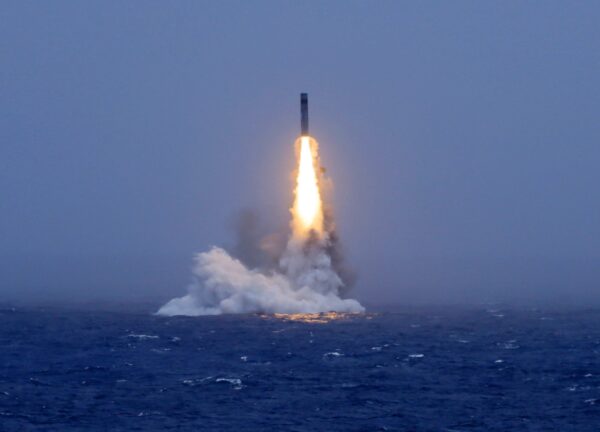
On July 6, the People’s Liberation Army Navy (PLAN) launched a submarine-launched ballistic missile (SLBM) into the Pacific Ocean. The launch has received plenty of coverage. What came the next day did not. A single social media post provided important context.
The launched SLBM’s likely maker, China Aerospace Science and Technology Corporation (CASC), put an image on Weibo to commemorate the 89th anniversary of the Marco Polo Bridge Incident. The graphic visually linked the July 6 missile test to an incident of historical victimhood.
The Marco Polo Bridge Incident of July 7, 1937 began the Second Sino-Japanese War and World War II in the Pacific. Despite its historical significance, this small happenstance skirmish near Beijing was initially considered a localized clash over a missing Japanese soldier. The incident was marked by confusion due to humid and dark conditions, along with tactical errors. Tokyo initially sought a “local solution and non-expansion” to the misunderstanding. Both sides negotiated a ceasefire.
Subsequently, however, Japan’s hardline Imperial Army faction found the Marco Polo Bridge Incident a useful excuse to expand operations into northern China, leading to an eight-year war. In China, the date long marked the commencement of the full-scale “War of Resistance Against Japanese Aggression,” a foundation of the country’s modern national story.
The image marking the Marco Polo Bridge Incident’s 89th anniversary, posted by China Aerospace Science and Technology Corporation.
CASC’s poster fused this history with a contemporary message. The artwork depicts the Great Wall (symbolizing China as an ancient, unbroken state defending its borders), resistance fighters (representing the Chinese people and their sacrifices), and the July 6 launch (demonstrating China’s military modernization and capability), along with the number 77 (the Marco Polo incident anniversary). “Never Forget History, Strive to Build National Strength” (勿忘历史,奋斗图强) is the slogan in the poster’s center. CASC’s graphic clearly presents China’s wartime suffering and its current military power as chapters of the same story.
The Chinese Communist Party (CCP) regularly draws on memories of the War of Resistance to reinforce a narrative of unity and the party’s accomplishments for China. CASC’s merging of this wartime imagery and the July 6 launch sends this message and highlights how military modernization guards against a repeat of past humiliation. It aligns well with the “national rejuvenation” narrative, pairing memories of suffering with displays of strength.
Other recent PLAN activity has lent itself to a similar narrative.
On September 18, 2024, the aircraft carrier Liaoning (CV 16), along with escorts, transited between Japan’s Yonaguni and Iriomote Islands, passing through Japan’s contiguous zone en route to the Philippine Sea. The transit was part of the Liaoning’s deployment during its 12th year of commissioned service.
Its movements near Japanese waters also coincided with the anniversary of the Mukden Incident. The Mukden Incident (September 18, 1931) justified Japan’s invasion of Manchuria. It holds a similarly central place in Chinese memory as the beginning of “imperial Japan’s invasion of China” – and China’s national resistance. In fact, in 2017 China officially changed the start date of the War of Resistance from July 7, 1937 to September 18, 1931.
Chinese state media did not connect the 2024 Liaoning transit and the Mukden Incident anniversary. In fact, state media detailed and challenged Japanese characterization of Liaoning’s operations, downplaying the transit as “in accordance with the annual training plan.” Framing its military operations as routine avoids a provocative narrative, allowing Beijing to dispute Japanese objections to PLA actions.
Online Chinese commentary instead made the connection between the events. Nationalist commentators and ordinary users noticed the timing right away and treated it as further proof of China’s growing edge over Japan.
Historical anniversaries do not drive the timing of PLA activity. The SLBM launch this week and carrier transit in 2024 happened per the PLA’s schedule, according to official statements. However, history serves as a useful amplifier for such activity.
PLA activity paired with historically significant anniversaries becomes a vehicle for highlighting a once-humiliated China that has grown strong and self-reliant under CCP leadership. Official channels keep their distance, leaving online commentary and other media to connect the dots.
For observers, the lesson is not that the PLA schedules operations around historical anniversaries. Rather, military demonstrations can take on additional meaning when integrated into the CCP’s wider narrative of national rejuvenation.
