

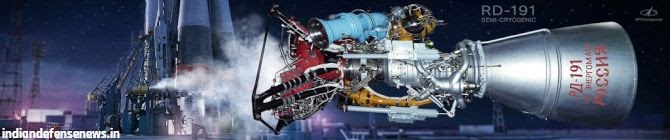
The RD-191 engine represents Russia’s latest advancement in high-performance
rocket propulsion, developed by NPO Energomash in Moscow for the Angara family
of launch vehicles.
This single-combustion chamber engine derives from the
legendary RD-170 family, originally designed for the Energia super-heavy
rocket and Zenit launchers.
By essentially dividing the four-chamber RD-170 into four independent units,
engineers created the RD-191 specifically for the URM-1 booster module of the
Angara rockets.
The concept of splitting the RD-170 emerged as early as the beginning of the
1980s, when designers considered using four such one-chamber engines, then
dubbed MD-185, on the Zenit’s first stage amid challenges with the RD-170
development.
Work on the RD-191 formally began at the end of 1998, building on the RD-180,
a two-chamber derivative already powering the American Atlas V rocket. All
engines in this lineage employ non-toxic kerosene (RP-1) as fuel and liquid
oxygen as the oxidiser, marking a shift from more hazardous hypergolics.
Unlike its multi-chamber ancestors, the RD-191 features a single gas generator
instead of two, paired with a smaller main turbine that drives pumps for both
oxidiser and fuel via a vertical shaft. Hot gas from the generator powers the
main turbopump before entering the combustion chamber to combust with
additional fuel, while fuel itself cools the chamber walls. The combustion
chamber is mounted in a gimbal suspension, allowing it to swivel up to eight
degrees along yaw and pitch axes for precise rocket steering, necessitating a
flexible hose for gas feed.
| Feature | Value |
|---|---|
| Propellant | LOX / RP-1 |
| Cycle | Oxidiser-rich staged combustion |
| Mixture Ratio | 2.6:1 |
| Nozzle Expansion Ratio | 37:1 |
| Sea-level Thrust | ~196 tons-force (~1,920 kN) |
| Vacuum Thrust | ~212.6 tons-force (~2,090 kN) |
| Specific Impulse (Sea Level) | 311.2 seconds |
Key technical specifications underscore its prowess: thrust stands at 196
tonnes at sea level and 212.6 tonnes in vacuum, with specific impulses of
311.2 seconds at sea level and 337.5 seconds in vacuum.
The engine measures
12.40 feet in height and 6.88 feet in diameter, with a dry mass
of 2,200 kilograms and fuelled mass of 2,430 kilograms. Combustion chamber
pressure reaches 262.6 kilograms per square centimetre, enabling exceptional
efficiency through an oxygen-rich staged combustion cycle.
Development progressed rapidly with extensive use of 3D computer modelling,
culminating in the first full-scale mockup in March 1999 and assembly of the
inaugural workable engine on 22 May 2001. The initial live firing occurred in
July 2001, followed by 10 tests by early 2004, outpacing the Angara rocket’s
overall schedule. By 2006, it had accumulated 4,500 seconds across 35 firings,
with the longest at 400 seconds, targeting 15,000 seconds over 70 tests on 10
engines.
In 2009, the engine achieved a milestone with the first test firing of an
integrated URM-1 booster on 30 July, burning for 232 seconds to simulate a
full orbital ascent profile. Subsequent firings on 1 October (203.4 seconds at
maximum throttle) and others confirmed reliability.
That year also saw the
debut flight of the South Korean Naro-1 (KSLV-1) rocket, powered by the RD-151
variant—a thrust-reduced version at 170 tonnes—despite the mission’s partial
failure due to upper stage issues.
Serial production faced hurdles, with early combustion chambers from Voronezh
Mechanical Plant (VMZ) requiring certification tests in 2012, including
firings of 330 seconds and 30 seconds to validate quality amid reported
issues. Plans shifted production to Proton-PM in Perm by 2009, but delays
persisted. NPO Energomash declared development complete on 23 May 2011 after
120 firings totalling 26,747.4 seconds, encompassing stage tests and two KSLV
flights.
Export variants proliferated: the RD-151 for South Korea, RD-193 (fixed
nozzle, steering via thrusters) for Soyuz-2-1v, and RD-181 for the US Antares
rocket, agreed upon in January 2015 to replace NK-33 engines post-explosion.
Production engines like D028, D029, and D041 appeared in 2019 footage for
Angara-5 assembly at PO Polyot in Omsk. A 2022 statement from Roscosmos hinted
at supplying around 10 RD-191s to India from 2024-2029.
The RD-191 inherits multi-burn reusability from the RD-170 family, enabling
ground firings before flight and theoretically supporting stage recovery,
though never realised operationally. NPO Energomash proposed the RD-195 for 10
reuses on the MRKS-1 reusable launcher and studied RD-192 on methane to reduce
residue, plus a telescoping nozzle extension for vacuum optimisation. Critics
note the high chamber pressure risks catastrophic failure from minor
deviations and potential turbopump erosion by metal particles.
Advancing the lineage, the RD-191M emerged in the 2010s for Angara-5M and
Angara-5V, test-fired in 2016 at 110% thrust, with full component tests by
end-2023 and tune-up firings completed on 8 July 2024. In 2024, 35 firings
covered both RD-191 and RD-191M; final ZDI tests ended 26 March 2025,
greenlighting serial production. Deliveries to Khrunichev for Angara-5M began
late 2024, with more in 2025.
Recent geopolitical shifts have spotlighted the RD-191M for India, with
Roscosmos agreeing to 100% technology transfer to ISRO, potentially during
President Putin’s 2025 visit, amid export curbs. This semi-cryogenic
powerhouse, using RP-1/LOX in an oxidiser-rich cycle, promises to upgrade
LVM3’s core stage (SC-120), boosting GTO payload from 4 to 5+ tons and aiding
Gaganyaan and Chandrayaan. Inspections of L&T facilities occurred in 2022,
with transfers eyed for 2026-27 and indigenous production by 2030.
For ISRO, paralleling its SE2000 efforts—validated via PHTA hot tests in March
2025—the RD-191M offers a benchmark for turbopumps, pre-burners, and controls,
accelerating heavy-lift and reusable ambitions. ROSCOSMOS benefits by
sustaining markets eroded by competitors, while India gains parity with
systems like China’s Long March. Thrust near 192-196 tonnes positions it
ideally for clustered boosters or single-core heavy-lifters.
Ongoing tests, like RD-191 D035 in 2016 and 2023 KTI firings, affirm maturity,
with 2010’s deliberate “burn-down” validating endurance limits. Integration
demos, scale models at Aerospace exhibitions, and footage from Moscow
facilities highlight its evolution from prototype to production asset.
As Angara flights resume and exports expand, the RD-191 family cements
Roscosmos’ propulsion dominance, blending heritage reliability with modular
versatility.
IDN (With Agency Inputs)
