

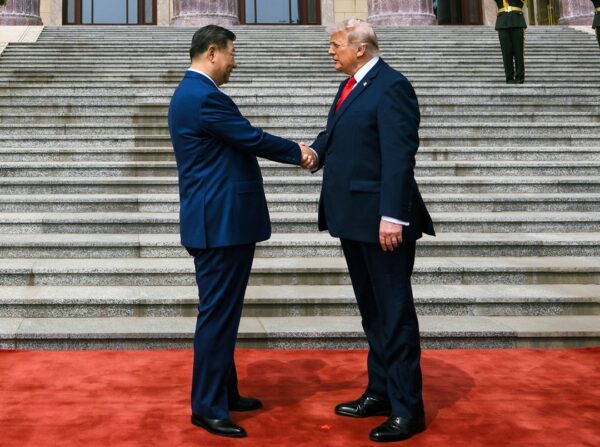
From May 13 to May 15 the world closely watched while the most consequential diplomatic meeting of 2026 unfolded. U.S. President Donald Trump landed in Beijing accompanied by 17 CEOs who, according to Forbes, are collectively worth more than $1 trillion. This was the first U.S. presidential trip to China in nine years and the first of Trump’s second term. There was a lot at stake, and not just for China and the United States. The impact of this summit will be felt on the African continent as well.
Since Trump’s last visit to China in 2017 a great deal has changed globally directly due to policy decisions taken in both the United States and China. First came COVID-19, which lead to an estimated 7.1 million confirmed deaths around the world. Trump’s second term sparked a trade war that saw the U.S. impose tariffs of 145 percent on Chinese goods while China retaliated with 125 percent tariffs on U.S. goods. A practical truce was reached in Busan, South Korea, where both presidents met in October 2025, but the United States’ broader “Liberation Day” tariffs on China and other countries – including in Africa – remain today, albeit at lower levels.
The Trump administration also shut down USAID in 2025. The U.S. aid agency had been, according to some estimates, safeguarding approximately 3 million lives in lower-middle income countries, including in Africa. The United States also revised the African Growth and Opportunity Act (AGOA) from a 10-year guaranteed policy of preferential trade for a selected 30 or so African countries to a more uncertain, annually reviewed policy – this after U.S. trade ties with African countries had already been eroded by Trump’s broader “reciprocal” tariffs.
Meanwhile, China announced the expansion of its aid program globally – especially via the United Nations – and extended zero-tariff treatment to all 53 African countries that have diplomatic relations with China.
Most recently, the United States and Israel started a war with Iran in February 2026 leading to the closure of the Strait of Hormuz, which severely affected global trade.
Policy made in China and the United States echoes around the world. Naturally, analysts worldwide were watching the Trump-Xi summit with keen interest. Beyond the pomp and circumstance, how did these talks really play out?
The White House readout was positive and focused on trade commitments, agricultural purchases, fentanyl cooperation, and the shared position that the Strait of Hormuz must remain open. Specifically, Trump announced China committed to purchasing 200 Boeing aircraft, representing the first Chinese order of U.S.-made planes since 2017, and said China had agreed to buy at least $17 billion in U.S. agricultural goods annually through 2028, in addition to purchasing American oil. Absent from Washington’s official account was any mention of Taiwan, though Trump’s remark that a Taiwan arms sale was “a very good negotiating chip” was widely read as a diplomatic win for Beijing.
The Chinese Ministry of Foreign Affairs readout, on the other hand, focused on how President Xi Jinping used the summit to set out a new framework of “a constructive China-US relationship of strategic stability.” Making no specific commitments on Iran, China’s summary centered Taiwan as “the most important issue in U.S.-China relations,” warning that any mishandling on this matter could lead to “clashes and even conflicts.” Different from the U.S. readout, China’s made no mention of specific trade figures, the Boeing deal, or fentanyl.
There were also expected to be discussions on semiconductors, but U.S. Treasury Secretary Scott Bessent declined to confirm reports of an agreement allowing 10 Chinese companies to purchase advanced Nvidia chips.
Finally, to keep discussions going, both countries agreed to establish bilateral Boards of Trade and Investment, and Trump invited Xi to visit the White House on September 24, with further bilateral meetings planned at the APEC summit in Shenzhen in November and at the G-20 in Miami in December.
This visit was mostly described as “constructive” and “good.” So what does this mean for Africa?
The Institute of Development Studies (IDS) noted that “the key question is not whether Washington and Beijing can stabilize their relationship, but rather if that stabilization expands or narrows their room to maneuver. Based on the evidence, we must prepare for continued uncertainty.
Most critically, while much was agreed bilaterally, the summit did not produce a definitive and clear path to reopening the Strait of Hormuz. The closure is directly affecting different African countries in different ways, such as increased fuel prices and transport disruptions in the air and on the ground. There have been protests in Nairobi over the rise in fuel prices, resulting in four reported deaths and 30 injured as of May 21. The Hormuz closure is also causing wider fertilizer and food supply chain disruptions across import-dependent economies across the continent. This may be the summit’s most concrete cost for Africa.
That said, the détente may well have bought the world some time that can be usefully spent strategically. In many ways, the question of “what does this summit mean for Africa?” is less useful than asking “how can Africa respond to this summit?” For instance, African countries can review their development plans assuming continued fossil fuel price increases and trade disruptions.
In this context, a stronger push by African countries for immediate expansion of global safety nets is critical. That could include the African Development Bank (AfDB)-led African Financial Stability Mechanism and reallocation of unused Special Drawing Rights at the IMF to organizations such as the AfDB. African countries will need more fiscal space to maneuver in a more uncertain context.
Moreover, African governments need to review whether they can switch energy generation and transport fuels to renewables, so that they are less dependent on imports (and exports) that can so easily be disrupted. The 2023 Nairobi declaration landmark target to increase the continent’s renewable energy generation capacity from roughly 56 GW to at least 300 GW by 2030 must be accelerated – and African governments must push all international partners including the World Bank to get on board, now, especially for industrial scale generation.
The same acceleration needs to be made when it comes to import substitution and value-addition policies. These need to be introduced for manufactured goods and critical minerals and accompanied by a massive expansion in cheap lending (including from Africa’s own multilateral financial institutions) to local medium and large firms. African countries should be looking to make everything from food to fertilizer to tires and electric vehicles locally.
Although recent policy shifts suggest that China may be more supportive of such African actions then the United States, there is also the question of whether other non-African countries are on board with African ambitions. The actions of what were recently called “middle powers” by Canadian Prime Minister Mark Carney – for example through IMF and World Bank board decisions, or even the forthcoming U.K. G-20 Presidency – could be extremely helpful to the African continent in building its own path. That said, like Trump and Xi during the summit, the middle powers may all well be too internally, nationalistically focused to understand the positive, supportive role they can play vis-à-vis Africa.
