

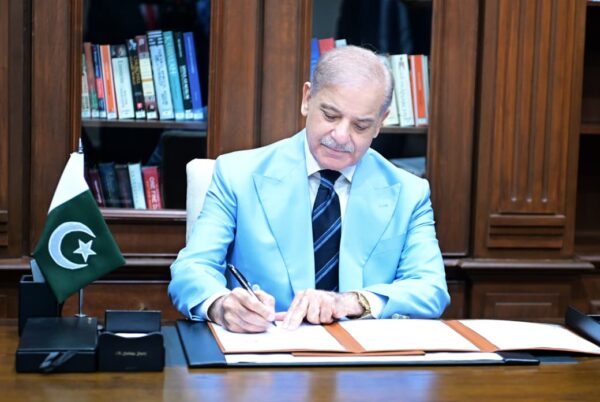
On June 17, the United States and Iran signed electronically a Memorandum of Understanding (MoU) aimed at permanently ending the war between the two countries and on other fronts, including Lebanon and, by extension, Israel. The document was signed by U.S. President Donald Trump and Iranian President Masoud Pezeshkian, as well as Pakistan’s Prime Minister, Shehbaz Sharif.
Sharif called the agreement the “Islamabad Memorandum of Understanding,” which he said he “endorsed” as the “mediator.”
However, hours after the digital signing of this accord, trouble erupted as talks that were scheduled to take place in Switzerland between the U..S and Iran on Friday to implement the peace deal were abruptly cancelled. While such disruptions are inevitable and are, in fact, to be expected in a complex peace process, they serve as a stark reminder that true stability is a long way off and immense challenges lie ahead.
The cancellation of the talks came after Israel accused Hezbollah of killing four Israeli soldiers. A wave of Israeli airstrikes on southern Lebanon followed, killing at least 18 people.
The technical talks were scheduled to begin in the Swiss village of Obbürgen just two days after the MoU was signed. The document is meant to open a crucial 60-day window to negotiate a permanent agreement over Iran’s nuclear program and restore oil traffic through the Strait of Hormuz.
The fragility of the process was made clear by the White House, which stated that it looked forward to “beginning technical talks as soon as possible” while simultaneously announcing that Vice President J.D. Vance, who is leading negotiations on behalf of the Trump administration, would no longer be traveling to Switzerland.
“The logistics of these negotiations have never been simple or predictable. As of now, the vice president is not departing tonight,” a White House spokesperson remarked late on Thursday.
Nevertheless, the signing of the MoU marks the culmination of remarkable efforts by Pakistan and other countries, including Qatar, Saudi Arabia, and Turkiye, to seal a deal between Iran and the U.S. after more than three months of war. Pakistan’s important role in keeping the dialogue between Iran and the U.S open has been widely recognized. Pakistan’s policymakers have every reason to congratulate themselves for this unprecedented achievement.
While implementation talks are clearly only at an early and highly volatile stage, Pakistan will hope that these hurdles can eventually be overcome. If the peace process can be sustained, the fundamental question for Islamabad remains: what does a successful long-term deal mean for Pakistan’s future, its development, and its ties with Iran and the U.S.?
As the war in West Asia winds down, Iran appears strategically well-positioned.
The MoU bolsters Iran’s position in several key ways. The U.S. and regional partners have committed to set up a $300 billion reconstruction fund for Iran. Ballistic missiles have been removed from central discussions. It allows Iran to downblend enriched uranium on sites within Iran under IAEA supervision. It permits Iran to sell oil freely, lifts all sorts of sanctions, and ends the war on all fronts, including Lebanon.
The U.S. and Israel carried out a range of highly lethal attacks against Iran but the latter not only absorbed these attacks but also survived. The government in Tehran has managed to keep cities and towns functioning. Despite the elimination of top leaders and officials in key institutions, Iran’s governance structure remains intact. Iran also retained control over the Strait of Hormuz, and forced the U.S. to opt for a settlement on terms that were unacceptable to Washington just a few weeks ago.
At the start of the U.S.-Israel war on Iran, Trump stated that any deal with Iran must result in the country’s “unconditional surrender,” setting maximalist war objectives for the United States. “After that, and the selection of a GREAT & ACCEPTABLE Leader(s), we, and many of our wonderful and very brave allies and partners, will work tirelessly to bring Iran back from the brink of destruction, making it economically bigger, better, and stronger than ever before,” the U.S. president wrote on his Truth Social platform.
Iran’s absorption of the U.S. and Israel’s bombing and its emergence with its state structure intact and in control is no small victory, especially since its economy has been reeling from years of U.S. sanctions.
Analysts have pointed out that the U.S. “went to war triumphant and will likely leave greatly weakened.” “President Trump lost,” Jonathan Lemire wrote in The Atlantic.
“The United States is left weaker—diminished militarily, strategically, economically, and perhaps morally,” Lemire argued, pointing out that the war accomplished “none of the goals that Trump named at the outset.” Instead, “it only empowered the hard-liners in Tehran and arguably emboldened them to someday seek a nuclear weapon.”
While these developments will have a huge impact on all countries in West Asia, their effect on Pakistan, which played the role of a key mediator, will be significant.
Even with the peace process still in its early stages and challenges likely in the months ahead, there is widespread expectation in Pakistan of an inflow of investments, trade and dollars. Pakistanis are hoping that the long-delayed Iran-Pakistan gas pipeline will finally be completed, providing much-needed energy relief.
Moreover, people also hope that Iran, now a trusted ally with an economy opening to the world, will boost Pakistan’s own economic prospects. There are hopes that Pakistan may now secure discounted oil from Gulf countries after its enormous contribution to regional stability, alongside new investments flowing in as Islamabad seeks to capitalize on its enhanced global stature.
Moreover, Pakistanis are expecting that Islamabad’s role in helping the U.S. secure a face-saving exit from the war will lead to better bilateral relations.
But the U.S. and Pakistan have a long history of robust military cooperation, followed by periods of neglect of Pakistan. For instance, the U.S. channeled arms and other logistical support to the Afghan mujahideen during the 1980s. But once the Soviets had exited, the U.S. saw little use for Pakistan and even put it under sanctions.
People are hoping that this history of U.S. neglect of Pakistan after securing its assistance will not be repeated.
The least Pakistanis expect from the U.S. after helping it get an off-ramp from the war is that it will now allow Pakistani companies to engage with Iran’s oil and gas sector, which can pass benefits directly to the public. However, this optimism is often tempered by past experiences of transactional alliances that have left Islamabad bearing the costs long after Washington moved on.
This raises questions about whether this time the rewards will match the risks taken by the country in this mediatory role between the U.S. and Iran.
After the war, Pakistan has undoubtedly emerged as a major player in West Asia. One can argue that the country has seemingly gained from a Middle Eastern identity or role alongside its traditional South Asian one. While immediate security concerns vis-a-vis India and Afghanistan anchor Pakistan to its South Asian identity, its expanded footprint in West Asia has generated immense geopolitical dividends and enhanced its global standing and diplomatic clout.
This could not have happened through its South Asian identity alone, where it is often tied to crises with India or Afghanistan and rarely garners the same global attention it attained through mediating this West Asia crisis. By positioning itself as a mediator, Pakistan has elevated its profile in ways that transcend its immediate neighborhood, which could offer it new avenues for influence in energy politics, Gulf security, and broader Muslim world dynamics.
The challenge for Pakistan, however, is to put its house in order. Pakistan faces several internal adjustments regarding the state of governance and the economy that may need to be addressed before it can fully capitalize on its growing global profile.
Political commentator Khurram Hussain has noted in an article in Dawn that after the war “whether Tehran chooses to remember us [Pakistan] kindly, and whether Washington decides to reward us handsomely, are matters beyond our control.”
“These are other people’s decisions, taken in other people’s capitals, for reasons of their own,” he said. “What lies within our control is the only thing that has ever mattered, and it is the one thing we keep postponing,” he pointed out, stressing the need for reforms at home.
Indeed, reforms are urgently needed in key sectors such as taxation, energy policy, anti-corruption measures, transparency and institutional strengthening for Pakistan to translate its newly-elevated geopolitical profile into tangible public gains and sustainable development.
In Pakistan’s history, the country’s fortunes have often oscillated between what F.S. Aijazuddin phrased in an article for Dawn: “spectacular successes and forgettable failures.” This essentially means that each time Pakistan achieved something remarkable geopolitically, it has been let down by domestic complications.
While the diplomatic track is only beginning and remains vulnerable to breakdown, Pakistanis are holding onto the hope that this time will be different, and that the true benefits of its historic role as a mediator will eventually reach the people.
