

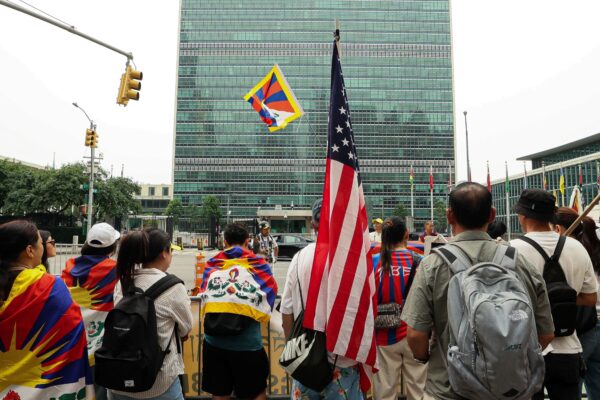
Lobga Rangzen chose perhaps the world’s most recognizable symbol of international diplomacy as the place of his death. Dressed in traditional Tibetan clothing, he planted a Tibetan flag on the sidewalk across from the entrance to the the United Nations headquarters in New York on July 2. There, he set himself on fire, livestreaming his self-immolation on Facebook. His final act was intended to draw attention to Tibet’s decades-long struggle under Chinese rule.
Rangzen, 52, was born in Tibet and fled to India in the 1990s, where he lived as a monk before immigrating to the United States in 2006. Over the next two decades, he became an active member of New York’s Tibetan community. His self-immolation was the first known by a Tibetan on U.S. soil.
The protest came one day after China implemented its Law on Promoting Ethnic Unity and Progress. Amnesty International argued that the legislation further institutionalizes assimilation policies targeting Tibetans, Uyghurs, Mongolians, and other ethnic minorities while expanding the legal basis for transnational repression.
Although Rangzen’s self-immolation was intended to draw international attention to Tibet, the response from the very institution he chose to stand before was limited.
A Muted International Response
Rangzen’s choice of site was carefully considered. For more than seven decades, Tibetans have looked to the United Nations in hopes that the international body would address China’s rule over Tibet. The Tibetan government first appealed to the U.N. in 1950 after Chinese forces entered Tibet. Although the issue reached the General Assembly, the organization took no immediate action. After the People’s Republic of China assumed China’s U.N. seat in 1971, Tibet gradually disappeared from the organization’s political agenda.
For Tenzin Dorjee, a researcher at the Tibet Action Institute and lecturer in political science at Columbia University, Rangzen’s decision was a direct appeal to the international community rather than to Beijing. “Instead of choosing the Chinese consulate, he purposely chose the United Nations as his site of protest,” Dorjee said. “The U.N. is the institution that is supposed to represent the international community’s promotion of peace, defense of human rights, and protection of cultural rights. I think he went to the U.N. because it was an appeal to the international community.”
At a U.N. press briefing the day after the self-immolation, spokesperson Stéphane Dujarric described the incident as “absolutely tragic” and expressed condolences, but did not mention Tibet or the political message behind Rangzen’s protest. Beyond that brief acknowledgment, neither the United Nations nor most governments issued substantive public responses to an act intended to draw renewed attention to Tibet.
For many Tibetans, that silence reinforced a long-held frustration. “The fact that the U.N. spokesperson refused to mention Tibet reaffirms the suspicion of the Tibetan community that the U.N. has been silent on the Tibet issue,” said Dorjee.
Amnesty International was among the few international human rights organizations to publicly respond. “Our thoughts are with everyone who knew and loved the man who has died and the broader Tibetan community,” said Sarah Brooks, Amnesty International’s deputy regional director for Asia.
“Self-immolation as a protest by Tibetans has persisted for many years, and it does not happen in a vacuum,” she added. “It reflects the depth of desperation felt by people who see no other way to draw attention to ongoing human rights violations.”
New York Mayor Zohran Mamdani also acknowledged Rangzen’s protest, saying he was “heartbroken” by the death. “No one should feel that such a desperate act is the only way to make the world listen,” Mamdani wrote on X. “New York stands for the dignity and human rights of all people.”
Why Tibet Has Faded From the International Agenda
Although Rangzen’s self-immolation drew international headlines in the days immediately following his self-immolation on July 2, attention quickly faded. Yet demonstrations continued. In New York, Tibetans gathered regularly outside the United Nations and the Chinese Consulate, while solidarity protests and prayer vigils were organized by Tibetan communities in India, Europe, and cities across the United States.
For many activists, the brief burst of media attention underscored a larger challenge: how to keep Tibet on the international agenda once the headlines move on.
Three Tibetan youth activists affiliated with Students for a Free Tibet chained themselves to the vehicular entrances of U.N. headquarters, demanding that the organization publicly address Rangzen’s protest and ongoing human rights concerns in Tibet. The activists blocked U.N. vehicles before being arrested on charges of disorderly conduct and refusal to disperse. Hundreds of members of New York’s Tibetan community gathered outside the U.N. in support.
Among those arrested was Tsela Zoksang, campaigns director at Students for a Free Tibet.
“His final act took place outside of the United Nations, a building that generations of Tibetans have stood outside of for 67 years in exile, calling on it to uphold its mandate of protecting peace, freedom, and human rights,” Zoksang said. “In the case of Tibet, it has failed miserably.”
For Dorjee, the issue is not simply whether the United Nations responds, but what those responses represent.
“The statements that have come from the U.N. are inadequate, for sure, but they are not ineffective,” he said.
The General Assembly adopted resolutions on Tibet and U.N. human rights experts raised concerns in 2023 over the separation of an estimated one million Tibetan children into state-run boarding schools. Those interventions have produced few immediate policy changes, yet Dorjee argued that even limited statements from international institutions remain significant.
“It may not lead to direct changes on the ground immediately, but what it does is it denies legitimacy to the Chinese government,” he said. “It denies legitimacy to Chinese rule over Tibet.”
For many Tibetan advocates and scholars, the United Nations’ muted response to Rangzen’s protest reflects a broader shift in which Tibet has steadily receded from the organization’s political agenda while China’s influence within international institutions has grown. Those concerns extend beyond Tibetan advocacy groups. A March 2026 report by the U.S. House Select Committee on the Chinese Communist Party argued that Beijing has expanded its influence across the U.N. system through growing financial contributions, leadership positions in U.N. agencies, participation in peacekeeping operations, and networks of state-linked organizations active in U.N. forums. The report argued that these efforts have enabled China to shape discussions on issues it considers politically sensitive, including human rights.
China has rejected allegations that it improperly influences the United Nations, while many scholars note that the organization’s decisions ultimately reflect negotiations among its member states rather than the actions of any single country. Nevertheless, the House committee’s findings added to a broader debate over how major powers shape international institutions.
Dorjee said China’s growing diplomatic and economic influence has made many governments increasingly reluctant to criticize Beijing’s policies in Tibet – and elsewhere.
He pointed to Beijing’s diplomatic efforts in Africa, Latin America, and the Pacific Islands, where 10 countries have shifted diplomatic recognition away from Taiwan over the past decade. Dorjee argued that similar economic and political leverage has discouraged governments from speaking more forcefully on Tibet.
“China uses the influence or the attraction of trade to get countries to turn their back on Taiwan,” he said. “This is precisely the same tactic they try to use on Tibet as well.”
However, Dorjee believes China’s influence is only part of the explanation for Tibet’s diminishing international visibility.
“People are basically giving their lives in order to make their voices heard,” he said. “Tibetans have felt for a very long time that their suffering is being ignored by the world. The repression inside Tibet has intensified while international attention has declined.”
Access to Tibet has become another major obstacle. Foreign journalists, diplomats, and independent researchers face tight restrictions on entering the region, while Tibetans risk punishment for sharing photos, videos, or information with people outside China.
According to the Central Tibetan Administration, Tibet’s government-in-exile, Chinese authorities have expanded digital surveillance, facial-recognition technology, and online monitoring to tighten control over the flow of information. Freedom House has likewise described Tibet as one of the world’s least accessible places for independent journalism, making it increasingly difficult for reporters to verify events or document alleged abuses.
Maya Wang, deputy Asia director at Human Rights Watch, explained that China’s restrictions on information have made it increasingly difficult for rights organizations and journalists to document and draw attention to abuses in Tibet. She added that other global crises often receive greater attention because they are accompanied by compelling audio and visual documentation.
Dorjee also argued that the Tibetan movement’s overwhelmingly nonviolent character has made it harder to sustain global attention.
“The world pays more attention to violence,” he said. “The Tibet movement has been overwhelmingly nonviolent.”
Lobga Rangzen’s protest did involve violence, however; it was simply directed at himself. That too has complicated the response from international organizations. When asked why Human Rights Watch had not publicly commented on Rangzen’s protest, Wang said that organizations face ethical questions about covering self-immolations.
“Self-immolations and suicides are hard for any media and rights organization to write about, for we try to do no harm,” she said. “…[O]ne confronts the dilemma of whether writing about it may encourage more such incidents.”
Whether Rangzen’s self-immolation succeeds in renewing sustained international attention on Tibet remains uncertain. Yet his final act of protest was not simply directed at the Chinese government. By choosing the United Nations rather than the Chinese Consulate, he appealed to an institution that Tibetans have petitioned for more than seven decades in pursuit of international recognition and accountability.
Standing beneath the flags of the world’s nations, Rangzen planted one that does not fly outside U.N. headquarters before setting himself on fire. His protest lasted only moments, but it posed a question the international community has yet to answer: what responsibility does it bear when repeated appeals for action continue to go unheard?
