

Recently, the Pakistan Air Force (PAF) Chief of Air Staff (CAS), Air Chief Marshal (ACM) Zaheer Ahmed Babar, visited Türkiye. Of note, ACM Babar met with Selçuk Bayraktar, the Chief Technology Officer (CTO) of Baykar Technologies. The PAF Directorate General of Public Relations (DGPR) stated that the meeting “focused on [the] advancements in aerospace innovation, unmanned aerial systems, and emerging technologies, reflecting the shared vision of both sides to pursue greater collaboration in next-generation defence technologies.”
Aside from the visit to Baykar, the CAS’ trip to Türkiye was standard fare in that there were meetings with his counterparts in the Turkish Air Force and the Turkish Ministry of National Defence.
However, it is worth noting that, among all Turkish defence original equipment manufacturers (OEM), the PAF CAS met only with Baykar.
Baykar has an active and evidently growing relationship with the PAF. The service was an early customer of the Bayraktar Akıncı high-altitude long-endurance (HALE) unmanned aerial vehicle (UAV) and also procured a number of Bayraktar TB2 medium-altitude long-endurance (MALE) UAVs. Currently, it does not appear that many of either type were procured, but on the back of the PAF’s purchases, Baykar both set up a site at the National Aerospace Science and Technology Park (NASTP) to co-develop the KaGeM V3 and YiHA loitering munitions. It later spun that out into a local subsidiary, Baykar Technologies Pakistan.
That same subsidiary is reportedly in talks with the PAF to establish an assembly or co-production plant for its drones.
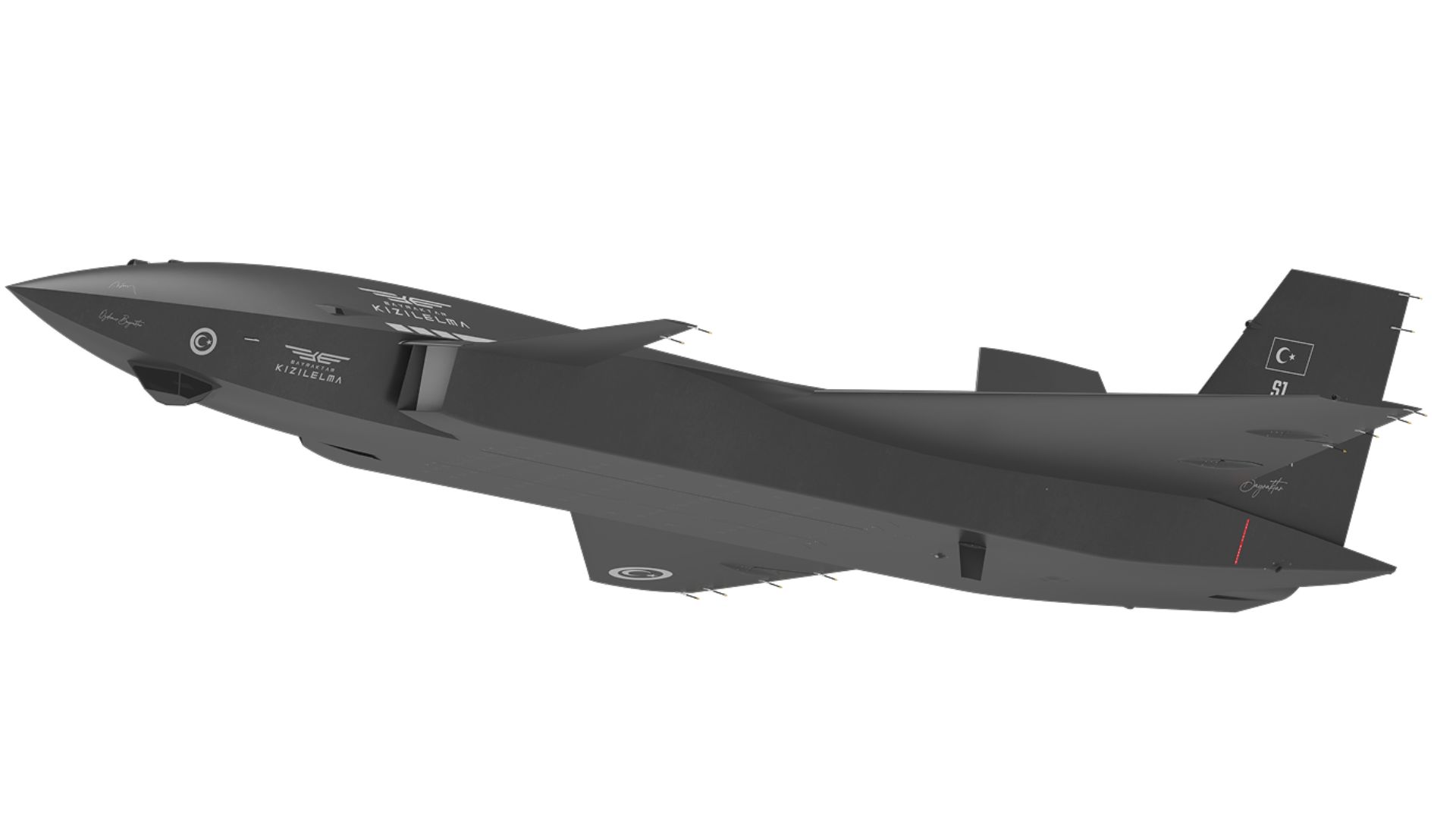
Thus, one can imagine that, at the very least, Air Headquarters (AHQ) is in discussions with Baykar about additional drones. These could range from new loitering munitions to additional Akıncı or TB-series UAVs, or potentially the Bayraktar Kızılelma unmanned combat aerial vehicle (UCAV).
Broadly, several indicators suggest that the Kızılelma is on the table. First, the UCAV itself is available for export, with Baykar recently signing a memorandum of understanding (MoU) with Indonesia. Second, Baykar has been marketing the UCAV to the PAF for several years, with the most recent apparent effort occurring during the CAS’ visit. Third, the PAF has an actual UCAV requirement, one that it intends to pair with its forthcoming next-generation fighter aircraft (NGFA).
The clearest indicator of an apparent UCAV requirement has come through a semi-official source, Second to None. Second to None is a magazine that has access to the PAF and, in one of its features, mentioned that AHQ sought a stealthy UCAV – among other systems that the PAF later confirmed or revealed through other media, such as its annual calendar.
However, when one closely examines how Baykar operates, the availability of an actual platform, and the PAF’s operational needs, the notion that the PAF could potentially fast-track – or at least initiate – a UCAV project with Baykar is, at the minimum, plausible.
Platform Availability
Baykar has entered the later stages of the Kızılelma’s development.
In November 2025, the UCAV successfully destroyed a jet-powered target drone using the indigenous Gökdoğan beyond-visual-range air-to-air missile (BVRAAM), developed by TÜBİTAK-SAGE. The test integrated Aselsan’s MURAD active electronically scanned array (AESA) radar for detection and tracking and TÜBİTAK-SAGE’s Gökdoğan missile for kinetic intercept, thereby validating the UCAV’s complete kill chain. Turkish officials identified the event as the first recorded instance of a jet-powered UCAV successfully engaging a jet-powered aerial target with a BVR missile.
The capability stack now extends beyond Baykar alone.
The Kızılelma’s sensor suite centres on Aselsan’s MURAD AESA radar. Its communications rely on Aselsan’s Indigenous Flight Data Link (IVDL) – a next-generation tactical data link (TDL) designed for manned-unmanned teaming (MUM-T) and collaborative combat aircraft (CCA) operations, incorporating phased-array directional beams for low-probability-of-intercept/detection (LPI/LPD) communication and electronic warfare (EW) resistance. Its munitions include Roketsan’s Gökdoğan and Bozdoğan air-to-air missiles, as well as stand-off strike weapons such as the SOM cruise missile.
In relation to this point, Baykar’s partnerships with major OEMs – not least Leonardo – open a secondary development line. Leonardo was testing MUM-T between its M-346FA light fighter and the Kızılelma.
For the PAF, this suggests that existing platforms, including lightweight twin-seat aircraft such as the JF-17B, could also assume the MUM-T controller role. In other words, the PAF need not delay MUM-T to an NGFA-led package; it could acquire it sooner with platforms it already operates.
Operational Necessity
The PAF’s need for a UCAV is not theoretical. Both Operation Swift Retort (2019) and Operation Bunyan-un-Marsoos (2025) established that offensive air capability is essential to Pakistan’s conventional deterrence posture.
However, as multiple Quwa analyses have shown, the PAF’s ability to deliver ordnance mass is constrained by its lack of access to medium- to heavy-weight aircraft such as the Flanker series.
While there could be a pathway for this capability via NGFAs – notably the KAAN, which is of a similar size to the Flanker and Eagle – one could argue that the PAF would benefit from acquiring strike mass sooner.
The availability of NGFAs, once teething issues are resolved and the platforms are fully integrated for strike, could be far off. Neither the J-35AE nor KAAN have begun air-to-surface weapons integration trials, while the Kızılelma is undergoing such tests today. It stands to reason that a strike-ready UCAV will be available to the PAF ahead of a crewed NGFA.
In the interim, the PAF’s sole options are to keep inducting JF-17s or to use the J-10CE, which, while capable of air-to-surface loads, is best employed for the air-to-air role for which Chengdu optimized it. The JF-17 can serve as a stand-off weapon (SOW) carrier up to a point, but a UCAV could build on that capability with a platform that can cross the border, engage in higher-risk strike operations, and absorb losses that would be intolerable for crewed fighters.
Operationally, the PAF could use UCAVs to conduct aggressive penetrator missions – perhaps targeting key air defence nodes such as radars and surface-to-air missile (SAM) batteries. JF-17s would follow up with SOW strikes via air-launched cruise missiles (ALCM) and glide bombs at stand-off range, while J-10CEs provide top cover via long-range AAMs like the PL-15.
This layered approach – expendable UCAVs forward, crewed fighters at stand-off – mirrors the force employment concepts emerging from the United States Air Force’s (USAF) CCA initiative.
The Co-Development Opportunity
Perhaps the most consequential reason for front-loading UCAV development is the opportunity it creates to co-develop the next-generation architecture that will drive MUM-T, autonomous operations, and future mission workflows.
Network-enabled warfare will likely evolve beyond the current state of sharing sensor feeds. The Americans and Chinese have demonstrated the capacity to support distributed sensor-and-shooter handoffs, in which an airborne early warning and control (AEW&C) aircraft can guide an AAM or SAM.
However, the next iteration could see sensors and shooters communicating directly with each other with minimal human intervention. In this scenario, the UCAV directly interoperates with an AEW&C to manage not just munition guidance, but potentially target identification, selection, and electronic attack.
Network-enabled warfare is becoming an entire system in its own right – one that will evolve as a platform. In this context, it aligns with the PAF’s interests to ensure it has sovereign, uncompromised control over its own next-generation TDL architecture. The PAF has already demonstrated this imperative through its development of Link-17 and Skyguard.
To achieve sovereign control, the optimal path is to develop the platform indigenously or with partners who share compatible incentive structures. Baykar will need a comparable next-generation connectivity platform for its own commercial purposes – both domestically within Türkiye and in third-party markets – as will Baykar’s main European partner, Leonardo. Others could enter the mix via their own dealings with Baykar, such as Indonesia and Saudi Arabia.
One can argue that there is a shared need among these players to build a platform they can all use freely. Multiple investing parties, each with their own requirements, would share development costs and reduce single-customer dependence – creating a consortium dynamic not dissimilar to that driving the European FCAS and GCAP fighter programmes, albeit at a lower cost tier.
In practical terms, this means there is potential work for the PAF to involve NASTP that does not require hardware or aircraft expertise. Baykar would handle airframe and flight systems through its local subsidiary. Instead, NASTP can draw on its existing capabilities in sensor integration, electronic support measures (ESM), EW, and communications protocols to support the PAF’s next-generation network-enabled warfare stack.
It should be noted that the IVDL and T-LINK platforms currently under development in Türkiye are designed as wide-bandwidth, low-latency systems capable of high-volume sensor fusion from AESA radar, electro-optical targeting systems (EOTS), and infrared search-and-track (IRST) sensors. NASTP’s potential contribution would lie in adapting such an architecture for the PAF’s specific operational requirements and fleet mix.
The platform’s evolution would also feed back into the UCAV. As the network architecture matures, the UCAVs themselves become more capable. The Kızılelma, in its early operational years, might, for example, fly towards a predetermined target, launch ordnance, and return. In the long term, the network platform could enable Kızılelma to adjust its target selection after directly interfacing with AEW&C, electronic intelligence (ELINT), and other sensors.
For this to work, it is imperative that the PAF – as it has with Link-17 and Skyguard – maintains sovereign-level control of its own next-generation TDLs, artificial intelligence (AI) layers, and other inputs.
The Case for UCAVs Over Crewed Aircraft
Overall, it would be more efficient for the PAF to concentrate its domestic aircraft design, development, and production resources on drones. The developmental work will be simpler because, in general, UCAVs are smaller, do not require life-support systems, can be designed as expendable assets, and may even be intended as short-lived, which is the direction the USAF is heading with its MQ-Next concept.
In other words, the PAF can work towards lower-cost UCAVs via both simpler, attritable designs on one end and economies of scale through continuous production on the other. This would not be feasible with a stealth fighter, which would necessitate a heavy research and development overhead yet yield only a modest production run.
As Quwa has previously argued, in the late 2000s the National Engineering and Scientific Commission (NESCOM) had stronger internal capacity than early-stage Baykar. Today, Baykar is among the world’s leading players in the drone industry, with a UCAV under development as a potential replacement for crewed lightweight fighters. NESCOM could have been in that position had Pakistan prioritized UCAVs over crewed aviation a decade earlier.
The opportunity has not closed entirely. NESCOM’s cruise missile and drone expertise provides a foundation to develop a smaller, attritable loyal-wingman UCAV in the 2,000–2,500 kg class. Global CCA concepts typically pair a large UCAV like the Kızılelma with a smaller one serving supplementary strike or anti-air roles. Türkiye itself currently lacks a 2–3-ton UCAV to complement its larger designs, creating an opportunity for a jointly developed platform that Pakistan could produce in volume and export.
In this framing, the Kızılelma is not the destination. It is the platform that creates the conditions – the joint ventures, the NASTP subsystem development, the next-generation TDL work – from which a sovereign Pakistani UCAV programme can emerge. Given the evolving nature of warfare, one cannot have ‘too many drones.’
The post Why the PAF Should Front-Load UCAV Development – And Why the Kızılelma Is the Starting Point first appeared on Quwa.
