

Myanmar’s National Unity Government (NUG) has spent years arguing that the country’s junta is a pariah – one that is too unstable to survive and too brutal and illegitimate to engage. Morally, that case remains persuasive. Politically, however, it is colliding with the reality that international patience is finite, and regional diplomacy rewards stability and national interests above all.
Given its foundation of “non-interference,” it is no surprise that the Association of Southeast Asian Nations (ASEAN) is drifting toward re-engagement with the generals. The real question is why the NUG appears insufficiently prepared for this shift when the signs have been visible for years.
This is not an argument that the NUG is not a legitimate representative of the Myanmar people. The junta has carried out airstrikes on villages, systematic torture, arbitrary executions, and mass displacement. The NUG, which derives from the government elected in the 2020 election, has not. That moral asymmetry should not be overlooked in the name of false balance.
But legitimacy alone does not guarantee victory.
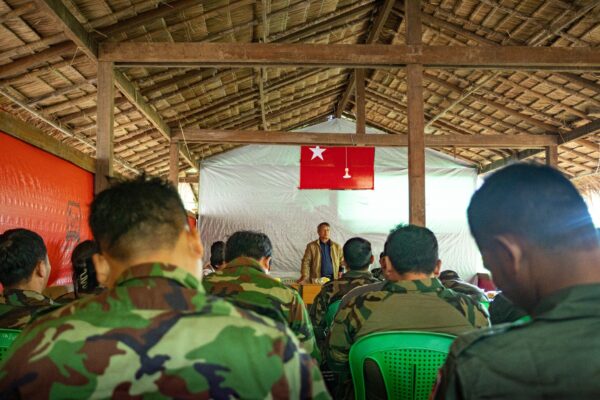
On May 5, the fifth anniversary of the founding of the People’s Defense Force (PDF), the tone from NUG leaders was notably sober. Acting President Duwa Lashi La described the revolution as “two steps forward, one step back,” while Defense Minister Yee Mon called for “unflattering criticism” of the NUG’s weaknesses and disciplinary failures.
“We have not yet reached the destination desired by the entire population,” Duwa Lashi La admitted. The candor was refreshing, but it also suggested that the movement is aware that time is no longer on its side.
Earlier revolutionary rhetoric implied the junta would collapse sooner or later due to a combination of battlefield pressure and international isolation. Instead, the conflict has entered a more dangerous phase for the resistance.
The reality is that the generals do not need to win decisively. They simply need to survive long enough for neighboring states and external powers to adapt to the situation inside the country.
That process may already be underway.
At the 48th ASEAN Summit in Cebu earlier this month, regional rhetoric appeared to shift somewhat. Philippine President Ferdinand Marcos Jr. called for Aung San Suu Kyi’s release while also lamenting Myanmar’s exclusion from the “ASEAN family” as a “tragedy.” Even governments uncomfortable with the junta increasingly appear more interested in reintegrating Myanmar into regional mechanisms than maintaining an indefinite diplomatic quarantine.
The NUG itself appeared increasingly aware of this shift in its May 11 response to the ASEAN Summit, warning that “any electoral process conducted amid ongoing conflict… lacks democratic legitimacy and popular mandate” and that any engagement should “explicitly include” the NUG and ethnic revolutionary organizations (EROs) “as legitimate stakeholders in any political process.”
ASEAN’s Five-Point Consensus (5PC) for addressing the Myanmar conflict has become largely performative, and the junta has ignored it repeatedly with few consequences.
This outcome should not have been unforeseeable. The junta’s strategy was always to outlast the international outrage at its coup. The NUG, by contrast, has often behaved as though international isolation of the generals would naturally intensify over time instead of gradually eroding due to sheer geopolitical fatigue.
The Strategy Gap
The clearest weakness in the NUG’s approach has not been military resistance, but its failure to adapt to the political changes in the country. Foreign Minister Zin Mar Aung has shown more realism than the ministry’s official messaging often suggests, as seen in her recent interviews. In 2022, she correctly diagnosed the core problem, that “countries don’t deal with governments, they deal with states.” Yet despite recognizing this reality, the NUG continued operating as though moral outrage alone would eventually force foreign nations to recognize it as Myanmar’s legitimate government.
Her later admission this month further exposed the limits of this diplomatic approach. “To be honest, we have asked for a ‘call’ with [Thailand] several times but there was no response,” she revealed in an interview in Burmese with the journalist Htet Aung Kyaw. “And, I would apply for visa to attend some events organized in Thailand, but they did not grant me one.”
The NUG’s strategy underestimates how major powers actually behave.
China never showed serious signs it would cease engagement with the junta, regardless of how carefully the NUG promised to respect China’s interests in the country. Some ASEAN members were never willing to sustain open-ended diplomatic isolation of Naypyidaw. Even Western governments largely based their policy around containment and humanitarian management rather than outright regime change.
The NUG can’t be blamed for failing to secure full diplomatic recognition; that was probably never realistic. The problem is that the NUG spent too long treating diplomatic recognition and moral outrage as primary benchmarks of success instead of focusing more on building up its governance capacity inside Myanmar itself.
Revolutionary legitimacy cannot remain permanently anchored to the outcome of the 2020 election. Six years into a devastating civil war, political authority increasingly depends on whether an alternative state can function in practice. The NUG needs visible proof that areas under resistance influence can deliver something more coherent than perpetual armed struggle.
The most realistic path forward is to make normalization with the junta strategically inconvenient by demonstrating that resistance governance is more effective.
That requires prioritizing three issues. The first of these is governance coordination.
Liberated and contested areas remain politically fragmented between EROs, local administrations, PDFs, and NUG-aligned structures. Some areas function impressively under wartime conditions; others suffer from overlapping authorities, inconsistent tax regimes, weak dispute resolution, or disciplinary abuses.
Analyst David Mathieson summarized one persistent criticism bluntly in an interview with BBC Burmese: “It seems like NUG has inherited this stance of arrogance the NLD administration had towards the ethnic minorities. NUG is the central government. Only NUG has the legitimacy and be the one to lead the revolution… but in reality, it does not possess those qualities.”
The formation of the Steering Council for the Emergence of a Federal Democratic Union (SCEF) in March was therefore one of the NUG’s more important recent moves. It was an overdue recognition that military cooperation alone is insufficient. The resistance also requires a political coordination mechanism capable of evolving into a transitional governing framework. However, the SCEF is still in its infancy.
The second priority for the NUG should be to address the shortcomings in its own ranks.
Yee Mon’s acknowledgment that misconduct by some resistance forces had damaged public confidence in the NUG was important. In the context of a protracted civil war, populations judge armed actors less by their slogans than by their daily behavior.
If the resistance wants to present itself as the foundation of a future democratic union, discipline cannot remain aspirational. Civilian complaint mechanisms, clearer chains of command, and visible punishment for abuses should be part of the contest for legitimacy.
Third, the NUG must articulate a clearer post-war political roadmap.
One of the least discussed risks within revolutionary movements is that military successes will simply create new problems if the political end goal remains vague. Duwa Lashi La’s comments that PDF fighters will continue serving as “statespersons” in the future federal union may reassure revolutionary forces, but they also raise unresolved questions about civil-military relations after the war in over.
How will PDFs integrate with EROs? What prevents wartime command structures from turning into permanent political structures?
The NUG does not need a perfect constitutional blueprint immediately. It does, however, need to show that the revolution is building toward an accountable federal order rather than simply a loose and indefinite anti-junta coalition.
Each of these three areas, if advanced, would make normalization with the junta more costly for external powers.
The Danger of Normalization
Time is currently very much on the Myanmar military’s side.
With its staged elections now completed, and coup leader Min Aung Hlaing installed as “president,” the military is actively trying to re-legitimize itself.
The generals have also returned to high-profile lobbying, reportedly hiring Trump ally Roger Stone to improve ties with Washington. While the junta attempted something similar in 2021 by hiring controversial Israeli-Canadian lobbyist Ari Ben-Menashe, that effort collapsed when sanctions prevented him from being paid. The reappearance of such efforts after five years of accumulated international fatigue signals that the window for keeping the junta isolated is narrowing – as ASEAN’s steps toward engagement suggest.
Unlike during Malaysia’s tenure as ASEAN chair, there has not been an explicit admission from the Philippines of meetings with the NUG and other revolutionary forces. Philippine Foreign Affairs Secretary Theresa Lazaro, who currently also serves as ASEAN’s special envoy to Myanmar, admitted this January that there was a meeting with Myanmar stakeholders, excluding the military, but declined to identify attendees at their request.
The joint statement that was issued during the recent ASEAN Summit still referenced the 5PC and a lasting solution that is “Myanmar-owned and led.” Despite previous diplomatic snubs for the junta, ASEAN seems to be opening doors for engagements with high-level officials this year. The ASEAN secretary general said in an interview during the summit that a “virtual meeting” is planned with the military’s foreign minister.
Separately, on May 19, Malaysia’s Foreign Minister Mohamad Hasan visited Naypyidaw, met with his junta counterpart, and reported that the military government, previously unreceptive to discussing the opposition, has now shown willingness to engage with all factions. Malaysia subsequently urged an extension of the existing junta’s ceasefire for at least six months beyond its July 30 expiry.
These developments show that time is ticking for the resistance, and that the next phase of the conflict will likely be decided less by rhetoric and more by administrative credibility.
If the NUG can demonstrate functioning governance networks, stronger coordination with ethnic resistance forces, credible civilian oversight, and viable local institutions in areas outside junta control, it could alter the diplomatic equation. External actors may still engage the junta pragmatically, but they will also be forced to recognize that an alternative political order exists on the ground.
If it cannot, the resistance faces gradual marginalization.
The generals are protected by the 2008 Constitution, a system designed to preserve military supremacy indefinitely. The NUG, meanwhile, recontinues to anchor its legitimacy in the outcome of the 2020 election, a mandate that, while still morally powerful, cannot indefinitely substitute for evolving political structures during a prolonged war.
Both sides are, in different ways, governing via the rearview mirror.
The challenge facing the NUG now is how to go beyond simply resisting the military dictatorship and to prove that an incipient future federal democratic state already exists.
In Myanmar’s conflict, time no longer automatically favors the side with the stronger moral claims.
