

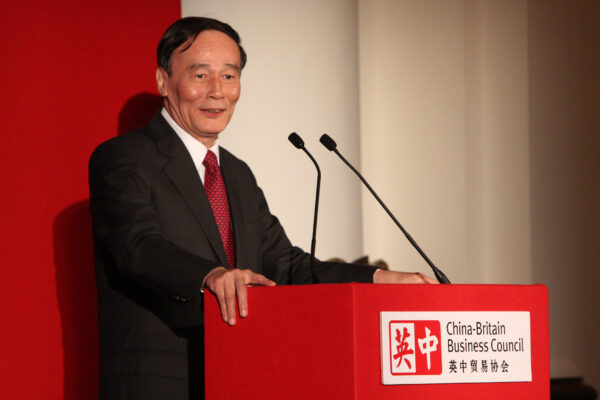
Xi Jinping’s astounding purge of the senior leadership of the military is well documented, but another purge within the Chinese Communist Party has drawn less attention. Xi Jinping has ruthlessly gone after former Politburo Standing Committee member and one-time economic czar Wang Qishan.
Xi has not charged Wang with any crime, but the latter lives under virtual house arrest in Beijing. Wang has not been referenced in the Chinese official media since October 2023. But, perhaps just as important, Xi has systematically purged Wang’s patronage network, which he built over the course of his party career. Just last month, Li Xiaohong, a former personal secretary to Wang and once the most important disciplinary official overseeing the China Securities Regulatory Commission, was placed under disciplinary investigation.
Xi’s decision to go after one of the most dependable Chinese Communist Party leaders, who even conducted Xi’s anticorruption campaigns, is probably intended to make sure that Wang and other elders within the Communist Party do not stand in the way of Xi’s ambitions for a fourth term as China’s unassailable leader at the 21st Party Congress next year. Historically, retired party elders have played outsized roles in influencing the selection of top leaders. For example, former Vice Premier Chen Yun played a pivotal role in selecting Jiang Zemin as China’s leader after the Tiananmen crisis.
Wang Qishan was at one time one of China’s most respected and influential economic leaders. His successes were legendary. He helped facilitate one of the World Bank’s first major loans to invest in China’s rural development and contributed to the establishment of China’s first stock market during the late 1980s. Working under then-Vice Premier Zhu Rongji in the 1990s, he helped establish China International Capital Corporation while heading China Construction Bank, which partnered with Morgan Stanley to create China’s first joint-venture investment bank.
Wang guided China safely through the 1998 Asian Financial Crisis and the 2008 Global Financial Crisis. His door was always open to international visitors making him a bridge between China and the Western financial system. He was one of the last of the true economic reformers.
Perhaps as important, after leaving his economic posts to become China’s anticorruption czar, he left in place a patronage network of highly competent economic and banking officials. Many had been his subordinates for decades and continued his reformist approach to the Chinese economy.
When I was serving on the U.S. National Security Council in September 2008, I saw firsthand how, when Lehman Brothers failed, Treasury Secretary Hank Paulson and Wang helped contain the Global Financial Crisis. China agreed not to sell its large holdings in U.S. securities, giving Paulson time to find the means to contain the crisis and avoid a recession or even a depression.
However, I sensed that Wang was in political trouble with Xi Jinping as early as 2018, when Wang was then serving as Xi’s vice president. I was part of a Brookings Institution delegation that met with Wang in the Zhongnanhai leadership compound. Instead of his usual business attire, he was dressed like a simple China factory worker and appeared to find it necessary to repeatedly tell us that Xi was the decisionmaker.
Four of Wang’s former personal secretaries have been either purged or are currently under investigation. All four served in positions either at the chief of staff or director level while working for Wang, indicating their status as his most important aides. The first to be purged was Dong Hong. Dong had been at Wang’s side when, as mayor of Beijing, Wang took charge of calming the crisis when the SARS epidemic caused chaos in the city. Prosecutors have accused Dong of abusing his multiple positions in high economic jobs between 1999 and 2020. In January 2022 Dong was sentenced to death with a two-year reprieve. Since then, three other former secretaries to Wang – Tian Huiyu, Zhou Liang and Li Xiaohong – have been brought up on serious corruption charges.
Wang’s broader network within the financial sector has also been targeted. More than ten senior executives at the China Construction Bank, where Wang once served as president, have been targeted for investigations that continue to this day. In addition, several senior executives at China International Capital Corporation, the investment company Wang helped found, have also been targeted in corruption probes.
Beijing makes the case that these are not political purges but rather the rooting out of corrupt “tigers.” As Xi told CCP leadership on one occasion recently, “[We must] not stop for a moment or yield an inch, [we must] not give corrupt officials any hiding place, and no one should harbor any illusions or wishful thinking.” But this explanation stretches credulity as some of the charges frequently leveled against corrupt officials involve their role as “two-faced men” practicing “false loyalty.” Moreover, few closest to the Xi family have been investigated.
Some prominent scholars have noted that a totalitarian leader must prove his unrivaled power repeatedly, even to the point of purging those most loyal to him. Xi’s purges of loyalists in the military have been well documented, with the downfall of five members of the Central Military Commission and over 100 top generals.
Wang’s fate goes beyond theory. He never defied Xi and instead faithfully implemented Xi’s will, even when Xi gave him the thankless job of being the party’s top anticorruption official. Yet Xi is highly paranoid and Wang’s reputation, assumed political leverage, and extensive network within the CCP likely proved too imposing for Xi to tolerate. Similarly, former CMC Vice Chair Zhang Youxia’s network in the military might also have been seen as a threat.
As Xi looks to continue to dominate Chinese politics after next year’s 21st Party Congress we can expect more of the same wherever he sees a threat to his lifelong rule.
