

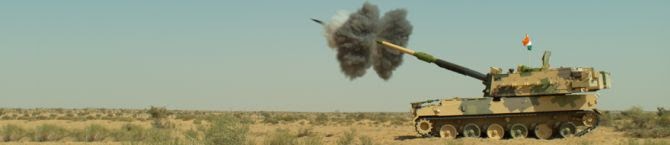
K-9 howitzers fire shells during a drill at Mahajan Field Firing Range, in Rajasthan
Analysts argue that India’s move to expand defence industry cooperation with Seoul in artillery and anti-aircraft systems will be interpreted as a strategic development with direct implications for China’s security calculus.
During his three-day visit to India, South Korean President Lee Jae Myung met Prime Minister Narendra Modi and announced that both countries had agreed to upgrade economic and defence cooperation.
The focus will be on vital sectors such as shipbuilding, defence and artificial intelligence. Lee emphasised South Korea’s support for India’s Atmanirbhar Bharat policy, pledging to actively assist in the production and operation of Indian defence equipment and to explore joint technology development. He cited the K9 Thunder howitzer as a successful example of bilateral defence cooperation.
India currently operates around 100 K9 Vajra-T 155mm self-propelled howitzers, with plans to acquire 100 more. These systems, manufactured domestically by Larsen & Toubro through technology transfer from Hanwha Aerospace, are optimised for India’s desert and high-altitude environments.
The Indian Army has deployed them in Ladakh to strengthen long-range firepower amid tensions with China and Pakistan. Self-propelled howitzers are particularly effective in mountainous terrain, capable of firing at steep angles to clear ridges and strike targets in valleys, while also serving as an all-weather alternative to air support.
Periasamy Kumaran of India’s Ministry of External Affairs confirmed that Delhi is entering a “third phase” of cooperation with South Korea, moving beyond direct acquisitions and localisation towards advanced manufacturing, technology transfer and co-design of next-generation defence systems.
Talks are also under way on developing air-defence systems, including anti-aircraft guns and missile platforms, to counter emerging aerial threats such as drones.
Analysts highlight the strategic importance of these developments. Nishant Rajeev of Singapore’s S. Rajaratnam School of International Studies noted that howitzers and anti-aircraft guns are critical to India’s defences, particularly along disputed borders. He described the K9 joint production as a model of cooperation that could be expanded, stressing India’s need for layered air-defence systems against drones, cruise missiles and fighter aircraft. Drones featured prominently in India’s recent conflict with Pakistan, underscoring the urgency of such capabilities.
Kang Jun-young of Hankuk University of Foreign Studies argued that Beijing is highly likely to view India-South Korea defence cooperation critically, seeing Seoul as playing a role in US-led containment of China. He warned that technology transfer and local production could dramatically enhance India’s defence self-sufficiency, posing a strategic challenge to China’s interests.
Jagannath Panda of the Institute for Security and Development Policy in Sweden added that India’s cooperation with South Korea reflects a broader transition from arms imports to industrial partnerships.
The success of the K9 Vajra-T demonstrated that South Korean systems can be adapted for Indian terrain and manufactured domestically, making Seoul a dependable technology partner.
India’s recent border clashes with both China and Pakistan highlight the relevance of artillery, air defence and mobile firepower. Panda stressed that these capabilities are not merely commercial but tied to India’s preparation for sustained competition with China while maintaining readiness against Pakistan.
He noted that South Korea’s defence industry is valued for speed, scale and modern engineering, qualities India needs in a deteriorating regional environment. Ian Hall of Griffith University in Australia agreed that South Korea is a strong partner for India, with the potential to significantly enhance India’s deterrence capabilities against threats from the north and west.
India’s pursuit of faster modernisation cycles, joint development and advanced manufacturing with South Korea is therefore not only about strengthening its military but also about signalling strategic intent.
For Beijing, the prospect of South Korean defence technology bolstering India’s capabilities along contested borders is bound to be viewed as a direct challenge.
SCMP
