

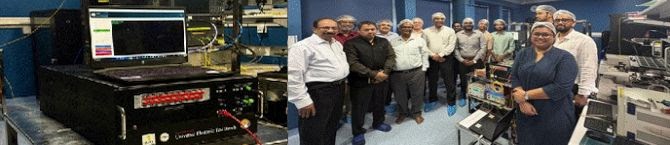
These developments will serve as a shared national facility for the Indian photonics research and development community.
The Silicon Photonics PDK contains a library of more than 50 verified components. This provides essential design enablement for industries, start-ups, academic institutions, including classical and quantum regimes and defence R&D organisations, allowing them to develop advanced photonic integrated circuits within India, reducing reliance on foreign tools. The Universal PPIC Test Engine is a state-of-the-art automated characterisation platform designed for photonic and optoelectronic modules, supporting a wide range of applications.
This technology supports India’s semiconductor self-reliance by offering shared national resources for photonic chip development in clean-room-like testing environments.
The next phase of technology development under the centre has also been announced. India’s Silicon Photonics capabilities are now aligned with global standards, and this achievement is expected to be complemented by the establishment of a Silicon Photonics fabrication facility under the India Semiconductor Mission. Such a facility would ensure end-to-end sovereignty in this critical technology domain.
The technology developed has applications across both classical and quantum regimes. With appropriate industry partnerships, it can be supported under the upcoming ISM 2.0 R&D vertical to drive further improvements and product development. After successful demonstrations of commercial capabilities, a Silicon Photonics fabrication facility with integrated packaging capabilities may be established.
Beginning in the third quarter of this financial year, the centre will enable Silicon Photonics multi-project wafer (MPW) fabrication runs. These will be accompanied by comprehensive testing, packaging, and module characterisation services. This initiative reflects strong institutional support for advancing India’s photonics ecosystem.
The CoE-CPPICS operates under a Product Research, Development and Manufacturing (PRDM) model, leveraging CMOS-compatible Silicon Photonics technology. It has partnered with SilTerra Malaysia as its foundry partner and Izmo Microsystems, Bangalore, as its photonic IC packaging partner. This collaborative framework ensures that India’s photonics ecosystem is positioned to deliver world-class solutions while fostering indigenous innovation.
PIB
