

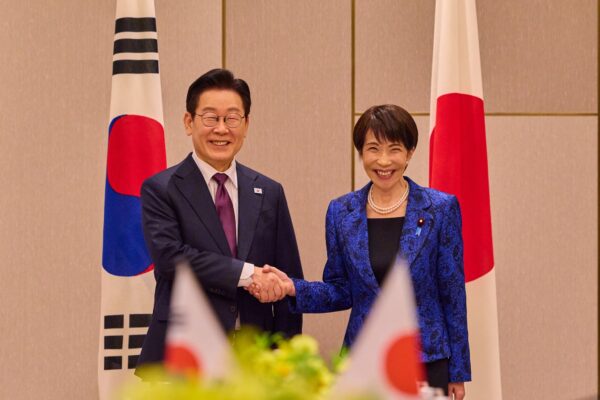
On May 15, the South Korean presidential office confirmed that Japan’s Prime Minister Takaichi Sanae will pay a two-day visit to South Korea beginning on May 19. The venue for this high-level visit will be the city of Andong, Gyeongsangbuk Province, the hometown of incumbent South Korean President Lee Jae-myung. The meeting is seen as a continuation of the Japan-South Korea summit earlier this year, when Lee visited Takaichi’s hometown, as well as an attempt to further institutionalize shuttle diplomacy between the two leaders. It will also serve as a new test for bilateral cooperation as both sides seek to strengthen coordination on security, economic affairs, and regional stability.
The timing of the meeting between Seoul and Tokyo is particularly noteworthy, as it comes immediately after the China-U.S. summit that ended on May 15. Amid intensifying strategic competition among major powers and an increasingly volatile regional security environment, Japan and South Korea are sharing growing strategic interests as well as common security concerns, particularly regarding the risk of disruptions to energy supply chains following the crisis in the Strait of Hormuz.
The recent China-U.S. summit quickly became the focus of international attention, as it marked U.S. President Donald Trump’s second visit to China – while also representing the first time in nearly a decade that a sitting U.S. president had made an official visit to the country. Immediately after the Trump-Xi meeting concluded, Japan and South Korea officially announced plans to hold a bilateral summit to discuss regional issues as well as prospects for advancing Japan-South Korea relations. This move can be seen as a form of follow-up response, reflecting both countries’ close observation of the reactions and strategic calculations of the two superpowers after the summit, while also illustrating the timely strategic adjustments being made by Seoul and Tokyo in an increasingly uncertain environment.
For decades, South Korea-Japan relations have fluctuated due to prolonged historical and political frictions, despite the fact that the two countries continue to share many common values, strategic interests, and a similar geopolitical environment marked by comparable security threats. As two key U.S. allies in East Asia, Tokyo and Seoul have long simultaneously competed with and depended on one another within the Washington-led regional security structure. However, changes in the U.S. approach toward its allies under Trump’s second term, combined with intensifying great power competition and growing risks related to economic and energy security, are creating stronger incentives for South Korea and Japan to move closer together.
Trump’s ambiguous remarks during his meeting with Xi Jinping, particularly those seen as alluding to Taiwan, as well as his limited attention to the North Korea nuclear issue, have generated two common forms of security anxiety among U.S. allies in East Asia: fears of abandonment and fears of entrapment in conflicts led by the United States. Within an asymmetric alliance structure, where smaller states accept partial constraints on strategic autonomy in exchange for security guarantees from a major power, allies are often the most vulnerable objectives when the patron state changes its strategic thinking or policy priorities.
Tokyo and Seoul are naturally well aware of this reality. Therefore, while maintaining close alliance relations with Washington despite pressure related to tariffs, defense burden-sharing, and trade imbalances, Japan and South Korea are also gradually activating “self-help” mechanisms aimed at minimizing strategic risks. This does not mean that the two countries are attempting to decouple from the U.S. alliance framework, but rather reflects a broader effort to enhance strategic adaptability through expanding bilateral cooperation, diversifying diplomatic networks, and strengthening resilience.
Pressure from the international environment may make security one of the central pillars of the agenda at the third Lee-Takaichi summit. Tokyo and Seoul share concerns not only over tensions surrounding the Taiwan Strait and the threat posed by North Korea’s nuclear program, but also over the possibility that escalating conflicts could undermine economic security and disrupt supply chains.
When the crisis in the Strait of Hormuz erupted, Japan and South Korea were among the countries most negatively affected by disruptions to energy supplies supporting strategic industries. Statistics show that Japan depends on the Middle East for roughly 90 percent of its crude oil imports, while South Korea’s dependence stands at around 70 percent. Conflict between Iran and the United States not only created fuel supply instability, but also drove up oil prices, placing significant pressure on the economies of South Korea and Japan, both of which are among the world’s largest importers and consumers of crude oil.
As a result, unlike many previous Japan-South Korea summits that focused primarily on managing historical legacies, this summit’s agenda is expected to focus more heavily on discussing alternative solutions to the traditional energy lifeline passing through the Strait of Hormuz, as well as measures to ensure the safety of maritime shipping routes in the region. Prior to this, both South Korea and Japan had already been attempting to diversify supply chains and explore safer and more viable maritime routes. This demonstrates that energy security is gradually becoming part of the overlapping strategic security thinking of Japan and South Korea, rather than simply remaining an economic, commercial, or historical issue as in the past.
Another issue that may emerge during the third meeting between Lee and Takaichi is the possibility of a bilateral Acquisition and Cross-Servicing Agreement (ACSA). On May 7, 2026, during the first vice ministerial-level “2+2” dialogue between the foreign and defense ministries of South Korea and Japan, the two sides discussed the possibility of establishing a mechanism for military logistics exchange and support.
However, representatives from South Korea’s Ministry of National Defense quickly stated during the talks that Seoul currently has no intention of signing such an agreement with Tokyo. Concerns mainly stem from the possibility that an ACSA could open the door to a deeper presence of the Japanese Self-Defense Forces on the Korean Peninsula during emergency situations, as well as fears that excessive military and security alignment with Japan could provoke negative reactions from both North Korea and China.
Nevertheless, the ACSA issue may still become an important topic on the summit agenda, particularly at a time when strategic maritime routes in both East Asia and the Middle East remain vulnerable to disruption. In addition, Trump’s limited attention to North Korea’s nuclear issue during his meeting with Xi Jinping, along with his ambiguous statements regarding Taiwan, are increasing concerns in both Tokyo and Seoul about the need to strengthen coordination and mutual support in potential regional crises.
In this sense, the ACSA is not merely a technical agreement on military logistics, but also reflects the level of strategic trust and operational coordination between Japan and South Korea. It is considered one of the most sensitive issues in bilateral relations today, as it could both trigger anti-Japanese sentiment within South Korea and potentially become a turning point that moves Tokyo-Seoul relations from symbolic cooperation toward more substantive security coordination.
Beyond energy and traditional security concerns, critical mineral supply chains are also likely to become an important issue on the agenda between Tokyo and Seoul. Amid increasingly fierce competition in high technology sectors, mineral security is becoming a crucial component of national development and economic security strategies. A report by the Observer Research Foundation showed that Japan and South Korea are both pursuing “de-risking” and diversification strategies in critical mineral supply chains in order to enhance resilience against external shocks while reducing excessive dependence on China.
Thus far, both Japan and South Korea have accelerated investment in mineral extraction and resource security. Since 2018, the Japanese government has invested approximately $256 million into deep-sea mineral development projects, while South Korean companies are expanding overseas mining investments in an effort to diversify sources of raw materials. By cooperating with one another, South Korea and Japan may be able to leverage complementary strengths within the value chain to enhance resilience against supply-side pressures, while also creating a new form of strategic leverage against the increasing politicization of critical mineral supply chains by China.
Japan-South Korea relations may be entering their most stable and open phase in nearly a decade, thanks to the growing convergence of security, economic, and strategic interests between the two leaders. The promotion of “hometown shuttle diplomacy” shows that under Lee Jae-myung and Takaichi, Tokyo and Seoul are not only seeking to manage short-term frictions, but are also attempting to build a more sustainable foundation for cooperation based on trust and long-term strategic coordination.
On a broader level, this trend also reflects the increasingly visible strategic adjustment of middle powers amid intensifying great-power competition and a more unpredictable alliance environment. As security commitments from major powers are no longer viewed as absolute guarantees, countries such as Japan and South Korea are increasingly seeking to strengthen their strategic resilience through bilateral cooperation, diversification of external relations, and the expansion of more practical coordination mechanisms.
In that sense, the third Lee-Takaichi summit may not only indicate a step forward in South Korea-Japan relations, but also reflect a shift in the strategic perception of U.S. allies in East Asia in response to an unstable and unpredictable regional environment.
