

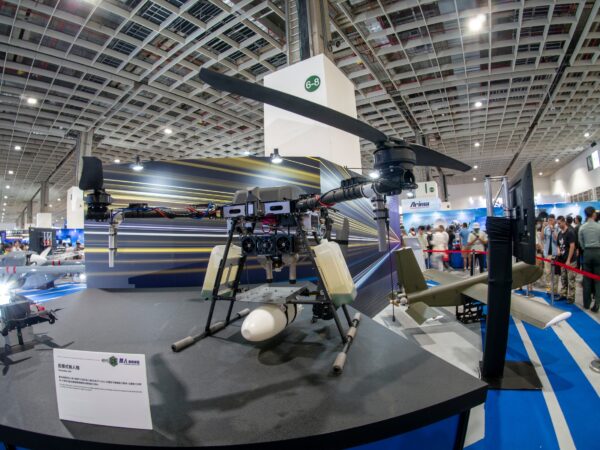
In light of lessons from Ukraine, Taiwan’s defense strategy over the past three years has increasingly prioritized unmanned systems. In late 2025, the government proposed its largest-ever unmanned systems procurement under a NT$1.25 trillion (approximately US$40 billion) Special Defense Budget, with about one-third allocated to procuring roughly 200,000 drones and 1,320 unmanned surface vessels over 2026–2032, alongside AI-enabled and allied collaborative systems.
After nearly six months of political dispute, all domestic procurement components were cut by opposition parties in May 2026, leaving only Foreign Military Sales (FMS) channels intact. New domestic defense drone procurement drops to zero. This comes as Ukraine targets production of over 7 million drones in 2026, China’s estimated annual production capacity runs into the millions, and the United States moves to procure 300,000 systems. The new budget leaves Taiwan’s unmanned buildup effectively stalled at a critical moment, while cooperation with key partners including the United States, Ukraine, and Japan becomes increasingly decisive for sustaining its defense drone ecosystem.
The Drone Budget Cut Breakdown
On May 8, the Legislative Yuan passed the opposition-sponsored Special Act for Safeguarding National Security and Strengthening Asymmetric Capabilities. It cut the Lai administration’s requested spending authorization by 38 percent, capping total procurement at NT$780 billion. The legislation’s title invokes asymmetric capability; its enacted provisions systematically defund the domestic unmanned systems programs that asymmetric capability requires.
Taiwan’s current inventory stands at fewer than 10,000 combat-relevant drones, a baseline the budget cut will deteriorate further. Zero new domestically produced platforms will be procured in 2026, stripping the industrial base of the anchor orders on which scaling depends. Even the NT$64 billion for Taiwan-U.S. joint R&D and equipment procurement is eliminated, potentially severing cooperative programs significantly expanded in 2025 at a critical stage.
Even if the funds are eventually restored through the annual budget cycle, Taiwan’s unmanned industry would be forced into a near two-year standstill. A September 2026 submission of the next budget and legislative passage no earlier than February 2027 would push contract awards for the 48,750-unit Armaments Bureau procurement to mid-2027 at the earliest.
Industrial Development: The Anchor Orders Problem
Taiwan’s drone sector entered 2026 with measurable progress against unmet objectives. Based on data compiled by DSET through industry interviews, procurement, and export records, planned domestic procurement expanded nearly 29-fold, from 3,422 to approximately 100,000 units. Approximately 267 manufacturers now operate across Tier 1 through Tier 3 of the supply chain. Annual production rose from roughly 8,000 to 10,000 units in 2024 to an estimated 123,000 in 2025, while export volumes reached 139,091 units in the first quarter of 2026 alone, surpassing total 2025 export volume.
These figures confirm genuine industrial expansion but fall short of the government’s targets: annual production of 180,000 units by 2028 and achieving a supply chain fully independent of China by 2027.
Both figures, however, require qualification. On platform capability, the overwhelming majority of exported systems are small, commercial-grade platforms averaging 2 to 15 kilograms (Group 1), priced at approximately US$800 to US$1,000 per unit. For military-grade Group 3 to 4 platforms, Taiwan remains entirely dependent on U.S. FMS.
On unit cost, Taiwan’s industrial ecosystem – spanning ICT, electronics, precision manufacturing, and advanced materials – positions its manufacturers as credible democratic suppliers, but unit costs run two to three times higher than Chinese-produced equivalents.
Both constraints can be solved in the same way: by sustained domestic procurement providing the demand signal against which facility expansion, capacity scaling, and technology upgrading become financially viable. Without it, neither gap will close.
Foreign government procurement markets oriented toward secured supply chains outside Beijing’s control represent the logical next destination, but entry demands credentials Taiwan has not yet had the opportunity to build. Verified military contracting records, compliance certifications, and demonstrated production consistency are threshold qualifications Taiwanese manufacturers have yet to establish. With Taiwan’s drone industry now forced into a standstill for at least two year, expect a widening gap between Taiwan’s current standing and the minimum requirements for foreign market eligibility.
Defense Readiness: The Inventory and Range Gap
Scale, capability breadth, and sustained resupply have proven decisive in attrition-centered asymmetric warfare. By all three measures, Taiwan’s current posture falls critically short, and the passed legislation ensures it will not improve.
According to DSET’s research, Taiwan’s armed forces currently have access to approximately 5,000 combat-relevant drones, encompassing the first batch of commercial-grade military UAVs procured in 2024, NCSIST acquisitions, and U.S.-sourced platforms. The preservation of FMS procurement items within the special budget could bring that figure to approximately 7,000.
The inventory figures, however, reflect quantity rather than combat effectiveness. Platforms in service remain limited to the Capricorn (Army), Albatross I, Cardinal II, and Mighty Hornet I (Navy), and the Chien Hsiang anti-radiation drone (Air Force). Counter-UAS coverage is thinner still: confirmed military counter-UAS acquisition comprises only two programs totaling NT$5.3 billion.
Quantity alone does not address Taiwan’s most critical operational constraint: range. The platforms currently being produced by Taiwan’s industry operate with a range well below 50 kilometers, yet the Taiwan Strait averages 180 kilometers in width. According to the CNAS’s “Hellscape for Taiwan” report, a credible layered drone defense requires platforms operating 40 to 80 kilometers offshore, with long-range strike assets reaching beyond 100 kilometers.
The Ministry of National Defense’s planned budget included 4,040 medium-range loitering munitions with a minimum range of 180 kilometers and 32 units of the Albatross II exceeding 2,000 kilometers. Neither was retained in the passed legislation. A defending force whose inventory falls orders of magnitude below its adversary’s, and whose domestically produced platforms cannot reach the operational kill zone, faces deterrence degradation not as a future risk but as a present trajectory.
Supply Chain Integration: Missing the Window
Supply chain positioning is distinctive among the budget impasse’s consequences in one critical respect: its costs, once incurred, are the least reversible. Taiwan holds dual advantages within the democratic drone ecosystem – geopolitical credibility as a China-independent supplier at a moment of active supply chain realignment, and technological depth in AI-enabled unmanned systems, spanning edge computing and computer vision for autonomous navigation, target recognition, and C2 integration across GPS-denied and electromagnetically contested environments.
These advantages, however, are not self-realizing. The suppliers establishing compliance records and procurement relationships during this formation period will occupy structural positions that later entrants cannot readily replicate. For Taiwan, a two-year procurement standstill is more than a delay. It is a forfeiture of positioning within a supply chain architecture that will define unmanned systems competition for the next decade.
What Allies Can Do
President Lai Ching-te’s three drone program objectives – industry development, self-reliant defense, and integration into the democratic supply chain – are mutually reinforcing. Each depends on the others, and all three depend on the sustained domestic procurement commitment the passed budget legislation has suspended. A second special budget remains the most credible but politically difficult path forward, providing the multi-year programmatic visibility that neither a supplementary budget nor the annual budget cycle can fully substitute.
The impasse in Taiwan’s domestic politics strengthens the strategic case for allied engagement. For the United States, a Department of Defense implementation plan under FY2026 National Defense Authorization Act is due this June, establishing the statutory framework for joint Taiwan-U.S. development and production of unmanned and counter-UAS systems. Enactment of the bipartisan Blue Skies for Taiwan Act of 2026 would fast-track Blue UAS certification and anchor Taiwan in a China-independent supply chain.
For Europe, Taiwan’s role as a verified supplier outside China-dominated supply chains warrants formal elevation through procurement dialogue, certification alignment, and institutionalized cooperation. For Ukraine, co-production on interceptor and long-range strike platforms combined with frontline operator exchanges would give Taiwan’s manufacturers combat-validated operational experience that no other partnership can replicate.
Within a single year, Taiwan’s drone industry has demonstrated genuine capacity in export volume, supply chain depth, and technological breadth, positioning itself as a strategically indispensable contributor to democratic deterrence. The budget impasse suspends the domestic demand signal required to realize the industry’s burgeoning potential. Whether allied engagement can sustain that momentum will determine not only Taiwan’s defense posture, but whether democratic deterrence in the Indo-Pacific is realized or deferred.
