

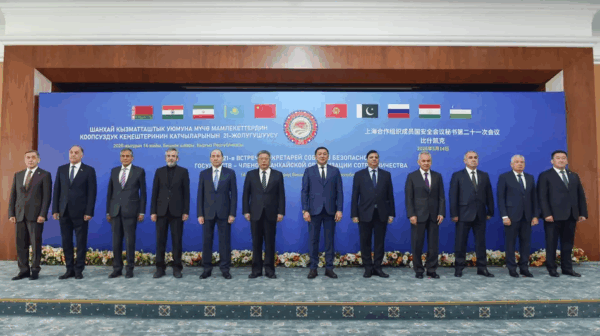
At a regional security gathering last week in Bishkek, Russian Security Council Secretary Sergei Shoigu said that Russia was “establishing a full-fledged partnership” with Taliban-ruled Afghanistan and stated Moscow’s opposition to any new third-country military presence in the country.
On May 14, the Shanghai Cooperation Organization (SCO) member country security council heads met in Bishkek, the capital of Kyrgyzstan, which currently holds the SCO’s rotating chairmanship.
The SCO’s full members are China, Kazakhstan, Kyrgyzstan, Russia, Tajikistan, and Uzbekistan, as well as India and Pakistan (since 2017), Iran (since 2023), and Belarus (2024). Afghanistan was an observer from 2012 until the 2021 collapse of the Afghan Republic government and the Taliban’s return to power; in 2025 it reemerged as an SCO partner, after the organization merged its observer and dialogue partner statuses.
At the meeting, Shoigu took the opportunity to warn against the potential return of any third-country military infrastructure to Afghanistan or neighboring countries.
“Our fundamental approach is that the United States and its allies must acknowledge full responsibility for their 20-year presence in Afghanistan and shoulder the primary burden of its post-conflict reconstruction,” Shoigu said. “We consider the return of third-country military infrastructure to Afghanistan or the deployment of new military facilities in neighboring states unacceptable.”
Media reports on Shoigu’s remarks do not speculate as to what shouldering “the primary burden of its post-conflict reconstruction” means in practical terms, or how such a task could even be completed without military infrastructure of any kind.
It’s also likely that when Shoigu referred to the “deployment of new military facilities in neighboring states” he’s not talking about the expanding Chinese-funded security infrastructure in countries like Tajikistan, where Beijing’s workers and businesses have come under increasing risk.
Moscow officially recognized the Islamic Emirate of Afghanistan – the Taliban’s government – in July 2025. Russia remains the only country to have taken such a step, though many others frame their engagement similarly as “pragmatic,” including the Central Asian states and China.
“We’re consistently building a full-fledged partnership ranging from political and security contacts to trade, economic, and cultural and humanitarian cooperation,” Shoigu said, according to the state-run TASS news agency.
Shoigu added that Moscow is “convinced that cooperation with Kabul meets the objectives of the region’s security and economic development.” He said that Russia believes “it is essential to agree on modalities for resuming the activities of the SCO-Afghanistan contact group, as well as expanding cooperation within the framework of regional initiatives, including the Moscow format.”
The SCO-Afghanistan contact group was established in 2005. Last month, SCO Secretary General Nurlan Yermekbayev said that the group had suspended its work but that Afghanistan “remains in the focus of our organization’s attention.”
Russia’s engagement with Afghanistan has been multifaceted and continues to expand. The day after Shoigu’s comments in Bishkek, the Taliban’s Minister of Commerce and Industry Nuriddin Azizi told reporters at the “Russia – Islamic World: KazanForum” in Kazan that Afghanistan is exploring the possibility of send migrant workers to Russia.
“Various agencies are working on issues related to migrant workers,” he said. “There is a shared interest, both on the part of Russia and on the part of Afghanistan, in achieving tangible results.”
According to Azizi, “The only existing barrier is language-related issues, but we are trying to resolve this challenge.”
Central Asian still provides Russia’s largest pool of migrant labor, although the relationship is fraught at times, with Central Asians targeted by military recruiters and increasingly restrictive regulations. Just as Central Asian countries have sought to diversify the destinations for their migrant laborers – looking elsewhere in Asia and to Europe – Russia has also cast a wider net to meet its demand for workers while prosecuting a war in Ukraine, including looking to increase the number of Indian migrant workers.
