

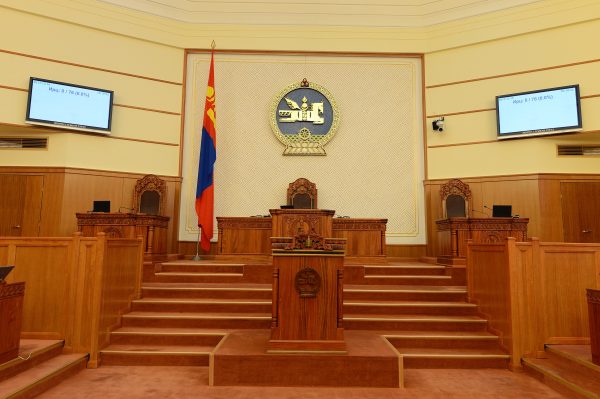
In April, the Mongolian parliament, the Great State Khural, passed President Khurelsukh Ukhnaa’s Bill to Rescind Parliament Members, which allows the incumbent president to probe members of parliament (MPs) on ethics and moral grounds as public government representatives. The bill sparked constitutional and governance debate among scholars and policy pundits concerning the balance of power and checks and balances of the Mongolian government. In principle and in practice, however, the bill shows potential for strengthening and filling in the legislative gaps of accountability.
Mongolia’s current governance model is categorized as a flawed democracy with a semi-presidential system. Mongolia’s president and the parliamentary members are directly elected by the people. While the Great State Khural is the main legislative body of the Mongolian government, the constitution also allows the president and the Cabinet to propose laws and legislation to the parliament.
Since 2019, Mongolia has been adjusting its governance model to strengthen accountability and representation for its citizens. That year, a Constitutional amendment limited the president to a single six-year term, without the option of seeking a second term. That was followed by the 2023 constitutional amendment, which enlarged Mongolia’s Parliament from 76 to 126 members. These structural changes aim to impact the balance of power, not only within political parties but also in terms of the government’s checks and balances.
Authors at the Verfassungsblog wrote:
A new constitutional culture is thus emerging in Mongolia, one marked by a growing reliance on the Court, which is increasingly perceived as the only effective check on the entrenched power of political parties. In this context, peaceful popular protests have become also an essential means for citizens to express their demands and influence parliamentary behavior.
In March, when the Office of the President proposed the Bill to Rescind Parliament Members to the State Great Khural legislators debated whether the bill is a breach of Khurelsukh’s presidential power. Critics said the bill could allow him direct power over the parliament itself, as well as parliamentary procedures.
The stated rationale behind the bill was to create another layer of accountability and establish a system whereby political parties are responsible for their party candidates serving as legislative representatives of the Mongolian people. Legislatively, the Bill aims to create an active mechanism that pressures the Parliamentary Ethics Subcommittee to strengthen its ethics and accountability standards – and thus restore public trust amid political instability and high corruption.
When the bill was introduced, however, MPs and political commentators reacted differently.
Despite criticism on Khurelsukh’s proposal of the bill, legal scholars nevertheless defended the president’s constitutional right to propose laws to the State Great Khural. Under Article 26.1 of the Constitution, the president, MPs, and members of the Cabinet have the right to propose a legislation and present it to the parliament. Other presidents have proposed laws as well.
In 2006, then-President Enkhbayar Nambar proposed the establishment of the Independent Authority Against Corruption (IAAC), where the president has authority to nominate the president of the IAAC, with the approval of the parliament. The IAAC is still an active government agency today.
Elbegdorj Tsakhia, who served two consecutive terms from 2009-2017, introduced Mongolia’s Neutrality Policy as official legislation, which was later annulled by Battulga Khaltmaa when he became president in 2017.
While some legal scholars argued that, like previous presidents, Khurelsukh’s legislative proposal is within the boundaries of his constitutional rights, the bill does give the incumbent president – and future ones – a bit more access to the parliament. This is in addition to already having a veto power.
Governance scholars and policy pundits have opposed the proposal, arguing that Khurelsukh’s proposal is in direct conflict with the independent of the legislative branch. Critics highlighted that accountability is supposed to run in the opposite direction – where the president is legally required to address the State Great Khural.
Mongolia’s last year has been marred by political turmoil and internal fighting within the Mongolian People’s Party (MPP). The MPP currently holds the presidency and the legislature, so political instability and shuffling inside that party will no doubt have a negative impact on Mongolia’s governance at large.
There is a strong correlation between governance and prosperity. Thus the crucial question now is how much the MPP’s internal feud is impacting political stability. If this detrimental trend continues, party infighting will reduce parliamentary effectiveness and reduce government services and development – even if the president is able to probe individual MPs on ethics ground.
At the same time, it would be overly simplistic to surmise that Mongolia’s governance is solely dependent on the political factions of parties. In practice, Mongolia’s multiparty political system and the fact that people use direct voting to elect both the president and the parliament is the real democratic governance model, which keeps Mongolia ranking high in world governance barometers.
Despite the recent dominance of the MPP and its internal power struggles, global research centers have long categorized Mongolia as a democratic state. The 2025 Arden Strategies Global Parliament Index gave Mongolia a democracy rating of 4 out of 4, making the country an outlier amid authoritarian neighbors like Russia, China, and even Kazakhstan. The V-DEM Institute’s 2026 Democracy Report listed Mongolia as a “grey zone” electoral democracy, noting that nearly every other country in the region was an electoral autocracy or closed autocracy.
