

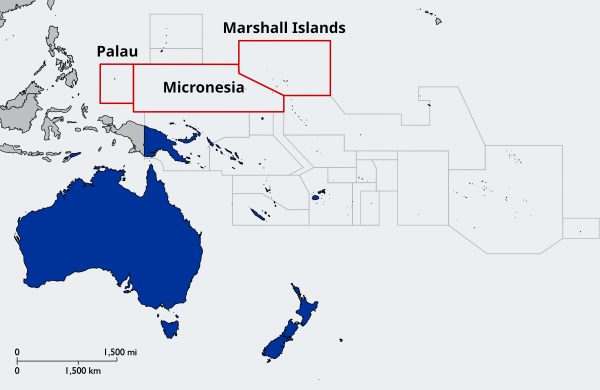
Earlier this month, the U.S. Government Accountability Office (GAO) released a report on the status of assistance being provided to the Freely Associated States (FAS) of the Federated States of Micronesia, the Republic of the Marshall Islands, and the Republic of Palau. The report revealed that the Trump administration has failed to properly staff necessary – and legally required positions – in a timely manner, preventing the FAS from satisfying their own reporting obligations.
Actions speak louder than words, and the administration’s actions – or lack thereof – in its dealings with the FAS are undermining the United States’ interest in a region that U.S. Indo-Pacific Command Commander Admiral Samual J. Paparo described as “the Department of Defense’s priority theater.”
As any World War II scholar can attest, the small islands that are spread out over the Pacific Ocean were critical for the United States’ ability to defeat the Japanese. Today, these islands make up roughly 20 independent countries and territories that have legal control over not only the land, but more than 7 million square miles of maritime territory. This area, which is twice the size of the United States, remains important for the same military reasons that existed 80 years ago. In addition to national security, the Pacific is also economically important, with hundreds of billions of dollars of goods being shipped through it every year, including significant portions of American imports and exports.
Unfortunately, instead of continuing the positive direction that U.S. regional policy had recently been taking, over the past year the Trump administration has sabotaged the U.S. military’s and diplomatic representatives’ diligent efforts to keep the Pacific free, open, and secure. Perhaps the most egregious example the GAO report cites is the administration’s failure to appoint members to the Joint Economic Management and Financial Accountability Committee and Joint Economic Management Committee until August 2025, more than a year after the required completion date and only one week before the committees’ annual meetings.
The administration’s failure to dedicate the attention and relatively minimal resources necessary to ensure the proper functioning of the U.S.-FAS economic relationship is simply the latest example of its failure to focus on the Pacific half of the Indo-Pacific region, which the administration has claimed is its priority theater.
To make matters worse, many of the administration’s other policies have cost the U.S. valuable reputational capital in the region. In the Republic of Palau, the Trump administration convinced the Palauan president to participate in the United States’ new third-country deportation scheme, a policy that is deeply unpopular with Palauans. In Tonga and Fiji, nationals are now stuck in limbo after the Trump administration suspended immigrant visa processing; and in Tuvalu and Vanuatu, nationals will be required to pay a $10,000 visa bond to travel to the United States (for perspective, in 2022, the average monthly household income in Tuvalu was approximately $1,540). These actions only compound the harm done by the administration’s decision to dismantle USAID, to withdraw from dozens of multilateral organizations, and to reject efforts to combat climate change.
As someone who spent two years in the Pacific working for one of the FAS, and additional time based in Japan studying the delivery of assistance to the region, I can speak first-hand about how these actions send the wrong signal to a region that prioritizes cooperation and that is at existential risk from climate change.
In the Pacific, a little can go a long way. Based on my own experiences, I know that many in the region would prefer to be able to work with the United States, instead of China. But the Trump administration’s failure to give the region the attention it needs, while also taking actions that are contrary to the region’s culture and interests, is leaving the door wide open for China to step in. And stepping in it is: a Chinese state-owned company is finishing the reconstruction of a World War II-era runway that is only a few hundred miles from Guam, while Kosrae High School, in the Federated States of Micronesia, is being renovated with money from China, rather than the United States.
Instead of targeting Pacific Islanders, ignoring their needs, and placing their very existence at risk, the Trump administration should continue to increase the positive engagement that had been occurring, dedicating the necessary staffing and resources that are required to ensure the region’s needs are met. Doing so would support not only the region’s small island states but also the United States’ own security at a critical moment in history.
