

For Tibetans, the complete omission of their cause from both diplomatic dialogue and media coverage during U.S. President Donald Trump’s recent visit to China represented a bleak low-water mark – a clear sign of where global priorities are shifting. At least since the George H.W. Bush administration, American leaders visiting Beijing were traditionally expected to raise the Tibetan issue during bilateral meetings. While some might view introducing topics that inconvenience Beijing as a diplomatic hurdle, doing so historically provided the United States with vital leverage, establishing a moral asymmetry between right and wrong on the global stage.
Today, by abandoning this leverage, the Trump White House has inadvertently granted Beijing the upper hand. In bilateral dialogues and negotiations, the United States has transitioned from an arbiter of global values into a receiver of Chinese demands, enduring warnings regarding the fragility of relations if Washington mismanages the Taiwan issue.
Stripped of a values-based agenda, the administration’s diplomacy has been reduced to a narrow, transactional scope: urging the purchase of American goods – something that China was previously doing anyway – and perhaps requesting Beijing’s assistance with Iran. By purging human rights and democratic principles from the U.S. international strategy and other tendencies, China’s governance has been effectively normalized.
This reality is underscored by a recent Gallup World Poll, which revealed that 36 percent of global respondents now approve of China’s leadership, compared to just 31 percent for the United States. It is a stark reminder of how fragile the current world order truly is, serving as a necessary wake-up call for an American public that has long slumbered in the complacency of taking its global standing for granted.
In 1998, I was fortunate enough to work with colleagues from the Milarepa Fund, a human rights organization founded by the Beastie Boys, to collect letters from Tibetan supporters worldwide. We ultimately delivered nearly 1 million letters to the White House ahead of then-President Bill Clinton’s historic visit to Beijing, urging the administration to press China for a resolution on Tibet.
Despite his broader strategy to integrate Beijing into the global economy by ushering it into the World Trade Organization – planting the biggest seed that transformed China’s global status today – Clinton nevertheless publicly confronted President Jiang Zemin over Tibet. During their joint press conference, which dedicated an unprecedented amount of time to the Tibetan issue, Clinton urged Jiang to engage in direct dialogue with the Dalai Lama. This pressure yielded a rare rhetorical shift. Jiang Zemin publicly expressed amazement at the popularity of Tibetan Buddhism in the West and even indicated his acknowledgement of the positive attributes of Tibetan cultural roots. This was a concession unprecedented for a Chinese leader.
This moment stood as a prime example of how, in a U.S.-led global order, the rhetoric of an American president possessed profound geopolitical weight. It also underscored a historical consistency that since George H.W. Bush, every sitting U.S. president had maintained the tradition of meeting with the Dalai Lama – a diplomatic streak that ultimately ended under the first Trump administration and continued through the Biden presidency.
As China’s global influence and economic power rose, the Tibetan issue steadily vanished from international dialogue and media coverage, even as the situation on the ground drastically deteriorated from bad to worse. In the 1990s and 2000s, the Tibetan government-in-exile, His Holiness the Dalai Lama, global supporters, and numerous world leaders frequently warned that Beijing’s policies were systematically undermining the survival of Tibetan language, culture, and identity. Today, that reality has compounded drastically. For the first time in history, a generation of Tibetans has emerged stripped of their mother tongue. This systematic erasure threatens to eliminate a highly sophisticated language that represents one of Central Asia’s greatest civilizations from the face of the Earth, all to serve China’s cultural expansion and geopolitical ambitions.
This institutionalized erasure began roughly two decades ago when Chinese authorities coerced Tibetan parents in urban centers like Lhasa to send their children to daycares and preschools staffed exclusively by Chinese instructors. Unlike previous generations of students whose parents spoke no Chinese, these younger parents had already passed through the Chinese educational system and were fluent in the language. This created a domestic environment where children continuously reinforced Chinese at home.
Just two months before the recent China-U.S. summit in the Great Hall of the People, a sweeping law was enacted under Xi’s leadership in that same hall, mandating that all ethnic groups under Chinese rule assimilate into a singular Chinese identity. This legal framework reinforced a directive Xi issued a decade prior, which explicitly urged the transformation of “ethnic minorities” into “Chinese nationals.”
As Xi himself stated in 2014:
Education must penetrate the blood and reach into the soul; it must be grasped from an early age, starting in kindergarten. We must do a good job with patriotic education, planting the seeds of love for China deep in every child’s heart… so they do not only identify with their own ethnicity, but first and foremost recognize themselves as part of the Chinese nation.
For Western readers, this rhetoric evokes a dark and familiar historical echo: the infamous colonial doctrine to “kill the Indian, save the man.” This is what Xi considers a “doing a good job.”
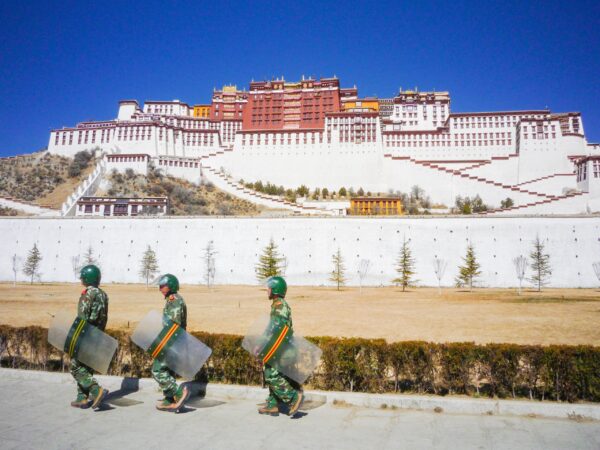
In Tibet, this ideology is being ruthlessly executed through a network of colonial-style boarding schools where children are forced to learn exclusively Chinese language and culture. Reports emerging on social media reveal that instructors go so far as to physically beat children for speaking Tibetan. This comprehensive campaign falls squarely under Xi’s explicit policy of the Sinicization of Tibetan culture. While the international community looks away, an ancient, unique civilization is being systematically erased in the dark in the name of constructing a homogenized “Chinese nation.”
Western media is heavily restricted from entering Tibet, a closed environment that Freedom House ranks as even less accessible than North Korea. Traditionally, when reporting from Beijing, international journalists made sure to remind their audiences of the ongoing crises in places like Tibet and Xinjiang. This time, however, the traveling press pool that followed Trump to Beijing maintained a glaring silence on such issues. In the West, society rightfully condemns the historical atrocities committed against Native Americans who were forced into assimilationist boarding schools. Remarkably, the journalists broadcasting from the Chinese capital, the very place that planned and implemented a borrowed colonial boarding school system in Tibet, refrained from noting this modern repetition of cultural genocide in the 21st century.
As a daily listener of National Public Radio (NPR), I found their reports from Beijing during these summits to sound less like Western journalism and more like promotional copy from a Chinese state tourism department. NPR’s coverage focused heavily on the speed of Chinese high-speed rail, advancements in technology, the ubiquity of robotics and AI, and the seamless nature of a society run entirely through smartphones. Their reporters seemed glued to professors from elite state universities and Chinese Americans who had relocated to China as their primary sources. They enthusiastically chronicled the superficial progress witnessed since their previous assignments, gushing over the cuisine, the dating apps, the richness of traditional Chinese culture, and the grandeur of modern architecture.
As a former journalist, I found no objective news value in these reports; they merely repeated what was already widely known. In doing so, these reporters allowed themselves to be captivated by the glittering spectacle of authoritarian modernization, while remaining willfully blind to the calculated erasure of an ancient civilization.
Meanwhile, Trump praised Xi. He repeatedly referred to Xi Jinping as a “great leader,” adding that he felt “honored” to be Xi’s friend. Historically, a global consensus associates the title of greatness with figures who expanded human freedom, such as Mahatma Gandhi, Abraham Lincoln, and Nelson Mandela. In the West, His Holiness the Dalai Lama and Martin Luther King were often ranked alongside Gandhi and Mandela. For most Americans, the semantic choices of a president addressing a Chinese counterpart may seem trivial. Mainstream domestic critics often view the tendency to bestow such titles on authoritarian rulers as mere rhetorical posturing. However, for those who endure the oppression of the Chinese regime and have long placed their hope in the ideals America portrays, witnessing this profound validation from the leader of the free world is deeply dehumanizing.
For Tibetans, who were historically coerced into venerating Mao Zedong under the exact moniker of “great leader,” hearing an American president tell Xi, “I have such respect for China, for the job you’ve done. You are a great leader” shatters their faith in the moral architecture of Western democracy. The video of Trump making these remarks circulated virally on WeChat the next day. The dead silence of Tibetan social media commentators on the platform spoke volumes about their collective shock and confusion.
Historically, the West classified Xi Jinping as a dictator. Even members of Trump’s own foreign policy circle, such as Secretary of State Marco Rubio, who sat right next to Trump during the meeting, had consistently labeled Xi a totalitarian dictator. Yet, at this summit between the world’s greatest democracy and the world’s strongest Communist Party, Xi was rebranded as an American-approved “great leader.”
Prior to this administration, such breathless adulation of Xi was confined to the pages of state-run propaganda like the People’s Daily. Remarkably, the White House has not only adopted Beijing’s internal framing of its leadership, but has also internalized the CCP’s attacks on Western institutions. When Trump dismissed the value of NATO, the bedrock of Western power, by calling it a “paper tiger,” he directly channeled a classic Maoist slogan originally minted to mock and diminish America and Western power.
Since the Chinese invasion of Tibet, countless Tibetan men and women have sacrificed their lives for the cause of freedom. First, they took up arms provided by the United States to resist Chinese occupation; later, they took to the streets in protest; and eventually, they turned to the desperate, tragic act of self-immolation. They endured these horrors sustained by a singular, foundational hope, that there existed a nation called the United States that genuinely championed and defended global human freedom and democracy. Every grown man in my own family sacrificed his life with this exact conviction when I was a child.
Last year, I visited Camp Hale in Colorado, the secluded site where the CIA once trained Tibetan guerrilla fighters. The visit gave me a sense of pride, but also reminded me of President Nixon’s historic trip to Beijing in 1972, which abruptly ended American support to Tibetan resistance and turned those freedom fighters into what historians call the “orphans of the Cold War.” Washington believed it could isolate the Soviet Union by embracing Beijing. Decades later, that strategy has collapsed into a dangerous irony. China now stands as the economic and geopolitical backbone of Russia, the successor state to the Soviet Union. Alongside North Korea and Iran, this authoritarian bloc poses a formidable challenge to Western and global security. If the cohesion of NATO is undermined and the Western alliance system is pushed or allowed to degenerate, the China-led bloc will fundamentally shift the global balance of power.
This year, which marks the 250th anniversary of America’s declaration of independence, should be a time to celebrate the democratic values that serve as the source of its actual power. If the Trump-Xi summit is any indication, the opposite is occurring.
