

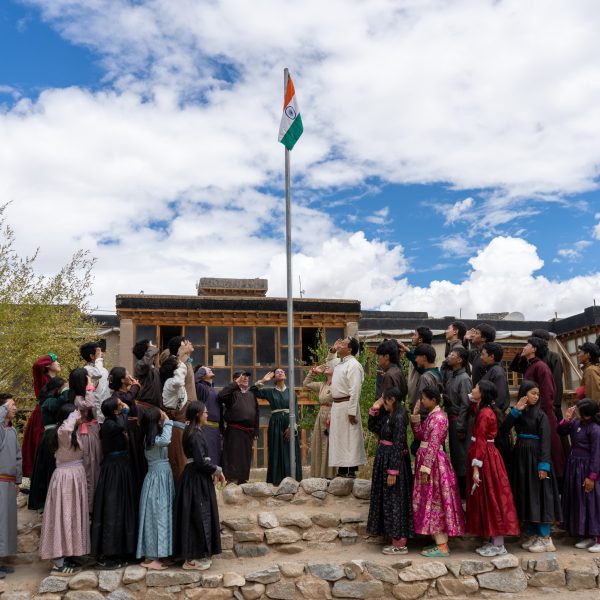
India’s latest internal rearrangement of its northern border territory of Ladakh – the creation of five new districts in addition to its existing two, which reduces the plurality of Muslims into a virtual minority in terms of representation – has sparked a cynical perception that it might be intended to polarize its Buddhist and Muslim populations.
Both Buddhist and Muslim Ladakhis have, since their region’s amputation from the erstwhile state of Jammu and Kashmir, overcome past skepticisms and pioneered a consensus-based, effective political struggle. Their litany of demands include statehood and guarantees under the sixth schedule of India’s Constitution that would protect land and job exclusivity for Ladakh’s 274,000 people (as per census 2011), 97 percent of whom are tribal.
In 2019, the government of India stripped Jammu and Kashmir of its semi-autonomous status, and divided it into two union territories: the UT of Jammu and Kashmir, and the UT of Ladakh. Since then, Ladakh has witnessed a bolstering of its bureaucratic apparatus, comprising administrative servants parachuted in from various parts of the country. The bureaucrats report to a New Delhi-appointed lieutenant governor, are largely walled off from grassroots sentiment, and have shown little aptitude for political inclusion, largely keeping the elected hill councils in Kargil and Leh out of decision-making.
Legislation approved by Lieutenant Governor Vinai Kumar Saxena on April 27 created five new districts: Sham, Nubra, Changthang, Zanskar, and Drass. Ostensibly, the delimitation aims to decentralize decision-making and facilitate direct funding to districts from New Delhi. It is unlikely that this will be the case. In a union territory structure, the power of resources and funding are vested in the lieutenant governor, who rubber-stamps the center’s directives. A robust federal arrangement would require an elected legislature.
Critics aver that the delimitation is palpably undemocratic, as Muslims – who comprise 46.4 percent of Ladakh’s population – will be now the majority in only two districts: Kargil and Drass. On the other hand, the remaining five districts of Sham, Changthang, Nubra, Leh, and Zanskar will be majority Buddhist, an unusual gerrymandering given that the Buddhist population at 39.65 percent lags behind its Muslim counterpart.
In the words of eminent Ladakhi historian Siddiq Wahid, the delimitation “reduces the voice of Muslim representation in Ladakh to less than one-third whereas the population of Buddhists and Muslims is all but equal, in fact, Muslims constituting a fractional majority.”
Radha Kumar, a political analyst and former interlocutor to undivided Jammu and Kashmir, questioned the procedural legitimacy of the delimitation. “This is not a decision to be taken by the lieutenant governor’s administration. The two elected Hill Councils should be the ones to decide, in consultation with the people through a transparent public process,” Kumar told The Diplomat.
The government of Ladakh maintains the delimitation was based on inputs of a special committee it set up. The committee met 1,300 people at more than 20 locations.
But activist Sajjad Kargili disagreed. “The committee never heeded to local representations. For instance, [Muslim-majority] Sankoo and Chiktan had pressed for district status but were denied, whereas [predominantly Buddhist] Changthang with a population of mere 7,000 was carved as a new district,” he said by phone from Kargil.
He dismissed the delimitation exercise as “another instance of the Modi government’s marginalization [of Muslims] project across India.”
New Delhi’s deployment of partisan politics needs to be understood in the context of Ladakh’s sustained opposition, which forced the Ministry of Home Affairs to uncharacteristically constitute a High-Powered Committee to talk with its civil society collectives in 2021. Whereas Kashmir remained largely quiescent in the face of the Modi’s government’s relentlessly pursued majoritarian projects, in Ladakh, the Leh Apex Body and the Kargil Democratic Alliance (representing the Buddhists and the Muslims, respectively) joined hands to map out a course that sporadically relies on intensifying street protests. The two communities repaired a past riddled with competitive aspirations and focused on areas of agreement: the urgency to preclude New Delhi’s unilateral revamping of political architecture in the sensitive border region.
The Ladakhi protests, along with the farmers’ protests in 2020-2021, marked moments when an aroused and organized population signaled that it was possible to challenge and contain the Modi government’s authoritarian drift. The government is known for its vindictive use of investigative agencies against political opponents; assaults on minorities; and – in the backdrop of a contentious voter list revision – perceptions of election manipulation.
Notably, the Ladakhi protests and farmers’ protests did not trigger violent clashes with security installations nor adopt any subversive expositions; the law and order situation and even the Modi government’s political legitimacy was never under assault.
But something more sensitive was impacted: its sense of political hubris. A tiny, electorally insignificant population confronting the center head on was bad optics for a regime that thrives on extracting conformity – partly by use of coercion, and partly by spreading the myth, disseminated in cooperation with oligarch-owned mass media, that protests are essentially globally coordinated campaigns aimed at weakening India’s territorial integrity.
During the farmers’ protests, India’s primetime TV circulated the specious argument that the protesting Sikh peasants took instructions from Khalistani separatists. But protests in Ladakh are harder to discredit; Ladakh’s unwavering patriotism in the face of several wars is often cited as evidence of India’s plurality.
A seamless coalition between a Muslim demographic and its non-Muslim counterpart – in this case Buddhists – is also an obstacle to the BJP’s insidious electoral maneuverings, which rely on consolidating a cross-section of voters against the Muslim “other.” The effectiveness of this polarizing strategy has been tested in various election cycles, more recently in West Bengal, where the BJP formed its first-ever provincial government.
A Muslim-Buddhist cross-pollination of political strategies also undermines years of right-wing overtures to incorporate Buddhists into its fold. Past BJP stalwart L.K. Advani’s launch of the annual “Sindhu darshan” pilgrimage in Ladakh in 1999, last year’s yoga “maha kumbh,” or Home Minister Amit Shah’s participation in a first-ever exhibition of Lord Buddha’s holy relics in Leh earlier this month are among the regular orchestrations to give steam to that project, with occasionally stupendous election dividends.
In the 2014 general election, the BJP for the first time won the Ladakh parliamentary seat, riding on the personal clout of Thupstan Chhewang, nephew of Kushok Bakula Rinpoche, the architect of modern Ladakh. Chhewang had joined hands with the BJP, which promised Ladakhis a destiny independent of Kashmir. But after Ladakh was carved out of Jammu and Kashmir in August 2019, the Ladakhi romanticization of a separate political arrangement quickly dimmed. There was general consensus that the BJP’s pledge of a great reforming government was thin on substance.
The abrogation of semi-autonomous status opened Ladakh’s doors for an influx of skilled non-local workers, stiffening competition and threatening local demographics. A whopping 39.6 percent of graduates in Ladakh were unemployed in 2023-2024, according to the Periodic Labor Force Survey. The corresponding national average is 12.4 percent.
At the height of the civilian protests, Chering Dorjay, president of the Ladakh Buddhist Association, told this reporter that “Ladakh has changed a lot, but not for the better.” The BJP lost the Ladakh Lok Sabha seat to independent candidate Mohammad Hanefa Jan in 2024. Before that, in 2023, it lost the Kargil Hill Council election.
As the pros and cons of New Delhi’s “bureaucratic control” of Ladakh got debated, the High-Powered Committee engaged Ladakh’s collectives in a series of talks. Discussions stalled after a violent crackdown on protesters in Leh in September 2025, which left four dead. On May 22, the talks are set to resume.
Shah has asked the Ladakhi delegation to come with “an open mind,” but in the fraught minds of Ladakhis, a question festers: Does the onus of peacemaking lie entirely with the beleaguered?
Wahid told The Diplomat that New Delhi “must listen to the LAB and KDA combine’s objections and not be adamant in going ahead with decisions arrived at with selective consultation and/or with predetermined agendas for Ladakh defined by the ideological preferences of the BJP.”
There are others who suspect the talks are a time-buying subterfuge, until the political chessboard is meticulously rearranged to New Delhi’s advantage.
