

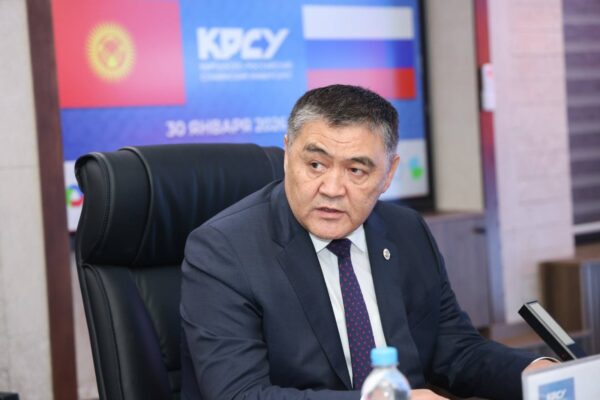
On June 15, the trial of the former head of Kyrgyzstan’s State Committee for National Security, Kamchybek Tashiev, and several other defendants – allegedly associated with the “Letter of 75” – was declassified at the request of the defendants. Now open, the trial is unfurling in the press as it is in the courtroom, including the leak of apparent interrogation videos.
The “Letter of 75” matter relates to an appeal signed by 75 public figures that urged Kyrgyz President Sadyr Japarov to call for an early presidential election. Some Kyrgyz media outlets have taken to referring to the letter as the “letter of the 75 aksakals” – literally “white beards,” a term for male elders. The letter began circulating two days before Tashiev’s dramatic dismissal in February and is at the core of the state’s allegations that Tashiev, and a number of other individuals, were plotting an coup.
In late April, Tashiev and the other defendants were charged under Article 326 (“Violent seizure or retention of power, as well as an attempt to violently change the constitutional order”) and Article 337 (“Abuse of office”) of the Kyrgyz Criminal Code. Among the defendants are former Prosecutor General Kurmankul Zulushev and former Speaker of the Zhogorku Kenesh Nurlanbek Turgunbek uulu. Turgunbek uulu resigned a week after Tashiev’s dismissal in February. Another defendant is Emilbek Uzakbaev, who served in various positions in the Kyrgyz government, with his last significant post being as ambassador to Uzbekistan in 2012-2016.
The trial began in May and was initially classified as secret. Although an initial request by the defense to declassify the proceedings was denied in May, the defendants continued to demand a public trial and on June 15 the court granted that request.
The first open hearings considered, among other matters, a motion from Uzakbaev’s defense insisting on a medical evaluation for the 70-year-old man and requesting that his pretrial detention be altered. Although some defendants, like Uzakbaev, are being held in pretrial detention, Tashiev is not. Photos from the courtroom also show several defendants in the usual glass cage, but Tashiev sitting at a table.
The trial proceeded with witnesses largely concerned with the reception of the so-called Letter of 75 in February by members of parliament and featured a verbal clash between Tashiev and a witness.
The state called Elvira Surabaldieva, a member of parliament, to testify regarding the circulation of the Letter of 75. Surabaldieva shared her opinion that she viewed the letter as an attempted coup, repeating a statement she had made in a in April interview with a Kazakh journalist.
Amid Surabaldieva’s testimony and questioning by lawyers on both sides, Tashiev chimed in to argue with the witness, reminding her that he was one of the first to arrive at the scene of her father’s murder.
Zhyrgalbek Surabaldiev, a businessman and member of parliament, was shot to death in broad daylight in Bishkek in November 2005. Media referred to him as a supporter of Askar Akayev, independent Kyrgyzstan’s first president and its first president to be deposed via revolution in March 2005.
In court, Surabaldieva met Tashiev’s barbs with her own retort: “What does my father have to do with this? My sister was there first, not you. You’re pressuring me by bringing up his murder. Are you threatening me? You wanted to put me in jail so many times back then, and now this?”
Tashiev denied ever wanting to imprison her. Surabaldieva responded by saying, “Someone here is used to silencing everyone and threatening people. I think the judge is also afraid of someone, which is why he does not reprimand him and only reacts to my statements.”
The judge eventually did step in to reprimand Tashiev.
The next day, on June 16, videos began circulating apparently showing Tashiev being questioned. The videos are undated and it’s not clear where they originated. In a commentary published by 24.kg, Sultan Makilov, head of the press service for the Kyrgyz Ministry of Internal Affairs, did not directly confirm that the videos are genuine, but neither did he take the opportunity to state that they are not.
Makilov dismissed the suggestion that the release of videos could be considered a deliberately orchestrated smear campaign by noting that the defendants themselves had demanded “maximum transparency.”
“Regarding the dissemination of video recordings of investigative actions on social media, we do not view this as a deliberately organized action or as an action pursuing political goals. We believe this issue should not be given a political overtone,” he said.
Makilov denied any knowledge of how the videos became publicly available.
In the leaked video, a man who looks like Tashiev appears to comment on the lack of public demonstrations regarding his case, and brag about his supporters.
“We’ll settle everything in court. Otherwise, I’ll also say everything openly, I’ll speak out officially. Today’s silence is deceptive. Thousands of people will rally for me,” the man in the leaked video says.
“I’ll start taking action too. I didn’t work for the Ministry of Agriculture either.”
The leaked videos, whether genuine or not, lack context. It’s not clear when they were filmed, or whether they have been manipulated. The video of Tashiev includes jumps and changes of angle, pieces of a longer tape that have been clipped together – arguably to influence the viewer and direct their conclusions.
The trial is ongoing and, as it remains open, is sure to be closely watched.


