

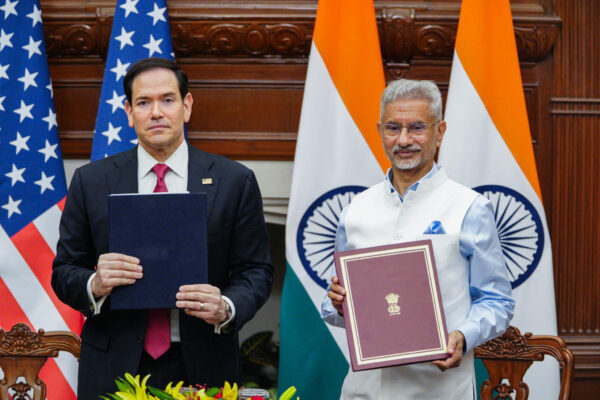
India’s current relationship with the United States is extremely difficult to classify in conventional geopolitical terms. It is neither an alliance in its traditional form, nor does it fit into the category of outright rivalry. And it is not a friendship marked by strategic intimacy. The India-U.S. relationship occupies an awkward and ambiguous space.
The recent conflict in the Middle East has only exacerbated underlying tensions caused by sharply different regional priorities. Nevertheless, anyone who looks for a convenient story of an emerging alliance or a collapsing one would also be disappointed.
Let’s start with the latest incident to roil the relationship. Between June 8 and June 11, U.S. military forces operating in proximity to the Strait of Hormuz attacked a number of ships traveling through the sensitive region. One of these ships was the oil tanker MT Settebello, which had two dozen Indian nationals on board. Unfortunately, three Indians died as a result of the U.S. military action. In a separate incident, another Indian sailor died of medical complications independently, and his body rotted away on the stranded ship owing to the U.S. blockade, which made it impossible to evacuate him.
When the Ministry of External Affairs of India summoned the U.S. charge d’affaires regarding the matter, U.S. Secretary of State Marco Rubio replied that the United States would not allow the “illicit transport of Iranian oil.” He added that “all commercial vessels should immediately comply with orders from U.S. forces.”
The American reaction has angered many in New Delhi and for good reason. The death of Indian citizens, whether intended or not, by a country that is projected as a strategic partner is not easy to brush aside with mere legal arguments and diplomatic platitudes.
For many Indians the first comparison that comes to mind makes for an uncomfortable parallel: China’s reaction to the 1999 NATO attack on its embassy in Belgrade, which killed three Chinese nationals. At the time, the Chinese could do little to stand up to the United States, but they still managed to get President Bill Clinton apologize publicly as well as extract $32.5 million in compensation. So far, India has succeeded at neither. The difference is not lost on either commentators or opposition politicians.
The innocent raises a legitimate question: Does India’s much-vaunted “strategic autonomy’” give New Delhi any leverage at all?
To be blunt, the honest answer would be: not much. At the very moment when India needs to be more flexible in its approach than ever before, it finds itself trapped in the bind created by its dependence on Russian military equipment, U.S. advanced technology, Chinese manufactured parts, and Gulf energy imports.
However, it is just as wrong to interpret these developments as signs of an unravelling India-U.S. partnership. The Quad has been written off by many as an obsolete platform, but its Foreign Ministers’ Meeting held in New Delhi in May came up with much more than meets the eye. The foreign ministers of Australia, India, Japan, and the United States emphasized practical cooperation and strategic continuity in an era of sustained great power competition. Cooperation on critical mineral supply chains, maritime surveillance, undersea cables, cybercrime, and development of ports in Fiji might not seem to be glamorous topics. However, they represent what a well-functioning partnership should be doing. Perhaps the point here is that the Quad should focus more on delivery and less on rhetoric.
It must also be recalled why India and the United States came together initially. The structural dynamics of the relationship have remained almost unchanged. China continues to be the critical element that pushes India and the U.S. closer together. And there has been no incentive on either side to let disputes and disagreements come in the way of an arrangement that has taken decades to build up. As Pete Hegseth, the U.S. secretary of defense, emphasized during his speech at the Shangri-La Dialogue in Singapore, an India strong enough to work for its own interests maintains the balance of power that the United States would like to sustain in the Indo-Pacific region. In fact, retired U.S. Marine and diplomat Grant Newsham has argued that even if the relationship currently finds itself in a “down moment,” it still looks remarkably positive compared to the Cold War era.
However, there are genuine tensions that cannot be wished away. It is hard to see Washington’s recent conduct in India’s neighborhood as partner-friendly. For example, the United States supported the 2024 regime change in Bangladesh, about which India had sounded warnings and which has resulted in Islamist resurgence, as feared by New Delhi. The U.S. stance toward Myanmar has also caused problems from a security perspective in India’s vulnerable eastern frontier. There has been a growing inclination in the United States to consider Nepal as an independent strategic partner rather than falling within the domain of India. And finally, the Trump administration’s warming up to Pakistan, which has long been sponsoring terrorism against India and is effectively a Chinese client state, adds insult to injury.
Then there is the awkward issue of what exactly Washington wants from India economically. The admission by U.S. Deputy Secretary of State Christopher Landau that Washington would not repeat with India the “mistakes” it had made with China – allowing it to develop its market and then potentially compete with the United States – has come as a rude eye-opener. New Delhi cannot be expected to be oblivious to this noticeable shift in the U.S. strategic framing of India.
Surely, the message from Washington feels contradictory: India is indispensable for Indo-Pacific security, but also a trade problem to be solved and also a country whose citizens can apparently be killed by U.S. military operations without a formal apology being deemed necessary. So what is India supposed to do about these paradoxes and contradictions?
The strategic advice coming out of different quarters tends to cluster around certain key points. First, be useful to Americans. The Trump administration values tangible help without caring for diplomatic niceties. Increasing cooperation at the working level within the Quad, increasing access arrangements in the Indian Ocean and helping to break China’s chokehold on rare earth minerals are the kinds of contributions that would earn India strategic credit.
But most importantly, India also requires its voice to be heard. While a restrained reaction to the deaths of the sailors may seem diplomatically prudent in the short run, there are limits to such political prudence. Nations build their prestige through defending their interests; tolerating the murder of their citizens without making any demands for accountability is hardly an image that can boost India’s global reputation.
A realistic portrayal of India-U.S. ties is not an optimistic story, but also not a pessimistic one of inevitable deterioration. Instead, it is a far more challenging reality of a relationship whose significance and common interests have been rising despite the tensions caused by differing regional considerations and asymmetric leverage as well as a transactional administration in Washington that values power more than anything else.
India is now economically and militarily more powerful than it ever was before, yet it is not quite powerful enough to dictate terms to the Americans. The task for the next several years is to close that gap while keeping the partnership alive long enough to benefit from it.
