

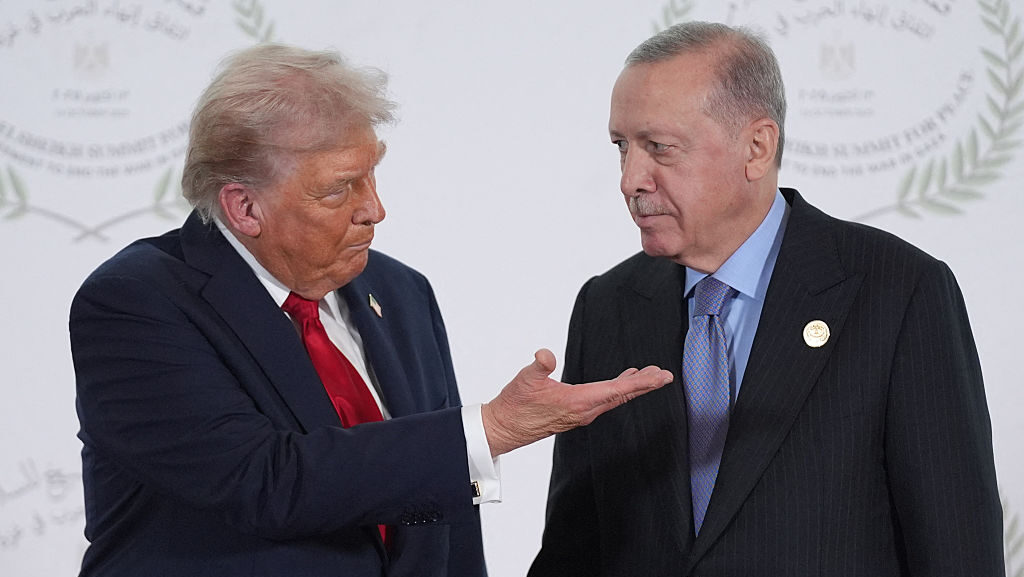
Turkish President Recep Tayyip Erdogan appears eager to impress Washington and Brussels at the upcoming NATO summit in Turkey, with Ankara undertaking robust preparations and Turkish officials trumpeting Erdogan’s personal ties with President Donald Trump.
Erdogan, no doubt, has many goals heading into the summit, including strengthening Turkey’s defense industrial base and championing its growing arms exports. Erdogan would also like to see Turkey readmitted to the F-35 fighter jet program.
It appears the Turkish leader’s campaign is having an effect. Speaking to reporters on Wednesday from the oval office alongside Secretary General of NATO Mark Rutte, Trump said he would “probably do something” to make Erdogan “very happy” in response to a question about whether the administration would allow Turkey to obtain the F-35. Vice President J.D. Vance indicated that the Pentagon was “reviewing” legal avenues to provide Turkey with the F-35, only for Trump to interject that “we will work it out.”
Readmitting Turkey to the F-35 fighter jet program would be a major mistake. That is because Erdogan has repeatedly cozied up with America’s enemies — namely Russia, Hamas, and China. A country led in such a manner should not be trusted with one of America’s most cutting-edge combat aircraft.
Despite the Trump administration’s suggestions to the contrary, the case against Ankara receiving the F-35 remains clear.
After Turkey procured the S-400 air and missile defense system from Russia despite repeated warnings from the United States, the first Trump administration was left with no choice but to evict Turkey from the F-35 program in 2019. The reasons are as self-evident now as they were then.
The F-35 boasts sophisticated capabilities and sensors that make it central to American security and future US conflicts with China, Russia, Iran, or North Korea. Turkey’s possession of both the S-400 and the F-35 would be dangerous because it would allow the two systems to be operated in regular proximity to each other or even networked together.
This would enable Moscow to potentially gain valuable intelligence helpful for shooting down F-35s flown by Americans or our allies. If that were to happen, given growing security cooperation among the four Axis of Aggressors adversaries, we should not be surprised if Moscow shares sensitive technological details of the F-35 with Beijing, Tehran, and Pyongyang. That would not only endanger American national security and pilots, but also US partners who fly the aircraft.
Even if Ankara got rid of its S-400s, something Erdogan has been reluctant to do, Washington should still not provide Turkey with the F-35 because he has demonstrated a willingness to align with other enemies of the United States as well.
Take Hamas, for example. After the terrorist group launched its horrific terror attack on Israel on Oct. 7, 2023, Erdogan continued to support a terror group that has murdered and held Americans hostage and is dedicated to the destruction of America’s partner, Israel. Indeed, after the terror organization conducted the worst single-day murder of Jews since the Holocaust, Erdogan praised Hamas.
But Erdogan’s embrace of America’s enemies does not stop there. In addition to purchasing Russian air defenses and supporting Hamas, Erdogan’s government has developed troubling ties with the People’s Republic of China (PRC), America’s leading adversary.
As part of a growing bilateral relationship under Erdogan, China has invested heavily in Turkey’s digital ecosystem. By the end of 2025, over 150 Chinese companies were active in Turkey’s digital infrastructure, including its 5G telecommunications system, according to a study by the Swedish Defence Research Agency. The presence of Chinese 5G equipment is especially concerning, as it has been linked to significant espionage and cyber risks.
To be sure, the issue of Chinese 5G devices and American allies is not unique to Turkey. But, unlike Turkey, many of these countries have worked to mitigate the presence of Chinese 5G equipment or transition away from it entirely. The United Kingdom, for instance, has taken steps to remove Chinese 5G equipment. Ankara, on the other hand, is moving in the opposite direction and its relationship with China goes beyond solely the economic and technological domains.
Turkey’s association with the Chinese and Russian-led Shanghai Cooperation Organization (SCO) is also troubling. The SCO is a key element of the PRC’s strategy to project power beyond the Pacific. While not a full member, Turkey has been a “dialogue partner” of the SCO since 2012. It is also worth remembering that Turkey came close to purchasing the export variant of the Chinese HQ-9 air and missile defense system in the 2010s before settling on another bad option: the Russian S-400.
Taken together, Turkey’s ties with China are clearly inconsistent with NATO’s 2024 Washington Summit Declaration, which identified the PRC as a country whose “stated ambitions and coercive policies continue to challenge our interests, security and values.”
Erdogan wants to portray Turkey as a robust Western ally that supports collective security goals. That marketing campaign will be on full display at the NATO summit. But that is not Erdogan’s real focus. His main priority is achieving strategic autonomy and independence from the West to further his aggressive revisionist and irredentist goals that undermine American, European, and Israeli security. That is why he is prioritizing obtaining technologies from the West and why he is willing to work with Russia, Hamas, and China.
It is clear that Erdogan has applied a full-court press on Trump. In his comments Wednesday, Trump called Erdogan “a respected man, a respected leader.” That is not exactly an assessment most Americans would use for someone who has fully embraced Hamas, a designated terrorist organization, especially after the group launched the Oct. 7 terror attacks. Moreover, what should matter to the US government is not the personal relationship between Trump and Erdogan, but rather a sober assessment of whether the transfer of the F-35 is in the American interest and consistent with US law.
It clearly is not and would run afoul of the Countering America’s Adversaries Through Sanctions Act (CAATSA) and Section 1245 of the 2020 National Defense Authorization Act. Section 1245 makes clear that Turkey cannot receive the F-35 if it still “possesses” the S-400. The Trump administration reiterated in a Dec. 15, 2025 letter that it was committed to abiding by CAATSA and clearly understood the requirements of Section 1245.
Congress should warn the administration to not ignore the law and serious concerns related to Russia, Hamas, and China. If the administration proceeds anyway, members of both parties and chambers would be wise to support joint resolutions of disapproval to block the sale of the F-35 to Turkey.
Regardless, Congress should also require the administration to submit an annual written report on any Turkish defense industrial base, dual-use, or security cooperation with Russia or China. That would help expose concerns that should inform future policy toward Ankara.
There are several opportunities to better secure the alliance and American interests at the NATO summit next month. But readmitting Turkey to the F-35 program is not one of them.
Cameron McMillan is a senior research analyst for the Center on Military and Political Power at the Foundation for Defense of Democracies (FDD), where Bradley Bowman is the senior director. Sinan Ciddi is a senior fellow and the director of FDD’s Turkey Program.
