

TOBYHANNA ARMY DEPOT, Pa. — As reporters walked through halls the size of football fields peering at spaces that will soon whir with machines and conveyor belts carrying stacks of minuscule parts, Army officials revealed new details on how they are scaling up drone component production at an unprecedented pace.
These details come ahead of an Army advanced manufacturing strategy expected to be released in the coming weeks.
“How do you take a culture that typically has five to eight years to stand something up and do it in weeks and months? We had to bend a lot of things, had to flex a lot of things, but we had to get a lot of support from both industry and senior leadership to say this can be done, and so every small win mattered,” Jonathan Strzelec, the chief of Tobyhanna’s Transformation Office, told reporters during a tour of the depot Monday.
A large part of the service’s new advanced manufacturing strategy is scaling small drone production in the US, Strzelec, who also supports Army Material Command “for all things UAS,” explained. The strategy falls into the Defense Department’s larger Drone Dominance initiative to scale production in the US so the country doesn’t have to continue to rely on parts made in other countries, namely China.
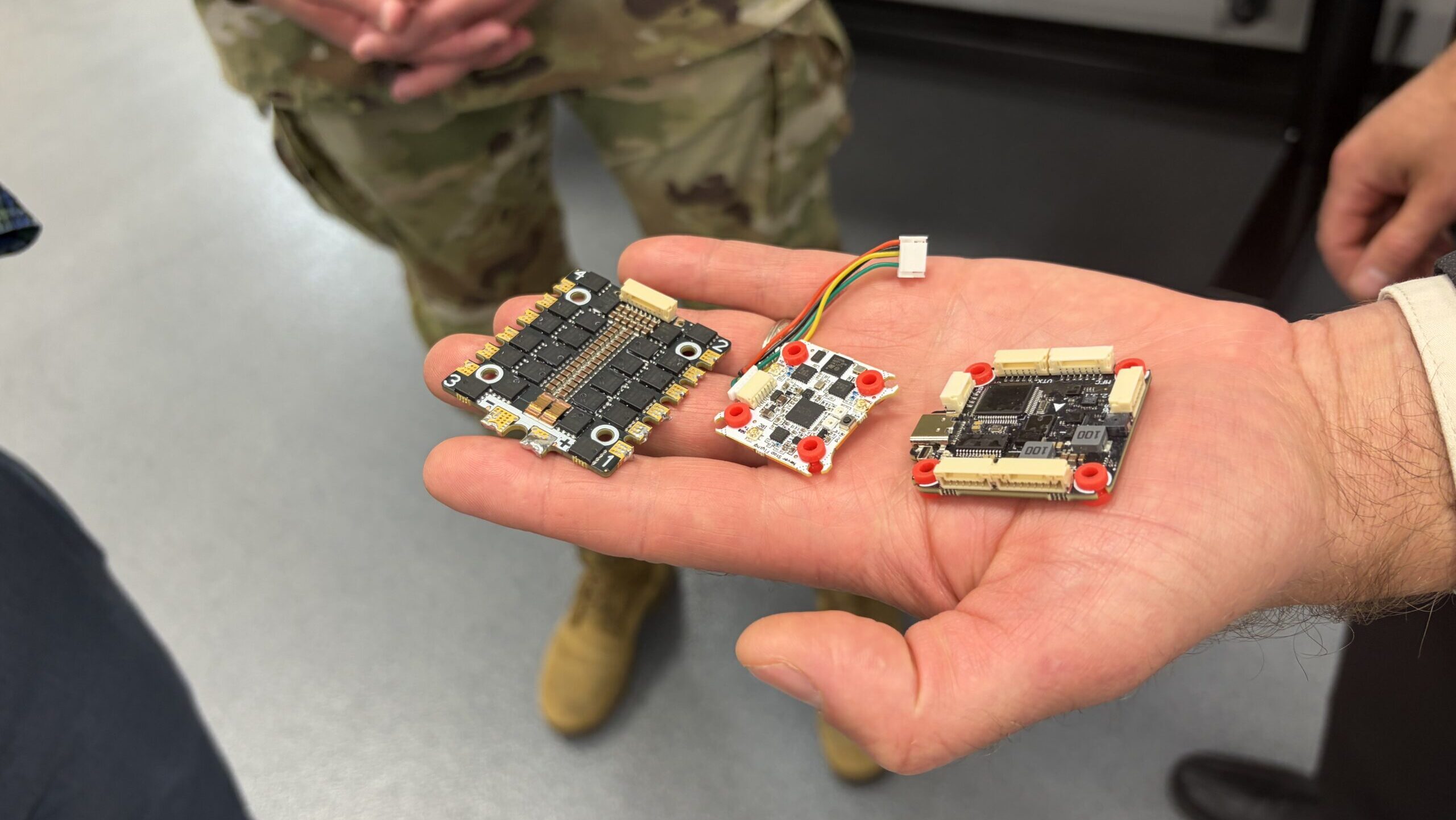
With that, Strzelec said that two tricky but vital components of drone production are making the brushless motors and the circuit card assemblies — the parts in a drone responsible for producing live video, GPS functions, motor speed and more.
Strzelec noted that the Army is officially starting up its new brushless motor assembly line in the depot today with the goal of producing 200,000 motors initially. He did not provide a timeline for when the depot expected to complete that task, but did note that the line is capable of making up to 1,500 motors a day — enough for 375 drones as each drone takes four brushless motors.
How many motors are produced each day, however, largely will depend on the demand from senior leadership and how much material the depot can acquire, Strzelec added.
For the circuit card assemblies, the depot is creating a new assembly line which Strzelec said he hopes will be up and running and capable of producing one million cards per day by the end of fiscal 2027.
“Right now, all of the circuit cards come from places we don’t want to be buying circuit cards from, and even if you find [places] that are making circuit cards in [the] United States, the components come from places that we shouldn’t be buying from,” Strzelec said.
He added that the depot will make four out of the five circuit cards that go on a first-person-view drone which will perform the following functions: video feeds, motor speed, GPS and power generation. The fifth card, which performs radio functions, will not be made at the because additional experts are needed, Strzelec said.
For both assembly lines, the service is aiming to bring in small vendors, probably those backed by venture capital firms, to utilize the Army’s facilities, Col. James Crocker, the deputy director of the Army’s Organic Industrial Base (OIB) Integration Office, told reporters on the tour.
The vision is for companies to rent the Army’s equipment, allowing vendors to avoid the cost and time of building their own facilities. That in turn enables them to scale more quickly and at a lower cost than larger companies, Crocker said.
Such arrangements, which are often structured as private-public partnerships (P3s) or the less restrictive cooperative agreements, also benefit the Army by generating revenue from its equipment while freeing personnel to focus on other tasks, Crocker added.
Further, Crocker said, the assembly lines can be altered to meet other Army needs. For example, if the service needs brushless motors for other use cases besides drones, he said a “slight change in the tooling can make brushless motors for a whole lot of different things.”
The depot can do the same with circuit card assemblies so they can be used for Army vehicles as well, Strzelec added, explaining that the service can even open their facilities up to the commercial automotive industry if there is a need.
“When Covid hit, you couldn’t get a Toyota or Ford because the backup camera circuit cars weren’t in stock. Technically speaking, the way we’re standing this up, if we hit another thing like that, and Ford or GM [General Motors] or Toyota, whoever needed a place to put circuit cards together, we could do commercial partnerships and cooperative agreements legally, and actually manufacture their cards for them and put them together here. If it was a national need that we were told to support,” he said.
“If you rethink of the OIB in that kind of construct, that’s really what OIB transformations about. It’s about changing how we think about the OIB, and how we leverage the sum of its parts to make a much better whole,” Crocker said.
