

India’s Defence Acquisition Council (DAC) has granted in-principle approval to a series of defence acquisition proposals for the armed forces, with an estimated collective cost of approximately Rs520bn ($5.5bn).
The latest Acceptance of Necessity (AoN) status was granted for projects involving equipment and systems for the Indian Army, Navy, and Air Force.
With aims to enhance the country’s air defence capabilities, the DAC, chaired by Defence Minister Rajnath Singh, has approved the procurement of anti-uncrewed aerial vehicle (UAV) electronic warfare system known as Akash Tarang, Medium Range Surface-to-Air Missile Weapon Systems (MR-SAM) and Very Short Range Air Defence Systems (V-SHORADS) for the Indian Army.
Akash Tarang is designed to counter UAV by utilising electronic countermeasures. According to Indian Defence Research Wing, the platform leverages electronic countermeasures that detect, track, and jam the control signals of drones, targeting their radio frequencies.
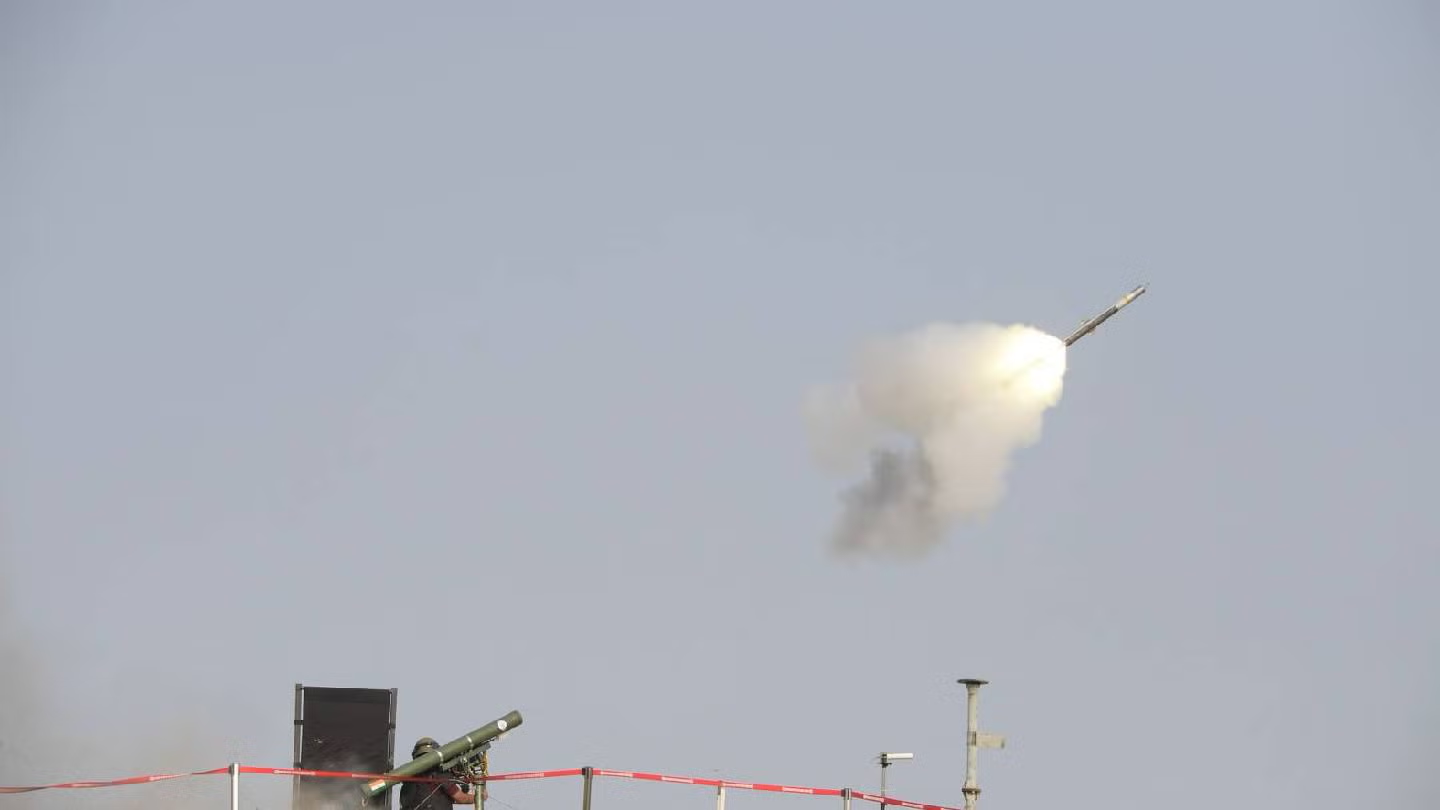
The MR-SAM Missile system will provide air defence coverage against a range of airborne threats, while the V-SHORADS, which is equipped with multi-spectral sensors, is expected to improve “counter-measure resilience and effectiveness” of the Indian Army.
DAC’s approval for V-SHORADS comes after the Defence Research & Development Organisation (DRDO) successfully conducted three trials of the system at the Integrated Test Range in February this year.
In addition, the DAC cleared the acquisition of Man Portable Anti-Tank Guided Missile Systems, Active Protection Systems for tanks, and Jet-Based Kamikaze Drone Systems for the Army.
The approval for Man Portable Anti-Tank Guided Missiles aims to enhance infantry capabilities against mechanised threats.
The Active Protection System for tanks is intended to improve armoured vehicle defence mechanisms and survivability, while Jet-Based Kamikaze Drones are set to strengthen electronic warfare options for ground forces.
The Indian Navy also has received approval to acquire Multi Influence Ground Mines (MIGM), Naval Shipborne Unmanned Aerial Systems (NSUAS), and to establish a Land Based Testing Facility (LBTF) for Electric Propulsion Systems.
According to the Ministry of Defence, the MIGM is intended to restrict adversary manoeuvre, while the NSUAS, which features advanced sensors, is expected to improve the Indian Navy’s situational awareness.
The LBTF will be used to address testing needs for motors and propulsion systems of Indian naval assets.
For the Indian Air Force, the council approved the procurement of Fixed-Wing Based High Altitude Pseudo Satellites (FW-HAPS), which are intended to support continuous intelligence, surveillance, reconnaissance, telecommunication, and remote sensing operations.
These approvals come after the DAC cleared procurement proposals worth approximately Rs2.38tn ($25.14bn) in March 2026, which included the Air Defence Tracked System and the S-400 Long Range Surface-to-Air Missile System.
Amid rising global tensions, the Indian government increased its defence budget, allocating Rs7.85tn to the Ministry of Defence in the 2026–27 Union Budget announced in February 2026. This marked a 15.19% increase from the previous year’s estimate and accounted for 14.67% of the total national budget.

