

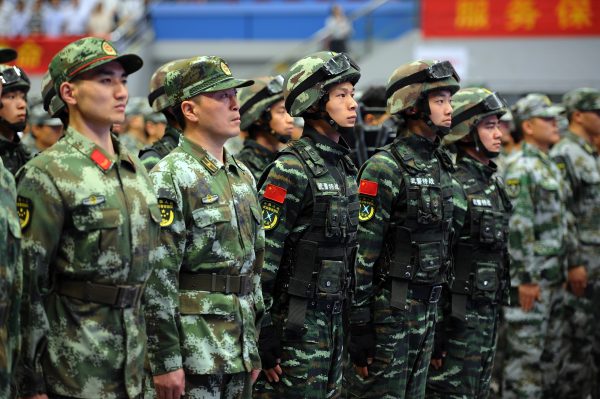
While the ongoing purge continues to haunt the People’s Liberation Army (PLA) officer corps – as seen, for example, in the June 26 removal of six military lawmakers from the National People’s Congress – there are signs that Chinese leader Xi Jinping has started assembling the cornerstones of a new Central Military Commission (CMC).
On July 3, a promotion ceremony was held at the CMC headquarters, where two lieutenant generals – Zhang Shuguang of the Army and Wang Gang of the Air Force – were elevated to the rank of general. At the same time, Zhang was appointed as the new secretary of the CMC Discipline Inspection Commission and Wang became the new Air Force commander.
A career political officer, Zhang has spent the last decade in the PLA’s graft-busting discipline inspection system, with experiences at the CMC-level, as well as in the Air Force and Army. This background makes him well-prepared to succeed Zhang Shengmin to lead the Discipline Inspection Commission, which has been indispensable in overseeing the PLA purge.
By contrast, the new Air Force chief Wang Gang seems to fit the definition of a professional military officer. Wang began his career as a pilot before rising to command an Air Force division. Later, Wang served as the director of the Air Force training department (2012–2016), assistant Air Force chief of staff (2016–2019), central theater command Air Force chief of staff (2019–2022), Air Force chief of staff (2022–2025), deputy Air Force commander (2025–2026), and finally the current commander of the Air Force.
Prior to the July 3 promotions, the PLA, an organization of over 2 million personnel, had only four serving generals. As a result of the rolling purges that reached a height in 2025, the PLA’s senior leadership has been depleted and new promotions are desperately needed to restaff posts at the CMC and its subordinate organs.
With that in mind, we should anticipate a steady stream of promotions from now until the 2027 Party Congress, when a new CMC will be unveiled.
Zhang Shuguang’s promotion to full general and take over of the CMC Discipline Inspection Commission shows Xi’s continued prioritization on enforcing strict discipline within the PLA – fundamental to sustaining his personal control over the most consequential institution in the Chinese political system. His predecessor, Zhang Shengmin, oversaw the second apogee of the PLA anti-corruption campaign, which reduced the senior military leadership to its smallest size in modern Chinese history. Zhang Shuguang is likely to carry out Xi’s directives with equal, if not greater, zeal, thereby improving his chances of becoming a CMC member at the next Party Congress.
Simultaneously, Zhang Shuguang’s appointment serves the purpose of chipping away at Zhang Shengmin’s powerbase. After almost a decade of controlling the CMC Discipline Inspection Commission, Zhang Shengmin has accumulated enormous clout within the anti-corruption apparatus – an institution with powerful individuals who can investigate and detain officers at any level. Since becoming the CMC vice chairman in October 2025, Zhang Shengmin’s power has been further entrenched, which might have caused concerns for Xi, who operates within an environment of very low trust.
Just as when Xi sidelined his old graft-busting partner Wang Qishan in 2018, at the peak of his authority and prominence following the initial years of the anti-corruption campaign, Xi appears to be repeating the same tactic here in 2026. While CMC Vice Chairman Zhang Shengmin retains indirect influence over military discipline and anti-corruption work, the immediate control over the CMC Discipline Inspection Commission has slipped from his hands.
The promotion of Wang Gang further confirms that the PLA Air Force remains Xi’s favorite service after the Army. Up until now, Air Force officers have been the least affected by the purge, suggesting that Xi still trusts them and see them as the least problematic service. In fact, Air Force officers account for three out of the PLA’s six existing generals. Wang’s elevation is likely to open doors for more Air Force officers to take up senior leadership posts as further promotions take place in the run-up to the 21st Party Congress.
More broadly, the promotion of one political officer and one professional military commander indicates that Xi is seeking to strike a balance between the two streams of officers, which respectively represent ideological reliability and professional military competence.
In essence, what seems to be a routine promotion ceremony exhibits clear signs of Xi laying the groundwork for a new CMC, after recent purges emptied the organ to just one member besides Xi himself. It would be very difficult for a military of over 2 million personnel to function effectively under the leadership of just two senior decision-makers. So, rebuilding the CMC with “red and expert” officers has become an urgent task for Xi.
