

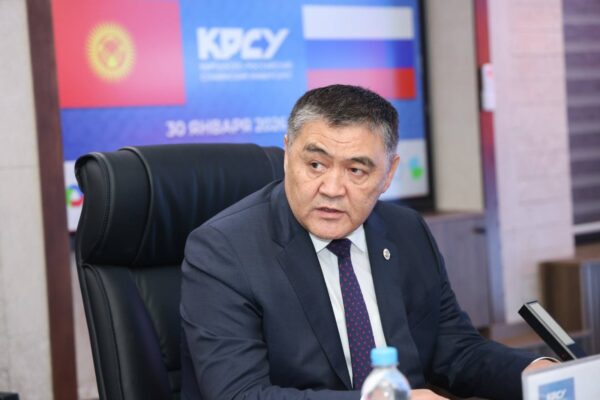
The day after Kamchybek Tashiev’s trial ended with a guilty verdict, the former former head of the State Committee for National Security was spotted heading for the VIP section of Kurmanbek Stadium in Manas (formerly Jalal-Abad) to attend a Kyrgyz Premier League match between Muras United and Asiagol.
On July 2, a judge in Bishkek delivered a verdict in the so-called “Letter of 75” case.
Tashiev, alongside former Speaker of the Zhogorku Kenesh Nurlanbek Turgunbek uulu, former Member of Parliament Kurmankul Zulushev, and five others, were found guilty of a coup attempt under Article 326 (“Violent seizure or retention of power, as well as an attempt to violently change the constitutional order”) and acquitted of abuse of office charges.
Although Tashiev and the rest were sentenced to four years in prison, the judge replaced their prison terms with three years of supervised probation. The five defendants who had been in custody were released. Tashiev served not a single day in detention.
The judge justified his changing of the sentences from jail time to probation because the convicted conspirators didn’t actually manage to complete the crime.
As reported by RFE/RL’s Kyrgyz Service, a statement from the court explained that “it was not a completed crime, as provided for by Article 326 of the Criminal Code of the Kyrgyz Republic, that was established, but preparation for its commission.”
The statement went on to cite the “personalities of the accused and their potential for rehabilitation without serving a prison sentence” in justifying probation.
The trial kicked off in mid-May and was immediately closed to the public. At the request of the defendants, the trial was opened in mid-June only for Tashiev to shout down a witness in full view of the media. The trial was re-classified thereafter.
The “Letter of 75” matter relates to an appeal signed by 75 public figures that urged Kyrgyz President Sadyr Japarov to call for an early presidential election. Notably, the letter framed Tashiev favorably, highlighting that many of the Japarov administration’s greatest successes – such as the final settling of the borders with Uzbekistan and Tajikistan – were initiatives spearheaded by the security chief. The mere hint that Tashiev would make an attractive presidential option blew the ruling tandem apart. He led the powerful State Committee for National Security, an organization whose historical roots are in the Soviet-era KGB, from May 2021 to until his dramatic dramatic dismissal in February, just two days after the letter began circulating.
Tashiev is far from the first person accused of plotting a coup during the Japarov administration, though the charge is occasionally framed as “inciting mass unrest” as in the case of two Kloop cameramen sentenced to five-year prison terms in September 2025.
That Tashiev – convicted of a coup plot – is spending his Friday nights in the VIP section of a football stadium while Kyrgyz journalists and musicians sit in jail, or exile, for reporting on his family’s corruption (reporting that the state effectively plagiarized to punish Tahsiev, his family, and his wider network) says everything that needs to be said about the character of justice and politics in Kyrgyzstan.
Kyrgyzstan has Central Asia’s most tumultuous political record, with three revolutions in 35 years: 2005, 2010, and 2020. The 2020 revolution brought Japarov and his longtime ally Tashiev to power together but now that tandem is broken.
Japarov surely has his eyes on January 2027, when he will invariably seek re-election. The closing of the case against Tashiev is hardly the end of his existence as a political force.
