

By André Pienaar
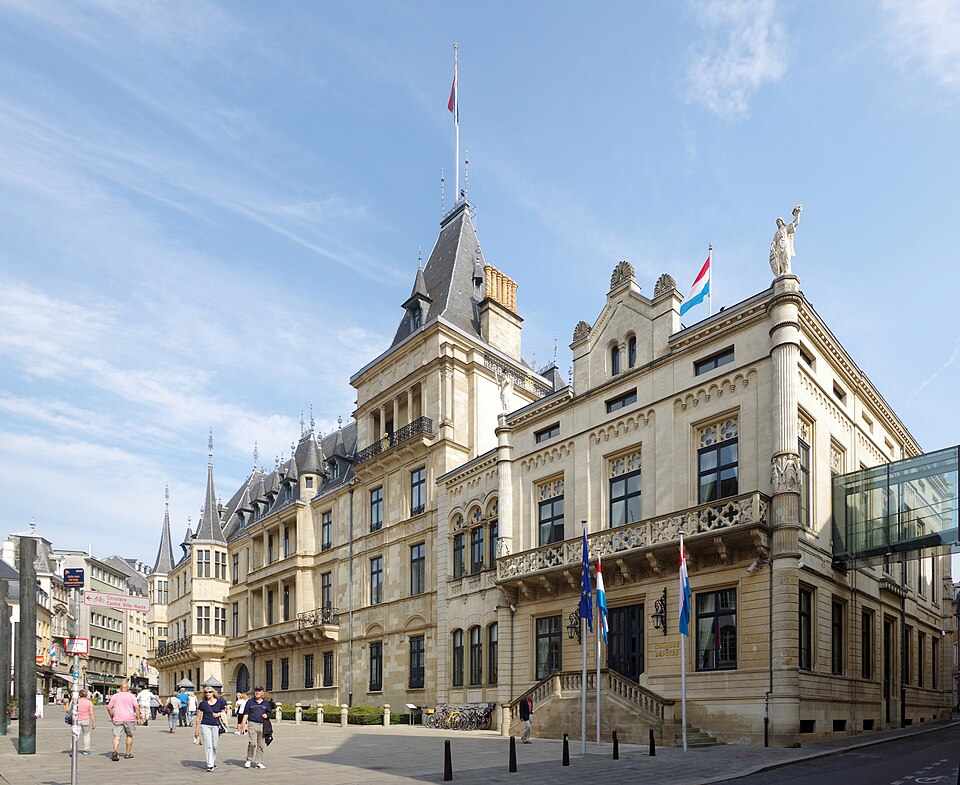
On Monday, at the grand-ducal palace in Luxembourg City, Grand Duke Guillaume V conferred on Jamie Dimon, Chairman and Chief Executive Officer of JPMorgan Chase & Co., the Commander Medal in the Order of Merit of the Grand Duchy of Luxembourg. The citation was brief, recognising the bank’s long-standing commitment to Luxembourg, and the ceremony intimate, attended by Mrs Judy Dimon and Xavier Bettel, the Deputy Prime Minister and Foreign Minister, who delivered the address. But the moment deserves more attention than a court circular entry. It tells us something important about how small European states are practising statecraft in an age of great-power competition, and about the role of American finance in the defence of the West.
It is the first year of a new reign. Guillaume V acceded only last October, upon the abdication of his father, and became, at the same moment, Grand Master of the Order of Merit, an order created in 1961 by his great-grandmother, Grand Duchess Charlotte, and one of the few Luxembourg honours that may be conferred on foreigners. That a new Grand Duke chose, early in his reign, to decorate the head of America’s largest bank is not protocol on autopilot. It is a deliberate signal of where Luxembourg sees its interests, anchored to American capital, American markets and the transatlantic system that has underwritten the Grand Duchy’s security and prosperity since 1945.
Finance as a pillar of national security
JPMorgan Chase employs more than 318,000 people in over sixty countries. Roughly 800 of them work in Luxembourg, where the bank’s subsidiary occupies a strategic place in the group’s international operations. For a country of under 700,000 people, that presence matters far beyond the payroll. Luxembourg has built its sovereignty on being indispensable to the plumbing of Western finance: the world’s second-largest fund domicile, a hub for cross-border banking, and increasingly a serious centre for financing European space and defence technology.
It is also a founding member of NATO, and its defence strategy is a study in how a small state contributes intelligently to collective defence. Rather than spreading itself thin, Luxembourg has concentrated deliberately on space and cybersecurity. Its 2022 Defence Space Strategy, the GovSat secure communications joint venture with SES, and the LUXEOSys Earth observation satellite have made the Grand Duchy a genuine space power within the Alliance, while its cyber defence programme, anchored by the Luxembourg Cyber Range and a ten-year Cyber Defence Cloud, reflects a stated ambition to field one of the most secure cyber defences in NATO and the EU. The Grand Duchy hosts NATO’s Support and Procurement Agency, was among the first European states to build a national space resources framework, and has accelerated its path to the Alliance’s spending benchmark. Small states survive by making themselves systemically important. Luxembourg has understood this longer, and better, than most.
Mr Dimon, for his part, has spent the past several years sounding an alarm that many in European capitals have only recently begun to heed. He has warned repeatedly that the world may already have slipped into a new era of protracted conflict between the West and an axis of adversaries, and that the health of Western capital markets is inseparable from Western hard power. His annual shareholder letters have read, at times, less like banking commentary than strategic assessments, treating supply chains, energy security, defence industrial capacity and the credibility of American alliances as balance-sheet questions. In this he has been right. Wars are won by economies before they are won by armies, and the deterrent power of the West rests on the depth, liquidity and integrity of its financial system, a system in which JPMorgan is a load-bearing institution.
Nor has he confined himself to warnings. Last October, JPMorgan launched its Security and Resiliency Initiative (SRI), a pledge of $1.5 trillion over ten years to facilitate, finance and invest in the industries on which Western security depends, including defence and aerospace, supply chains and advanced manufacturing, energy resilience, frontier technologies and critical medicines, with up to $10 billion in direct equity investment. It is the largest commitment of private capital to national security ever made by a financial institution. In April, the initiative crossed the Atlantic. SRI was extended across Europe, with the United Kingdom, France, Germany, Poland and Italy as priority markets, and every EU and NATO member state within its scope. Mr Dimon framed the expansion plainly: the United States and Europe have relied for too long on unpredictable sources for the things their collective security depends upon, and it is in their shared interest to fix this together. For a continent scrambling to rearm and re-industrialise, a trillion and a half dollars of intent from America’s largest bank is not a gesture. It is capacity.
The company he keeps
It is telling that among the foreign recipients of Luxembourg’s Order of Merit is Admiral James Stavridis, the former Supreme Allied Commander Europe. The symmetry runs deeper still. JPMorgan’s own SRI advisory council includes General Chris Cavoli, until recently SACEUR himself, and the bank has announced its intention to appoint Admiral Sir Tony Radakin, the former Chief of the UK Defence Staff. A Grand Duchy that decorates both a Supreme Allied Commander and the chief executive of America’s largest bank is expressing a coherent worldview: the defence of Europe is a joint venture between military power and financial power, and both are, for now, disproportionately American.
As Europe rearms, with defence spending commitments unseen in generations and a continental defence technology sector finally beginning to attract institutional capital, including here in Luxembourg, the question is whether European and American capital will move together or apart. Monday’s ceremony was Luxembourg’s answer.
There was a lighter coda. The following day, Mr Dimon continued his European tour to The Hague, where he was received in audience by Queen Máxima of the Netherlands, herself a former banker and the UN Secretary-General’s Special Advocate for Inclusive Finance for Development, in a meeting cheerfully gate-crashed by the royal dog. But the serious business had already been done in Luxembourg.
At seventy, and in what may prove to be the closing chapter of a singular career, Mr Dimon has become something more than a banker: an unofficial ambassador for the proposition that the American financial system and the security of the free world are one and the same project.
The Grand Duchy, which has survived two centuries of European upheaval by reading the strategic weather correctly, has just pinned a medal on that proposition. The rest of Europe should take note.
