

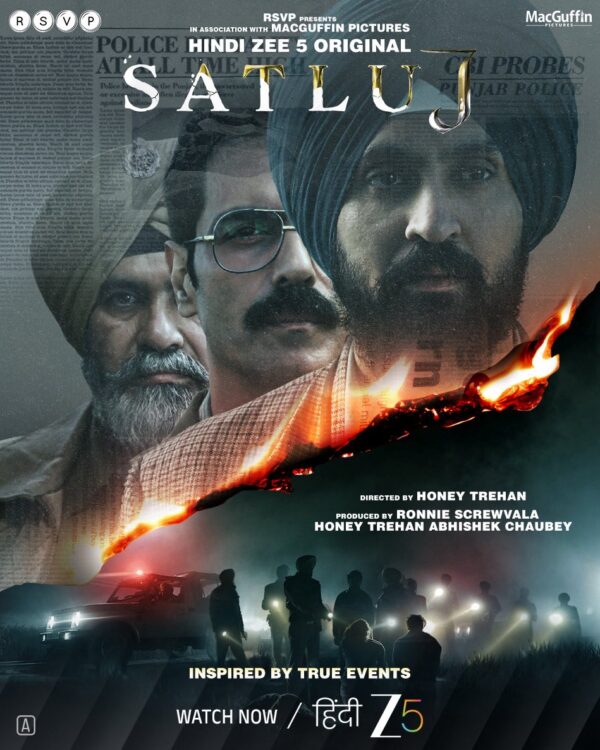
The innocuously titled film “Satluj,” named after a tributary of the River Indus that flows through the Indian state of Punjab before crossing into Pakistan, was quietly released on the OTT video streaming platform Zee5 without much fanfare on July 3. Within two days, it was suddenly pulled by the channel due to a government diktat citing “national security concerns.”
Originally titled “Punjab 95,” the film is set against the backdrop of the Sikh separatist insurgency in Punjab during the 1980s and 1990s, when the movement for an independent Khalistan was at its peak, and when the Congress party was in power.
The scale of violence that Punjab witnessed during those years, both by the separatists as well as by the state, which used all its power to crush the movement, has left deep scars in the Punjabi psyche and population.
“Satluj” is based on the life of human rights activist Jaswant Singh Khalra, who fearlessly exposed police atrocities – thousands of enforced disappearances, secret cremations, and extrajudicial killings – during that period. The film is being hailed as one of the “most powerful films made in India” in recent times.
Directed by Honey Trehan and starring the famous Punjabi actor and singer Diljit Dosanjh, the film had been battling India’s Censor Board for three years to get a theatrical release. Censors demanded 127 cuts in the film. They wanted the names of the film’s protagonists and even places to be changed so that none could be identified as the setting of real events. The director and his team refused to cave in under pressure.
India’s Censor Board is supposed to be an objective body. But it has been increasingly accused of taking decisions based on the political interests of the government in power and stifling free speech and creative expression.
Ultimately, the makers of the film opted to release the uncut version of the film on OTT, where Censor Board clearance is not required. They also changed the name of the film from “Punjab 95” to “Satluj” to avoid controversy. Despite no publicity or marketing, Satluj received rave reviews from the OTT audience. The popularity can be gauged from the fact that it garnered 6.58 million views on the Zee5 platform in India alone within the 48 hours it was online.
The 163-minute-long biopic shows how Khalra, a bank employee in Amritsar, started investigating the disappearance of his friend and stumbled upon thousands of similar cases of forced disappearances of young men. He goes public with his investigation and allegations that the police, at the height of the insurgency, had secretly cremated 25,000 people without informing their families. He even garnered international attention to these extrajudicial killings and met Canadian parliamentarians. Expectedly, Khalra faced the full brunt of the state machinery’s attempts to silence him.
In the 1990s, the Punjab Police, which was at the forefront of the counter-terrorism operations, was led by “supercop” KPS Gill, who had unbridled power to crush the insurgency. His brutal tactics institutionalized custodial torture and killings. Gill is credited with wiping out the insurgency in Punjab, but his methods were illegal and controversial.
Ajit Singh Sandhu, who is alleged to have been behind the abduction, torture, and murder of Khalra in 1995, reported to Gill. Incidentally, Sandhu later committed suicide. Four policemen were later found guilty by the High Court and sentenced to life imprisonment.
The violence of the 1990s may have receded, but the trauma it left behind has not been fully addressed. Not surprisingly, the film has resonated with the audience, especially Punjabis.
However, the film has also drawn flak from critics for glossing over the large-scale terror and crimes that the Khalistanis unleashed on Hindus and police forces in Punjab. The Khalistan movement enjoyed the active support of Sikh religious institutions, including the gurdwaras, as well as political backing from the Akali Dal, a regional party.
To avenge the storming of the sacred Golden Temple gurudwara in Amritsar by the Indian Army (titled Operation Blue Star), the separatists assassinated then-Prime Minister Indira Gandhi in October 1984 and subsequently General Arun Shridhar Vaidya, who was army chief during Operation Blue Star.
Nonetheless, the banning of the film from being screened in India and abroad underscores how the Indian state is reluctant to revisit uncomfortable episodes in the past or to allow discussions on related issues. The ruling Bharatiya Janata Party (BJP) seems to prefer silence and erasure to control the narrative. It reflects the refusal of authorities to accept that there was repression and state-perpetrated violence.
The use of force has always been an important part of the Indian state’s counterinsurgency strategy, be it in the insurgency-wracked Northeast or in Jammu and Kashmir. There has been an excessive reliance on heavy deployment of troops and use of force, while ignoring or subordinating the root causes and grievances underlying the insurgency.
The government’s response to “Satluj” reinforces this pattern of avoiding introspection of the state’s role in fueling militancy.
The BJP government’s justification of the ban on the grounds that the public screening of “Satluj” would reignite secessionist passions does not stand to reason. After all, it had no objection to movies like “The Kashmir Files” or “The Kerala Story” that demonized Muslims while championing Hindu supremacy. Not only did the government allow these incendiary films to be screened, but it also provided tax cuts to encourage more people to view these films.
The ban on “Satluj” has triggered discussions on how it will impact politics in Punjab.
Punjab is due to vote in assembly elections in February 2027. Amid rising political temperatures in the state, the controversy that “Satluj” highlights has assumed political colors.
With “Satluj” reopening old wounds and reviving memories of Punjab in the 1980s and 1990s, the Congress, which presided over the counterterror operations of that period, could be impacted adversely in the election.
The Shiromani Akali Dal (SAD), which projects itself as the standard bearer of Sikh interests, stands to gain electorally from the film revisiting Sikh grievances. SAD is an ally of the BJP.
While highlighting atrocities against Sikhs, “Satluj” ignores the killings of Hindus, who were targeted by the Khalistanis. This could help consolidate Hindu votes in favor of the BJP. While Sikhs comprise the majority of Punjab’s population, there are a large number of Hindus as well.
Interestingly, while the BJP government has banned the screening of “Satluj,” the movie is being screened freely in gurudwaras and in villages. While silencing informed discussion of what the film has to say, it is keeping the communal cauldron bubbling.
