

The old saying goes that an enemy of an enemy is a friend. This proverb seems to match the growing closeness between Taliban-ruled Afghanistan and India, which, for strategic reasons, remained anti-Taliban during the group’s rule in Afghanistan between 1996 and 2001 and supported the Afghan Republic governments between 2001 and 2021.
Meanwhile, Pakistan was considered the biggest ally and supporter of the Taliban from 1996 until the group’s takeover of Kabul in August 2021. But thereafter, the former allies have been unable to see eye to eye. The core issue is the Tehreek-e-Taliban Pakistan (TTP), which, according to Pakistan, is using Afghan soil as a safe haven from which it engages in terror activities against Pakistan. The Taliban deny this allegation and say that the TTP is an internal matter for Pakistan.
While Pakistan and Afghanistan have been striking each other, particularly since October 2025, India – Pakistan’s arch-rival – is deepening its relations with Taliban-run Afghanistan. Since early 2025, New Delhi’s policy vis-a-vis the Taliban has undergone an arguable strategic realignment.
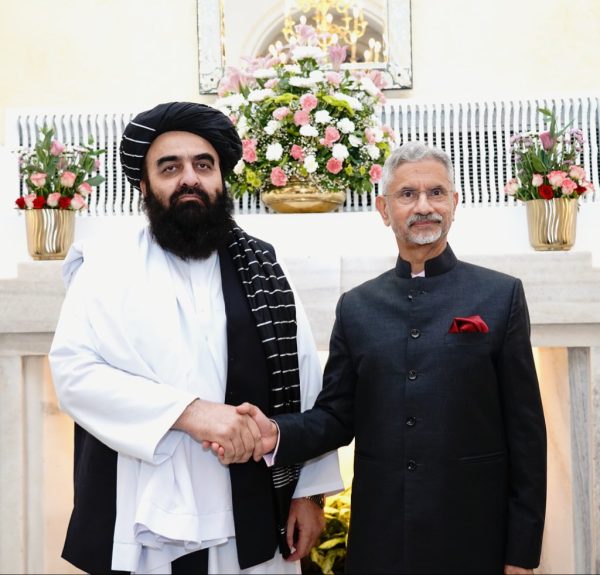
India’s diplomatic outreach to the Taliban has increased tremendously over the last year, following the United Arab Emirates’ facilitation of a meeting in Dubai between Indian External Affairs Secretary Vikram Misri and Taliban Foreign Ministry Amir Khan Muttaqi on January 8, 2025. That meeting marked a major diplomatic milestone, as the relationship between New Delhi and Taliban-controlled Kabul began to take a positive turn.
Prior to the January 2025 meeting, Indian Ministry of External Affairs Joint Secretary J. P. Singh was the senior-most Indian official to have publicly met with Taliban officials, meeting with Muttaqi and Defense Minister Mohammad Yaqoob in November 2024.
Engagement has picked up since, to include telephone diplomacy. The first high-level ministerial call took place last year on May 15 between Indian Minister of External Affairs S. Jaishankar and Muttaqi a few days after the four-day war between India and Pakistan. But engagement has gone beyond phone calls. During the last nine months, four Taliban ministers have visited India.
This timeline of growing relations between the Taliban and India coincides with the ongoing conflict between Pakistan and Afghanistan.
In October 2025, Muttaqi traveled to India for a six-day visit. It marked the first visit by a senior Taliban minister to India. For Muttaqi’s visit to New Delhi, a U.N. committee temporarily lifted a travel ban on Muttaqi. After his visit, India handed over the Afghan embassy in New Delhi to the Taliban and sent a chargé d’affaires to its former mission in Kabul. Then the Taliban’s senior foreign ministry official, Mufti Noor Ahmad Noor, arrived in New Delhi in January 2026 to assume responsibility as the chargé d’affaires of the Afghan embassy. India’s move came a few months after Pakistan upgraded its diplomatic ties with the Taliban.
After Muttaqi, the Taliban Minister of Industry and Commerce Noorudin Azizi, along with a trade delegation, visited India from November 19-25. According to the Indian Ministry of External Affairs, during his visit, Azizi also met Jaishankar. The two sides discussed connectivity, people-to-people exchanges, and bilateral relations. He also held delegation-level talks with Indian Commerce and Industry Minister Piyush Goyal and Minister of State for Commerce and Industry Jitin Prasada. Along with discussing market access, capacity building, connectivity, and trade facilitation, the re-initiation of the air freight corridors on the Kabul-Amritsur and the Kabul-Delhi sectors was also announced. These air freight corridors were officially launched in 2017 but were disrupted in 2020. In December 2025, New Delhi reactivated the Kabul-Amritsar and Kabul-Delhi air freight corridors, which restored a critical trade route between the two countries. Since there is no direct land route for trade between India and Afghanistan, any any such corridor would need to pass through Pakistan, the air freight corridor is critical for India-Afghanistan trade.
Trade volume between India and Afghanistan surpassed $1.5 billion during the last fiscal year. The volume could grow as Pakistan’s trade with Afghanistan collapses. During fiscal year 2024-2025, bilateral commerce between Pakistan and Afghanistan grew by 25 percent, reaching nearly $2 billion. Due to ongoing military tensions, which resulted in a border closure, the volume has already fallen to around $1 billion. Amid the decreasing trade between Pakistan and Afghanistan, India seems poised to capitalize on the opportunity to strengthen its economic ties with Afghanistan.
Other than Azizi, the Taliban Minister of Public Health Noor Jalal Jalili visited India between December 16 and 21. During his visit, he held a bilateral meeting with Indian Minister of Health and Family Welfare J. P. Nadda. India reaffirmed its commitment to humanitarian assistance and cooperation on healthcare with a particular focus on the long-term supply of medicines.
Jalili’s visit came after Mullah Abdul Ghani Baradar, the Taliban’s deputy prime minister for economic affairs and head of the Economic Commission, announced the complete ban on medicines imported from Pakistan. Medicine prices have risen sharply in Afghanistan, leaving some essentials entirely unavailable within a few months of the ban and the closure of Chaman and Torkham border crossings due to the ongoing conflict. Amid this, India has expanded its supply of pharmaceutical goods and medicines to Afghanistan.
Taliban Minister of Agriculture, Irrigation and Livestock Mawlawi Ataullah Omari, along with a high-level delegation, visited India between July 7 and 12, marking the fourth ministerial-level visit from Afghanistan to India during the last nine months. This tempo, according to the Indian Ministry of External Affairs, is “reflecting the continued momentum in bilateral engagement.”
During his visit, Omari held meetings with Indian Minister of Agriculture and Farmers’ Welfare Shivraj Singh Chouhan and Minister of State for External Affairs and Textiles Pabitra Margherita. These meetings focused on expanding cooperation in trade, livestock, and agriculture.
For decades, Pakistan maintained a policy of “strategic depth” in Afghanistan, focused on cultivating a friendly government in Kabul in order to secure its western border. However, since the Taliban’s return to power, Pakistan’s policy seems to have backfired, as the Taliban regime tries to assert its independence. The Taliban refuse to recognize the Durand Line as a permanent international border and reject Pakistan’s interference in Afghan affairs. Most particularly, the Taliban deny any control of the TTP, despite their ideological closeness. The growing engagement between the Taliban and India is yet another challenge for Pakistan.
High-level ministerial visits by Taliban ministers to India vividly underscore that the bilateral ties between the two are strengthening. Pakistan’s changing relations with the Taliban and the ongoing conflict have indeed played a significant role in this regard.
Besides expanding its relations with the Taliban, India has raised its voice and condemned Pakistan’s strikes inside Afghanistan at the United Nations. In fact, after the most recent attacks by Pakistan on Kunar, Paktia, and Paktika, during the last week of June, India was the only country that condemned the attack. Thus, India seems to be using the conflict between Pakistan and Afghanistan to increase its engagement with the Taliban. The Taliban, on the other hand, are using this opportunity to increase their diplomatic engagement to win support from a country that opposed them for decades.
