

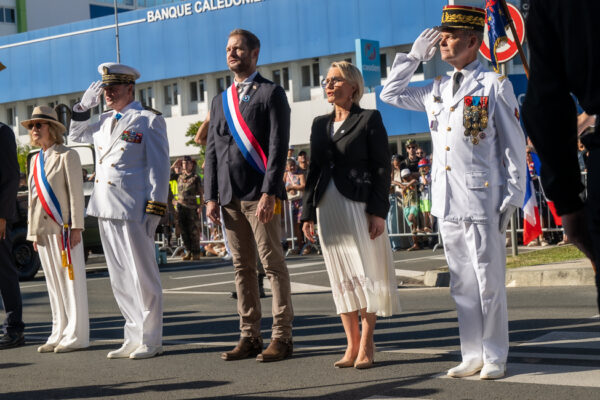
The French overseas territory of New Caledonia in the southwest Pacific, which has endured a decade of political turbulence, social tensions, and economic shocks, has emerged from elections held on June 28 with a new president. Virginie Ruffenach, leader of the French loyalist Rassemblement (The Rally) Party, was elected president of the New Caledonia Congress on July 10 after negotiating a coalition with the Polynesian Islander-led Eveil Océanien (Oceanian Awakening) Party to achieve the majority to govern.
Ruffenach emphasized unity and dialogue in her inaugural speech as she prepares to preside over a Congress divided between the pro-independence and loyalist blocs.
“Our ambition is clear: to put our territory back on the path to recovery. We must rebuild our economic tools, repair our social fabric and restore trust. This is essential because no society can build its future when doubt undermines minds and institutional instability compromises public action,” Ruffenach stated on July 10.
New Caledonia is home to more than 290,000 people. More than a century and a half after French colonization, about 41 percent are Kanak islanders and 24 percent of European heritage. Another historical legacy is the political gulf between the pro-independence, mostly Indigenous-led movement, which is deeply committed to self-determination, and loyalists who prioritize economic stability and security, which they believe is only attainable under France’s oversight.
Issues of inequality are also inextricable from political positions. The coastal capital, Noumea, located in the southwestern Pacific Ocean more than 16,500 kilometers from Paris, features avenues of French-style cafes and boutiques around a landscaped city park. The harbor view is dominated by luxury yachts. But life in the city’s informal settlements for many Kanak islanders is one of hardship, high unemployment and low incomes.
The new coalition government combines staunch pro-France parties, such as The Rally and Caledonian Republicans, with the kingmaker centrist Oceanian Awakening, a small party founded by islanders from Wallis and Futuna, another French island collectivity in the Pacific. However, Sonia Backès, leader of the Caledonian Republicans, alluded to the pragmatism behind the pact. “We have chosen to set aside our disagreements on the institutional future to focus on the concrete, everyday concerns of New Caledonians… this agreement does not erase our differences, it simply allows us to move New Caledonia forward,” Backès claimed on Instagram on July 9.
And there were pressing domestic issues for voters as they went to the polls. Two years ago, unrest erupted across the islands following the French government’s unilateral move to expand New Caledonia’s restricted electoral roll to an extra 25,000, mostly non-Kanak voters. Since the 1990s, New Caledonia’s list of eligible voters had comprised only Kanak islanders and long-term non-Kanak residents in response to local opposition to European migration, and many pro-independence supporters perceived the new reform as a move to undermine their political aspirations. While French President Emmanuel Macron eventually suspended the electoral changes, islanders still had to contend with destructive fallout of the riots, which included a rise in poverty and unemployment, decline in government revenues, and a damage bill of more than $1 billion.
The crisis led to New Caledonian leaders requesting more economic aid and, in February, France boosted its funding with 2 billion euros (US$2.2 billion) to support the islands’ recovery. Independence activists, such as Doriane Nonmoira of the Union of Francophone Women of Oceania, decry the territory’s slide into deepening fiscal dependence on France. Today “economic life has not been restored; it survives through borrowing from the government and the indebtedness of future generations,” she told The Diplomat from Noumea.
For this year’s election, New Caledonia used a modestly expanded electoral roll. The more than 192,000 voters included an additional 10,500 Kanak and non-Kanaks who were born in the territory after the 1998 Noumea peace agreement that ended years of political unrest in the 1980s. French Prime Minister Sébastien Lecornu emphasized the amendment was necessary, in line with democratic rights. “The status quo is not inevitable; the status quo gradually traps people” and poses the risk of becoming “the breeding ground for tomorrow’s violence,” he reasoned.
Even with so much at stake, the turnout of voters was exceptionally low at 63.7 percent, with a reported decline in Kanak participation. Factors are likely to have included political frustrations and logistical challenges for some of those living on low incomes to travel to polling stations.
Yet despite the lower turnout, the balance of power in the New Caledonia Congress has not significantly changed. Les Loyalistes and The Rally together claimed 24 seats and was the strongest power bloc in South Province, the wealthiest part of New Caledonia. Meanwhile, parties advocating self-determination dominated in the pro-independence heartland of the rural North and Loyalty Islands Provinces. Collectively, they secured 26 seats – two more than the loyalist bloc – in the New Caledonia Congress. The stanch UC-FLNKS (Caledonian Union in the Kanak and Socialist National Liberation Front) party won 16 seats, followed by the moderate coalition National Union for Independence, which includes the PALIKA Party (UNI-PALIKA), with seven. The Indigenous Dynamic party secured three.
The new line up continues the trend of pro-independence parties gradually increasing their political representation over the past quarter century from 18 seats in 2004. Pro-independence voter Maurice Sitrita in Noumea told The Diplomat that he shared “the motivations and ideas championed by the Kanak people’s growing political awareness” and was “satisfied on the whole [with the polling outcome] despite remarks about abstention.”
Now the stage is set for French and New Caledonian leaders to resume talks in a bid to mutually agree on the territory’s political future. Under the 1998 Nouméa Accord, the plan was to resolve this question with three referendums held between 2018 and 2021. These votes all resulted in pro-France outcomes, but the last, widely boycotted by Kanaks during the pandemic, catapulted the loyalist vote to 96.5 percent. The final vote was broadly rejected by pro-independence parties.
Political grievances lingered until formal negotiations were launched in February last year by France’s then-Overseas Minister Manuel Valls. The resulting Bougival Accord, signed in July 2025 laid out a plan to create a New Caledonian “state” within the larger nation of France, where some, but not all, powers would be devolved. It was a compromise of statehood in name only. Yet his accord, signed by a majority of, but not all, New Caledonian parties, has also failed to secure the necessary buy-in to truly settle contentious questions of identity and governance. France has yet to pass the constitutional amendment necessary to lock in the changes, and New Caledonia has indefinitely postponed a referendum giving voters a chance to approve or reject the accord.
For France, a complete break with New Caledonia would seriously undermine its vision of being “a European and Indo-Pacific nation” and its related strategy of strengthening its global stature and political, military, and economic influence in the region. Severance is also incompatible with France’s unique view of its relationship with overseas regions and territories. It believes that all of its territories around the world are part of the “indivisible” republic or the one unified French state.
Unsurprisingly, many pro-independence leaders perceived the Bougival Accord as part of a containment strategy by France. Paul Néaoutyine, leader of the PALIKA Party, said that it marked a step backwards “and closes the door to full sovereignty for New Caledonia.” It was also dismissed by the UC-FLNKS faction. But the new accord met its final fate in France’s National Assembly where it was widely opposed across the political spectrum.
“The previous agreements, the 1988 Matignon and 1998 Noumea, were not consensual either: they have always involved internal opposition and disputes, sometimes strong,” Dr. Pierre-Christophe Pantz, a University of New Caledonia researcher, commented. But “the absence of a stable majority in the National Assembly in France has made any constitutional validation of the agreement uncertain.”
Undeterred by the deadlock, Lecornu is calling for talks to resume with the territory’s new leaders as a priority with the optimistic goal of achieving an agreement by the end of this year.
Compromise will remain a major ingredient of any future discussions. Yet, the call for independence is also unlikely to dissipate. Even with evidence of some progress in development in the outer provinces, inequalities in Kanak communities are still marked. The employment rate for Kanaks, for instance, is still 49 percent, compared to 70 percent for non-Kanaks. And economic inequality is a grievance, among others, that is being wielded by youth activists.
Nonmoira spoke of unmet expectations when she claimed that peace will not endure in the territory “without decolonization with France.” The situation has not gone unnoticed by the United Nations, which weighed in with a statement in May advising that France must ensure the free, prior, and informed consent of the Kanak people to any political reforms.
However, discussions in the coming months will be overshadowed by uncertainty until the next French presidential election. Stark divisions in the current French Parliament have made it extremely difficult for Macron to pass legislation. “Negotiations [with New Caledonian leaders] may not really resume before the next presidential and legislative elections in 2027,” Pantz predicted, with the first round of voting scheduled for April 18, 2027.
Current polls indicate that support for French far-right parties, such as the National Rally, is growing, but the outcome is unlikely to be clear until polling day. Whoever France’s new president ends up being, they will inevitably influence the fate of New Caledonia.
