

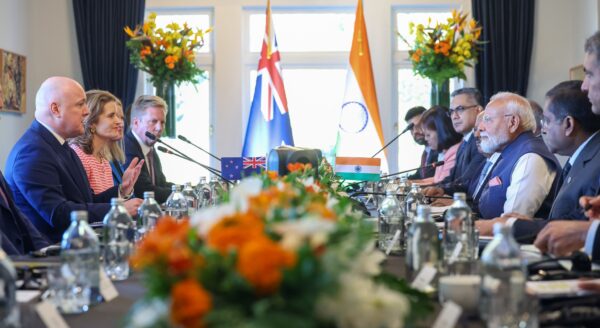
For the past several decades New Zealand has looked to China and Australia, and to a lesser extent the United States, United Kingdom, and European Union, as its major economic partners, while relying on Australia and other Western states as its major security partners. The July 11 visit by Indian Prime Minister Narendra Modi to New Zealand on the heels of the bilateral Free Trade Agreement (FTA) signed in April suggests a new effort by New Zealand to expand and balance its economic and security relationships to resist growing militarization and politicization in the Pacific.
Modi’s one-day trip was the first visit by an Indian prime minister since Rajiv Gandhi visited New Zealand in 1986. The visit celebrated the signing of the New Zealand-India Free Trade Agreement and signified the deepening relationship between the two states. Currently two-way annual trade between the countries is approximately $3.1 billion, with New Zealand exports (primarily in wool, logs, and apples) making up about $718 million of that total.
The Indian government has said that the FTA is a “forward-looking partnership” that promises to give its labor-intensive sectors, such as textiles and leather, additional economic opportunities. The New Zealand government stated that the FTA provides new and expanded business opportunities. Trade Minister Todd McClay stated that the new agreement would eliminate or reduce tariffs on 95 percent of exports, such as kiwifruit, apples, meat, wool, coal, and forestry. “It puts New Zealand exporters on an equal or better footing to our competitors across a range of sectors and opens the door to India’s rapidly expanding middle class,” McClay said.
While the trade legislation supporting the deal passed its first reading in Parliament at the end of June (with Labor Party support), it has not been without controversy. Foreign Minister Winston Peters, leader of the Nationals’ coalition partner, New Zealand First, objected to the FTA. He argued that the agreement adversely impacted national migration policy, did not provide enough access for dairy products, and included unrealistic investment obligations for New Zealand business. Peters told Radio New Zealand that “the deal was neither free, nor fair.” He added, “I’ve seen deals where the objective was for political purposes rather than economic advantage for New Zealand. This is one of those.”
A major point of debate has been whether the FTA “commits” New Zealand to invest $20 billion over the next 15 years or merely requires New Zealand to “promote” investment in India. Critics have noted it is unlikely for New Zealand to reach this investment amount, and failing so could lead India to claw back market access. The Māori Party (Te Pati Māori) has also rejected the agreement for failing to uphold Te Tiriti o Waitangi/the Treaty of Waitangi or protect Māori interests.
Other aspects of the deal have attracted particularly vituperative rhetoric. Shane Jones, deputy leader of New Zealand First, warned that the deal would bring a “butter chicken tsunami” coming to New Zealand. Conservative Destiny Church leader Brian Tamaki urged New Zealand to “purge” Hindus, Sikhs and Muslims in response to what he claimed was the persecution of Christians in India under Modi, leading to widespread condemnation across the political spectrum.
Despite the controversy, the government’s rationale for pursuing the FTA with India is clear. Trade in goods and services comprises about 50 percent of the New Zealand economy. With such an open economy, New Zealand has recently entered into a number of free trade agreements with both developed and developing states including the U.K., the EU, and the Comprehensive and Progressive Agreement for Trans-Pacific Partnership spanning both sides of the Pacific.
The new FTA is a recognition that India can become an important and growing international market that provides significant opportunities for New Zealand services and products. India has overtaken Japan as the world’s fourth largest economy and its economy is expected to grow over 6 percent in the next few years. To date there has been limited interest and opportunities for New Zealand businesses on the subcontinent; the FTA is an effort to change that.
It is also an attempt to diversify import and export supply chains from dependence on China. This is coupled with an appreciation of the vulnerabilities that such dependence can engender, as well as an awareness that China might decide to leverage its trading and political relationship to achieve other political objectives.
At the same time, the FTA links security issues more closely to trade and economic relations than has been usual. As is becoming the norm in many trade agreements, there are political and security components that parallel and augment the trading relationship. These broader elements, laid out as part of the India-New Zealand “Roadmap to 2030,” include commitments to improve bilateral ties in investment, technology, maritime security, education, tourism, sport, agriculture, and people-to-people links, as well as trade.
In the security area, it was announced that the New Zealand-India relationship has been elevated into a “strategic partnership” during Modi’s visit. The new partnership involves the establishment of a joint working group on counterterrorism to strengthen cooperation in combating violent extremism. Other priorities include engaging on cybersecurity, institutionalizing intelligence exchanges, and deepening maritime defense ties. The Roadmap to 2030 also extends the March 2025 Defense Cooperation Arrangement that established regular bilateral defense engagement and dialogue between the two countries.
Since the end of its U.K.-dominated trade relationship in the 1970s, New Zealand has not closely tied its trade to security objectives. As a small trade-dependent state, New Zealand rather has worked hard to lower trade and investment barriers as an important aspect of deepening its economic relations with Asia generally; security issues were less of a concern. However, New Zealand’s liberal view of free trade and economic relationships – and a more benign view of the international environment – has shifted with the increased strategic competition and Chinese attempts to gain influence in the region. As noted by Prime Minister Christopher Luxon, “We live in the Indo-Pacific region, it is a big focus for us where our national interests actually sit… our national interests are both security and economic and those two issues are increasingly interdependent.”
Whether these new India-New Zealand security arrangements will amount to more than rhetorical support remains to be seen. On one hand, it is clear that the security relationship is directed toward a China that is, according to New Zealand’s intelligence service, looking to extend and embed “its influence across the region” and has demonstrated “both a willingness and capability to undertake intelligence activity that targets New Zealand’s national interests.” To this extent, reinvigorated relations with India, along with deepening ties with Japan and South Korea, provide New Zealand additional political, economic and security resources and opportunities.
Yet New Zealand remains firmly focused on its Pacific neighborhood and it has found it difficult to balance its commitment to a nuclear-free non-militarized Pacific with the increased polarization in the region. While it seeks to eliminate or minimize strategic competition, New Zealand supports Australian and other regional efforts to extend security arrangements in the Pacific Islands. Meanwhile, Wellington has opposed Chinese efforts to garner influence in the Pacific Island states, such as the Solomons and the Cook Islands.
New Zealand is firmly embedded with the regional security arrangements involving NATO’s Indo-Pacific Four partners, which also include Australia, Japan, and South Korea, and has indicated a willingness to join the new Ocean of Peace Alliance between Australia and Fiji, which obligates its partners to “act to meet common danger.” It also supports AUKUS overall and has considered joining Pillar II of the agreement despite its nuclear-free policies.
India’s ability to assist with maritime security and deter threats in the Pacific region is limited. Even if it could, the potential to expand Indian security competition with China into the Pacific is contrary to New Zealand’s efforts to demilitarize the area. Moreover, India’s strategic outlook is considerably broader than New Zealand’s. Wellington has little ability to materially assist Indian strategic objectives, nor would it wish to get involved in China-India disputes that might arise outside of the Pacific.
Whether the security issues will overshadow the economic opportunities the new FTA is designed to provide remains to be seen. In exchange for future opportunities and other types of security and non-security cooperation, New Zealand has entered into a more limited trade deal with India when compared with its other free trade agreements. Despite the limited gains in the FTA for the dairy sector, the agreement should increase bilateral trade of goods and services while facilitating a more competitive and resilient New Zealand economy.
Nevertheless, the new agreement signals an increased willingness to link security and trade issues in a more overt manner and suggests recognition that New Zealand foreign policy must adjust to changing economic and political circumstances.
