

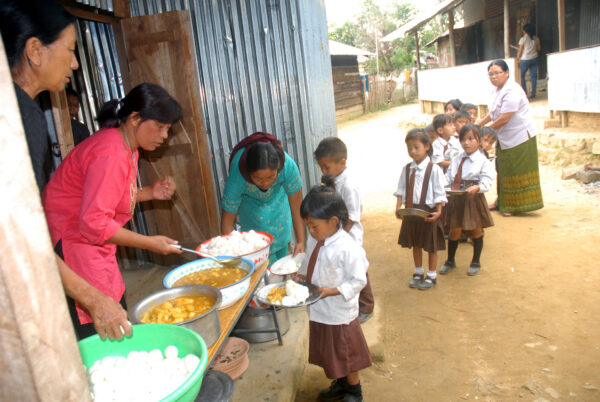
A major controversy recently erupted in the Indian state of West Bengal, where a Bharatiya Janata Party (BJP) government recently came to power after state assembly elections. The new government, whose base of support includes traditionalist Hindus, moved to drop eggs from the midday meal program in the state capital of Kolkata.
The midday meal program is a scheme that provides free lunches to children in government schools, a policy that has helped reduce malnutrition in India, a country with a large number of poor and hungry children. Protein is considered vital for growing children and eggs are considered a cheap, affordable, and tasty way of providing protein.
The government instead proposed to award the contract for meal preparation for those schools to the Vaishnavite organization, the International Society for Krishna Consciousness (ISKCON), a group that promotes a vegetarian diet. While ISKCON is known for the quality of its products, its catering services still do not provide options for those wishing to eat eggs or meat.
Many traditional schools of Hindu, Jain, and Buddhist thought, including Vaishnavism, advise their followers to eat a sattvic diet, a diet that is said to promote clarity of mind and peace through avoidance of pungent foods, such as onions and garlic, as well as meat and eggs. Many such groups believe that eating eggs is akin to eating embryos or aborted animals. Furthermore, different jatis, or caste groups, have their own dietary traditions. While there are a multiplicity of such traditions — for example, most groups of Brahmins do not eat meat, but some eat goat or fish — more prestigious jatis tend to follow sattvic diets, which do not include eggs. Interestingly, 96 percent of Kolkatans are non-vegetarian.
Schools in other states in India, such as Karnataka or Bihar, provide midday meals with both egg and eggless options. West Bengal itself is looking into an option modeled after neighboring Odisha’s in which schools could procure eggs separately with additional funding.
While politics and religious beliefs are at the root of this controversy, it is not simply about religious beliefs or the desire to use political power to make policies based on those beliefs.
The West Bengal egg controversy sheds some light on the larger structure of Indian society. How can a modern polity be created in a society with thousands of communities with different cultural practices, including dietary expectations? For many families, it is not enough that their children are not being forced to eat eggs, or meat. Choice is not enough because choice is actually the problem. If students have the option of eating meat or eggs at school, then they can choose to eat in a way that allows them to drift away from the dietary customs of their families and communities. It is one thing for an individual or family to choose to eat an egg in private, but it is another for that choice to be dangled in front of everyone. This is why many of those who support policies to exclude eggs from midday meals frame their position in terms of preventing their children from being corrupted or “going astray.”
In other words, instead of families and individuals opting into the egg diet, the idea is for all of society to opt out by default, and to have a baseline vegetarian diet in public, so as not to tempt vegetarians.
For traditional communities seeking to preserve their own distinct customs, schools, colleges, malls, restaurants, bars, cafés, and even offices and factories — the public sphere — are a potential threat, because these places enable different jatis and communities to interact and mix. Issues such as the egg controversy arise in India because of the tension between the demands and assumptions of traditional social units and the life that entails and the reality of the development of a public sphere, and all the mixing that entails, in contemporary India.
No country, especially one as large, diverse, and globally connected as India, can restrict life to the familial sphere, the realm of watertight units with their own distinct norms.
Although wildly different from the egg controversy, the recent alleged murder of a man in Maharashtra by his fiancée — who did not want to go forward with their arranged marriage — and her boyfriend sparked a debate in India on endogamy, the practice of marrying within one’s community. Here, too, there is increasingly a dichotomous tension between marrying someone chosen by one’s parents and someone one may meet through participation in the public sphere.
The premise of a democratic society with a market economy in which citizens have rights is that an individual can enter the public sphere and do whatever he or she chooses, within the bounds of the law. They can go to a restaurant and eat eggs or meat, purchase any item within their budget, or marry someone that they met at a mall. It does not matter what their ancestors did or what their jati traditionally ate.
The premises that underlie traditional Indian social life are starkly at odds with modernity and the fruits of modernity that Indians line up in droves to access in the West. Indians cannot have it both ways. Options and choice cannot be avoided in modernity. Nor can eggs, if one wishes to eat them.
