

FARNBOROUGH — Lockheed Martin today unveiled the PAC-3 Adapted Capability Effector (ACE), an air defense system designed to defeat cruise missiles and short-range ballistic missiles at half the price of the existing PAC-3 MSE per unit.
It was one of two notable low-cost interceptor designs revealed during day one of the Farnborough Airshow, as European firm MBDA also announced a new interceptor for cruise missiles, helicopters and drones.
Lockheed’s PAC-3 ACE system appears to be a direct response to the global desire for Patriot, but at a price point that is more affordable — which in turn would make it, in theory, easier to mass produce.
“It is not designed to replace the MSE, but to supplement it — it has its heritage and maturity, but we bring the costs down by changing some of the components,” Tim Cahill, Lockheed’s president for missiles and fire control, told reporters during a media briefing here.
The way Lockheed has envisioned bringing down the interceptor’s cost starts by backing off on component capability, including on the solid rocket motor in the system’s seeker that the company is going to “throttle back.” In addition, the firm is looking to apply advanced manufacturing techniques and make design changes to improve production, including by bringing AI capabilities into the fold. Cahill said he expects high demand, which would increase production and allow for a reduction in price.
“Our intention is to be able to produce ACE’s seeker overseas. It is going, the first order, [to be] a commercially-derived system. Let’s say we come to Europe, we’re looking for companies that have experience in radio-frequency and seeker technology,” he said. “We haven’t decided on any, but are sending out a Request for Information to them.” Cahill named Saab and Diehl as examples of companies that already possess this expertise.
Notably, President Donald Trump recently announced that Ukraine would be given a license to produce Patriots in country. While details of that plan have yet to be revealed, a scaled-back system like ACE would likely be easier to set up.
The expectation is for ACE to carry out its first test in early 2028. The company said in a press release that they will achieve this by collaborating with American and European industry partners and suppliers.
While the interceptor is not designed to counter drones, Cahill explained that lessons from recent conflicts have driven the market need for lower-cost systems in greater quantities than countries anticipated.
“We’ve seen this in different places: an adversary can throw a lot at you, not just drones but ballistic and cruise missiles in significant quantities and you have to have the numbers, both from a defensive and offensive perspective,” he said.
New Interceptor From MBDA
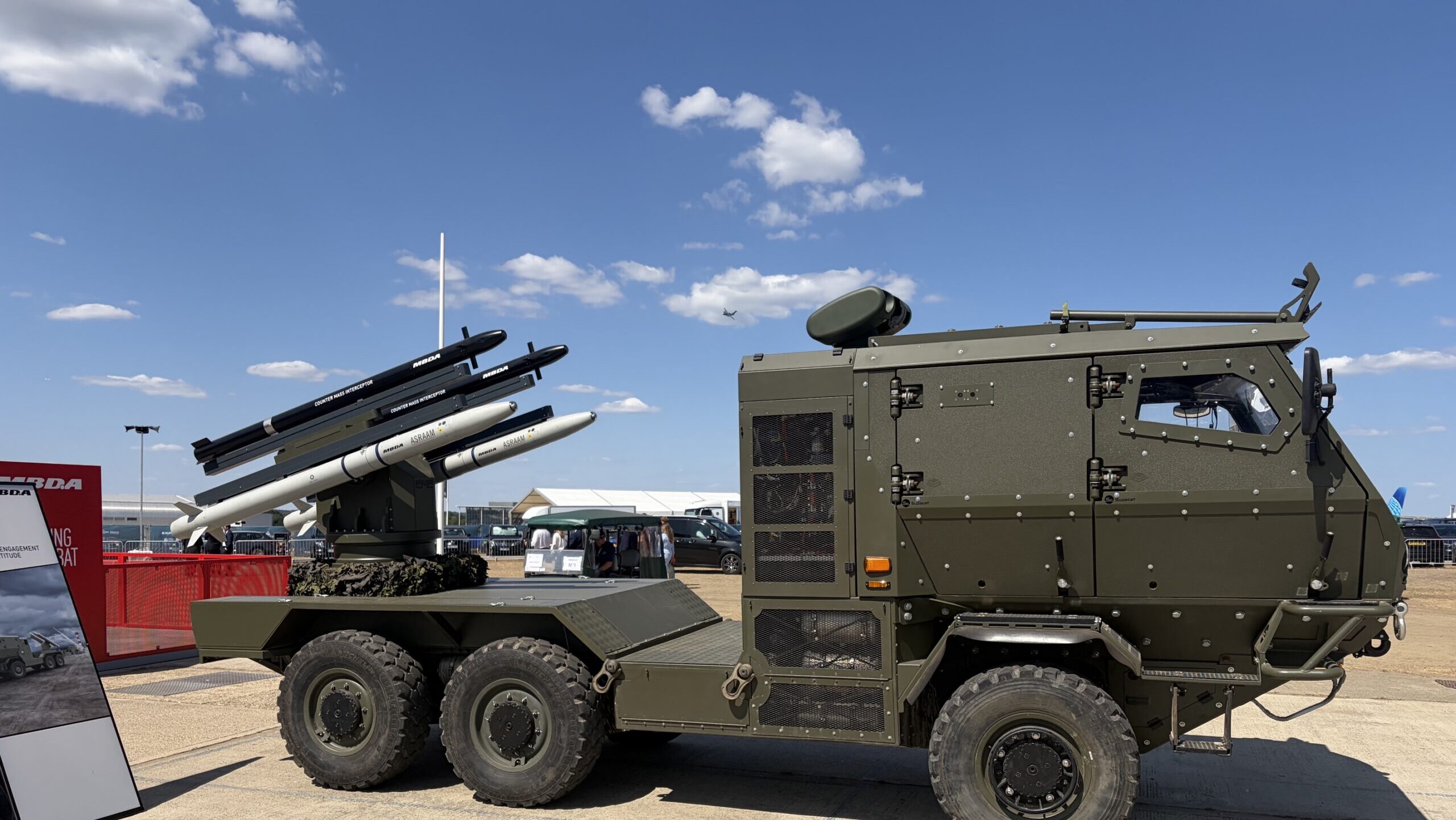
Meanwhile, European missile house MBDA today launched a potential rival low-cost system, albeit one designed for a lower-tier threat than ballistic missiles. Dubbed the Counter Mass Interceptor, the system is designed to defeat drones, helicopters and cruise missiles.
Displayed in a truck-mounted configuration at the show, the new weapon is an upgrade to the company’s ground-launched, Advanced Short Range Air-to-Air Missile (ASRAAM) and can also be integrated on unmanned ground vehicles or unmanned surface vessels, according to Luke Webster, MBDA UK business development manager for ASRAAM.
“The real key on the Counter Mass Interceptor is about the problem space that’s coming,” he told reporters. “So, as drones become more capable they will fly faster and higher, and that’s what this is” designed to counter. “This is for those higher altitude engagements. You know, your traditional counter UAS effectors only go up to sort of a two to three [kilometer] ceiling. This will double that.”
In tandem, ASRAAM can be used to strike higher value targets like fighter jets, he added.
MBDA plans on holding a live fire test of the 53-kg (117-pound) weapon in 18 months, Webster said, though a location has yet to be decided. While no first customer order is lined up, Webster noted that the UK’s recently published Defence Investment Plan “mentions a large proportion of money for low-cost [solutions] and dealing with the problem space that that we believe we can really help in.”
At a design level, MBDA deliberately decided on an approach that is as “close to platform agnostic as we can be,” said Webster. “That’s a very difficult task because there are loads of platforms, loads of different parameters and constraints, but [the] technical work we’ve done so far suggests that we can get on” a multitude of different launch vehicles.
