

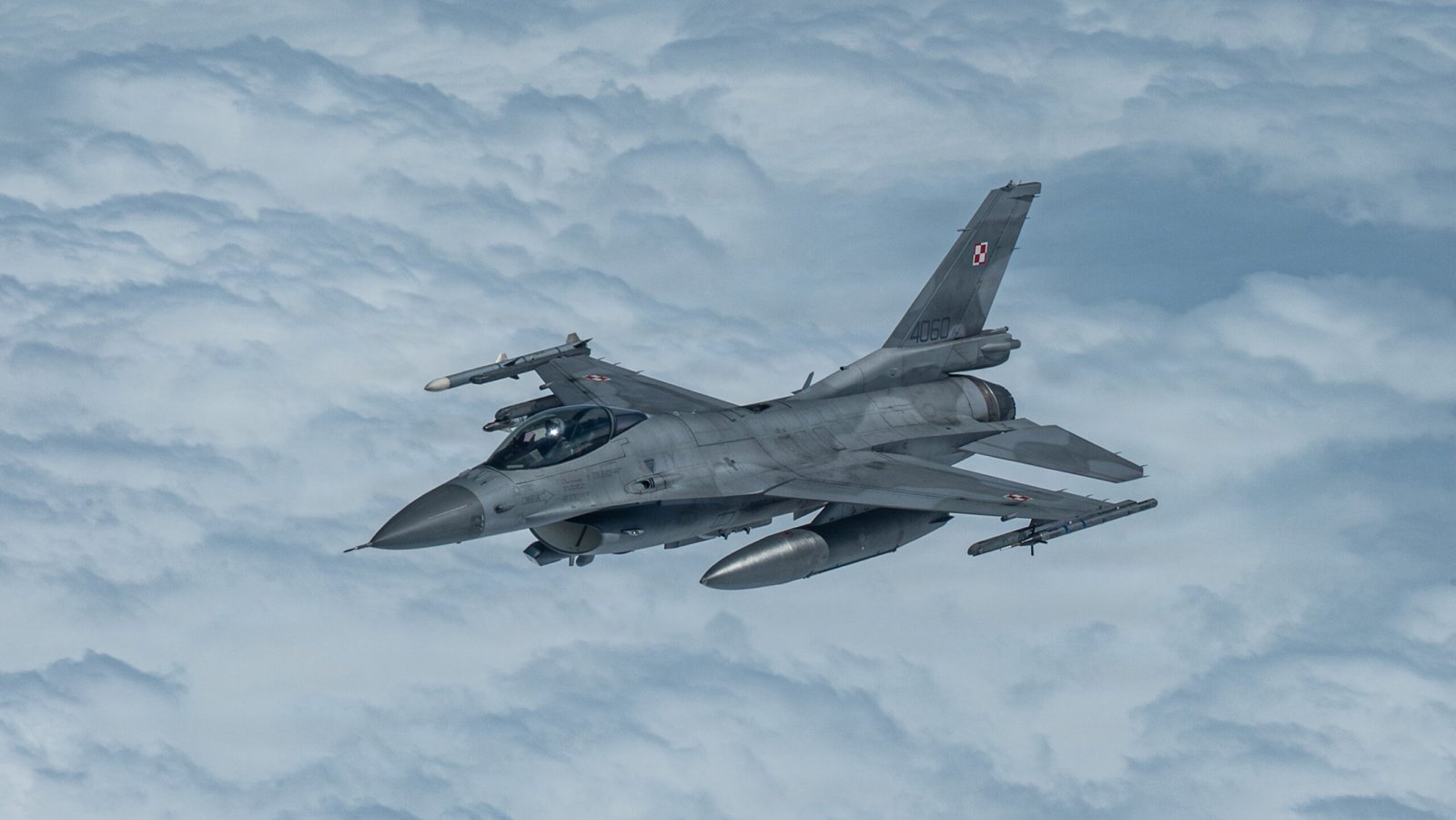
WARSAW — With Poland only partway through an air defense modernization effort, the Polish Air Force has been operating at the highest readiness on a nightly basis, which is putting heavy strain on personnel and equipment, according to Maj. Gen. Ireneusz Nowak, the operational commander for the Polish Armed Forces.
Nowak said 80 percent of his service’s attention is focused on air defense, with the ground and air components of Poland’s integrated air defenses still three to four years away.
“We are actually like maybe 30 percent advanced in that process. That means basically that we are procuring, we are acquiring new weapons systems and we are simply waiting for them to be implemented,” he said during a panel discussion at the Warsaw Security Forum.
In the meantime, the Air Force has changed how it operates in order to fill the gap. Starting Oct. 1, the service stopped following Visual Identification (VID) procedures in which a pilot confirms a target’s type, markings or nationality by sight before engaging.
Instead, they are now following Positive Identification (PI) procedures. That means that the pilot no longer needs to be close enough to see what the aircraft they are tracking is, and instead can engage based on factors such as radar data, information from other systems and intelligence, including information passed on by Ukraine.
“So now we are much more flexible, much more responsive,” Nowak, who is responsible for Polish airspace, said.
During the panel discussion, Nowak acknowledged that using fighter jets to shoot down cheap drones is a bad cost ratio for Poland, but said there simply isn’t any other option at the moment. “We need to develop massive, responsive weapons systems capable to counter-react the UAVs operations,” he said.
Lt. Gen. Rolf Folland, Norway’s Military Representative to NATO, agreed that the air superiority model of recent decades is under challenge, noting “We can’t just use all of our munitions in one blast. We have to repeat it over and over again.”
Poland should have some options, but systems that the country hoped to have ready now are still underway. Nowak pointed to the integration of Advanced Precision Kill Weapon System missiles on F-16s as a near-term solution, but said there is a hitch in getting those weapons in the field.
“It hasn’t happened yet, and we are trying to process it, but we [Polish Air Force] couldn’t get the fuses, which were utilized by the US Air Force, and were certified, because of business restrictions and limitations. So we are waiting for the new type of the fuse,” he concluded.
Nowak also mentioned the possibility of using the F/A-50GF aircraft to combat drones, which Defense Minister Władysław Kosiniak-Kamysz announced earlier this month has officially commenced combat duty. Nowak described the plane as very promising as a drone hunter and a very good tool against current threats which the Russian Federation presents, but said weapon integration challenges remain.
“So I must admit that this aircraft will be ready in maybe two years, fully operational and as a very good tool against current threats. But as always, it takes time, and the time is too long and that’s the part which frustrates me a lot,” he said.
