

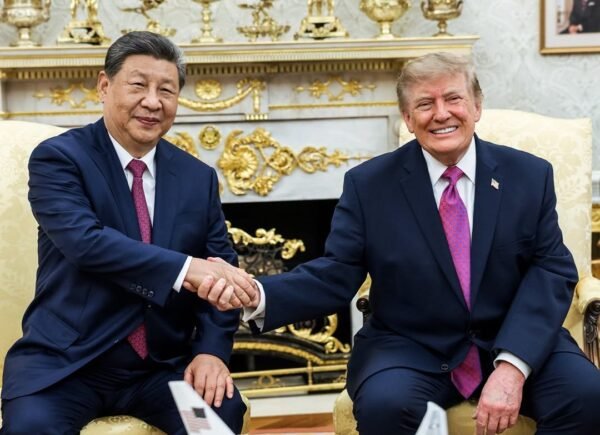
On September 24, the presidents of the United States and China met in Washington and agreed to build what their joint language calls a “constructive relationship of strategic stability.” On November 18-19, Donald Trump and Xi Jinping are expected to meet again, on the sidelines of the APEC Economic Leaders’ Meeting in Shenzhen. Two summits in three months is a rare occurrence in China-U.S. relations.
In the September summit, already their second of 2026, one key area stood out as the focus: artificial intelligence. The risks of AI now have a dedicated channel for discussion. There’s not yet a corresponding China-U.S. platform for talking about the economics of the AI race.
During Trump’s state visit to Beijing in May, the two leaders agreed to restart government-to-government AI dialogue. In September, at the eighth round of economic consultations in New York and Washington, U.S. Treasury Secretary Scott Bessent, U.S. Trade Representative Jamieson Greer, and Chinese Vice Premier He Lifeng held the first AI dialogue within that framework. They agreed to establish a channel for communications on AI incidents, and scheduled a second round of talks before the end of November.
Shortly thereafter, at the presidential summit, Xi described China and the United States as two AI powers that should “draw on each other’s strengths, not guard against each other.” He added, “The two sides can continue their dialogue on AI, exchange views on its risks and benefits, and jointly prevent the misuse and abuse of AI.” Trump noted that discussions on “pressing issues” related to (among other topics) AI, which he calls “superintelligence,” could “promote peace and prosperity for decades and decades to come.” Both leaders thus offered the new dialogue platform political cover.
That is genuine progress, with a revealing limit. All the steps thus far – the exchanges on risks and benefits, the incident channel, the push for lab self-regulation – concern the dangers AI might create. Nothing yet addresses the looming economic problem of the AI sector.
The Growing AI Bubble
In the United States, recent developments are rather worrying. The business model for U.S. frontier AI businesses assumes that compute demand will keep growing exponentially, model capability will convert reliably into revenue, and capital will stay patient. All three assumptions are looking increasingly risky.
The capex needed to remain at the frontier is heavier, relative to the industry’s age, than anything technology has carried before. Utilities are signing power contracts for gigawatts of capacity that do not exist.
Meanwhile, Wall Street has started asking a question it ignored a year ago: where, exactly, is the return? In July, efficient Chinese open-weight models showed that frontier-level performance could be reached with a fraction of the compute. AI-linked U.S. equities sold off hard; analysts stepped back from price targets built on the assumption of permanent scarcity.
China has the mirror-image problem. Chinese companies are trying to close the frontier gap under foreign constraints while having to produce returns large enough to justify the spending at home. In a September study, the Rhodium Group calculated that the combined free cash flow of Chinese tech giants Alibaba, Tencent, and Baidu swung from positive 170 billion yuan in 2025 to negative 16 billion yuan in the first half of 2026.
The five American hyperscalers saw their own fall from $191 billion to $14 billion and raised $163 billion in long-term debt in six months to keep building.
Clearly, neither the U.S. nor the Chinese AI sector can fund this race from operations anymore. Both countries’ capital markets are tired of narratives without actual returns. Patience on both sides is wearing thin.
The China-U.S. competition exacerbates these economic dynamics. Each new round of U.S. export controls accelerates the Chinese substitution process, which shrinks the market available for American firms. At the same time, deeper substitution raises the investment China must absorb, which worsens China’s return-on-capital problem.
In other words, further escalation in the AI race might drain away the capital both systems depends on. This is not a moral argument, but a real financial dilemma.
Washington and Beijing have already conceded, in their September dialogue, that they face some common risks from AI risks. What’s not clear is whether the economic problem is included on that agenda.
The Chance at Shenzhen
The November APEC summit offers an unusually practical setting for addressing this issue. The APEC CEO Summit will bring about 1,000 business leaders to Shenzhen with AI on the formal agenda and a Shenzhen Initiative to be released. The host city itself, long nicknamed the Silicon Valley of the East, holds China’s densest cluster of AI and robotics firms.
Unofficial channels are also in place. Tsinghua’s Center for International Security and Strategy and the Brookings Institution have hosted 14 rounds of China-U.S. AI dialogue since 2019, with Microsoft’s former chief research and strategy officer Craig Mundie serving as a co-chair.
Three deliverables should be on the agenda for the APEC meeting.
First, China and the United States should add the missing piece of the puzzle in Shenzhen. The official AI dialogue will be held in November; at the APEC summit, both sides can start a standing China-U.S. AI economics dialogue mechanism supported by think tanks and industry associations, the “track two” format long used in China-U.S. exchanges.
Every official AI conversation so far lacks the people who control the money: finance officials, stock market regulators, and executives. The first such dialogue could take place on the margins of the APEC meeting, convened by think tanks and industry associations rather than ministries.
In Shenzhen, the Guangdong Artificial Intelligence Industry Association – which operates the Guangdong AI & Robotics Overseas Service Center, the province’s platform for firms going global – could co-convene, alongside established think tanks, a working session between U.S. investors, analysts, and executives and their Guangdong counterparts, on the industry’s own ground.
Why start with the “track two” format? Because the U.S. and Chinese governments would find it hard to host this conversation. No U.S. administration can openly entertain the thought that its AI boom may be overextended; no Chinese ministry can candidly compare burn rates with a foreign power. Finance officials can talk to economists, and economists can talk to each other. An unofficial venue is the only why this particular talk can happen.
Second, China and the United States should set a floor under export controls and market access in Shenzhen. Neither side can afford to be seen conducting negotiations over such fundamental issues, but they can quietly exchange red lines in a private setting. Misjudgment, not malice, triggers most crises. The cheapest deterrent is a sentence spoken early.
Third, it’s time to increase collaborations on the periphery. Standards for AI deployment in third countries – things like data governance, safety evaluation, labor displacement – don’t always pit U.S. and Chinese interests against each other. In fact, that happens far less often than either side assumes. Shenzhen has already hosted APEC-track discussions on responsible AI under the Policy Partnership on Science, Technology and Innovation framework. A joint signal from Washington and Beijing supporting shared regional norms would cost little, match the CEO Summit’s own agenda, and keep third parties from profiting from dueling standards.
Time Is Short
By greenlighting discussions on the economic side of AI, Washington would be shifting a burden, not making a concession. Industry leaders and academic would be the interlocutors, meaning the administration does not need to make more promises even while the Treasury gains more insight into AI’s financial stability.
For its part, Beijing would reinforce its longstanding claim that Chinese AI is an economic project rather than a military one. The talks would also give China’s capital-hungry sector a forum to argue against escalation using commercial – not diplomatic – logic.
The dialogue wouldn’t release a communiqué or joint statement. This would be a recurring conversation that, over time, builds a shared vocabulary for what sustainable AI competition could look like.
The capital markets are not waiting; they are repricing both countries’ AI sectors now. There’s still a chance for China and the U.S. to get ahead of the bubble, but the window is closing. After the U.S. midterms, coalition politics in Washington will harden, and every unmanaged month afterwards would strengthen the case for constraint in Beijing.
